14 Kitchen Island Decor Ideas That Balance Style and Function
A kitchen island that balances style and function pairs a hardworking work surface with details that make the space feel finished, think layered lighting, considered materials, and a few personal touches instead of pure utility. This article gives you 14 kitchen island decor ideas that hit both marks at once. There’s a quiet confidence to a well-dressed island: warm wood catching afternoon light, a stool tucked in at just the right height, a single ceramic bowl holding lemons instead of clutter. It feels lived-in but never messy, practical but never cold. The best islands don’t choose between form and function — they let one make room for the other. Here are 14 ideas worth saving — and stealing.
Why a Style-and-Function Island Works So Well
A function-first island design treats the island as the kitchen’s true center not just extra counter space, but the anchor for prep, casual dining, storage, and conversation. It draws from the open-concept kitchen movement of the last two decades, where the island replaced the breakfast nook and the wall oven as the room’s social hub, borrowing cues from both Scandinavian efficiency and American farmhouse warmth.
The materials that make this balance work are specific: white oak and walnut for base cabinetry, honed quartz or leathered granite for tops that resist staining, and matte black or warm brass for hardware. Color palettes lean toward warm white, greige, sage green, and deep charcoal — tones that read as calm rather than sterile.
This approach is trending now because kitchens have become the room people actually live in, not just cook in. Post-pandemic, homeowners started asking their islands to do more homework station, coffee bar, wine storage and Pinterest search data shows rising interest in “multi-functional island” and “island styling” queries. People want a kitchen that photographs well and survives a Tuesday night.
Small spaces can absolutely achieve this look, but with real limits. A narrow galley kitchen can’t support a 6-foot island with seating on both sides — prioritize a slim rolling cart or a peninsula instead, and put your styling budget into lighting and one hero material rather than square footage you don’t have.
Style at a Glance
| Element | Detail |
|---|---|
| Philosophy | Function first, style layered on top — nothing purely decorative |
| Key Materials | White oak, walnut, honed quartz, leathered granite, matte black steel |
| Key Colors | Warm white, greige, sage green, deep charcoal, brass accents |
14 Kitchen Island Decor Ideas That Balance Style and Function
1. Warm Terracotta Accents Against a Neutral Palette
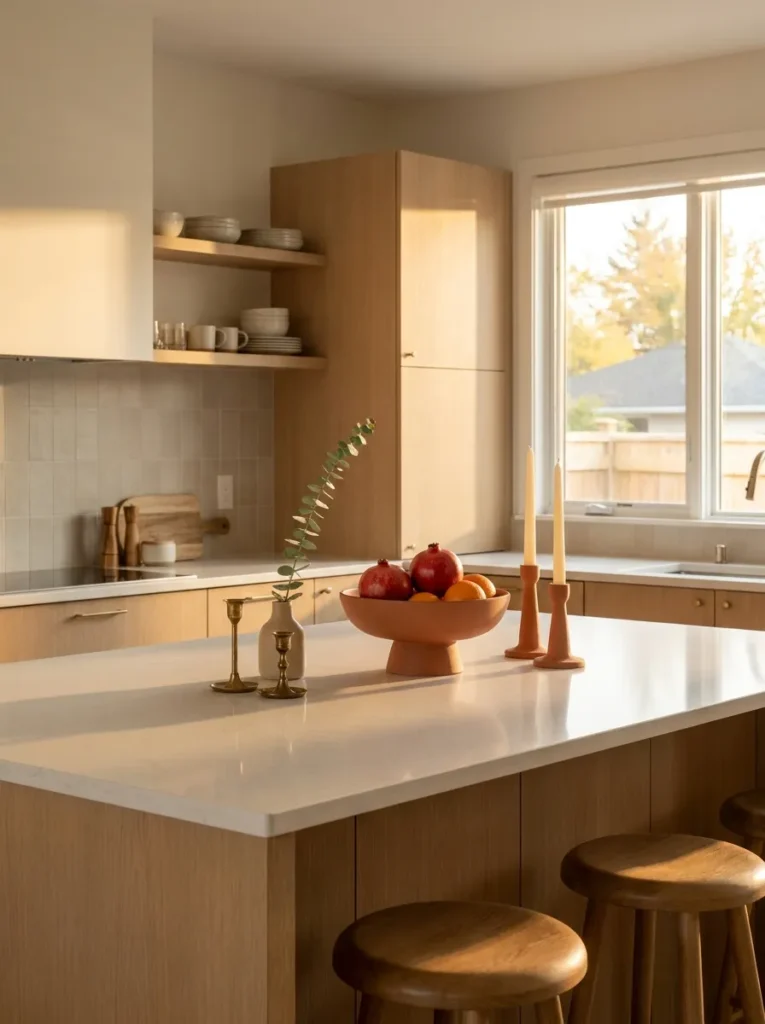
Vibe: Sun-warmed, like the island caught the last hour of daylight and held onto it.
Why it works: Terracotta sits opposite cool quartz and white oak on the color wheel, so a small dose reads as intentional warmth rather than clutter. This is contrast working in miniature — one saturated tone against several neutrals.
How to get it: Add one terracotta object per three feet of island length a bowl, a vase, or a set of taper holders and keep everything else in the vignette matte, not glossy, so the terracotta stays the visual anchor.
Quick Win: A single unglazed terracotta planter with a small trailing pothos costs under $20 and does the job instantly.
Shop the Look
| Item |
|---|
| Terracotta ceramic fruit bowl matte finish |
| Brass taper candle holder set of 2 |
| Small trailing pothos plant terracotta pot |
| Linen table runner neutral tone |
| Handmade stoneware serving board |
Also view; 13 Kitchen Island Ideas for Minimal Style Homes
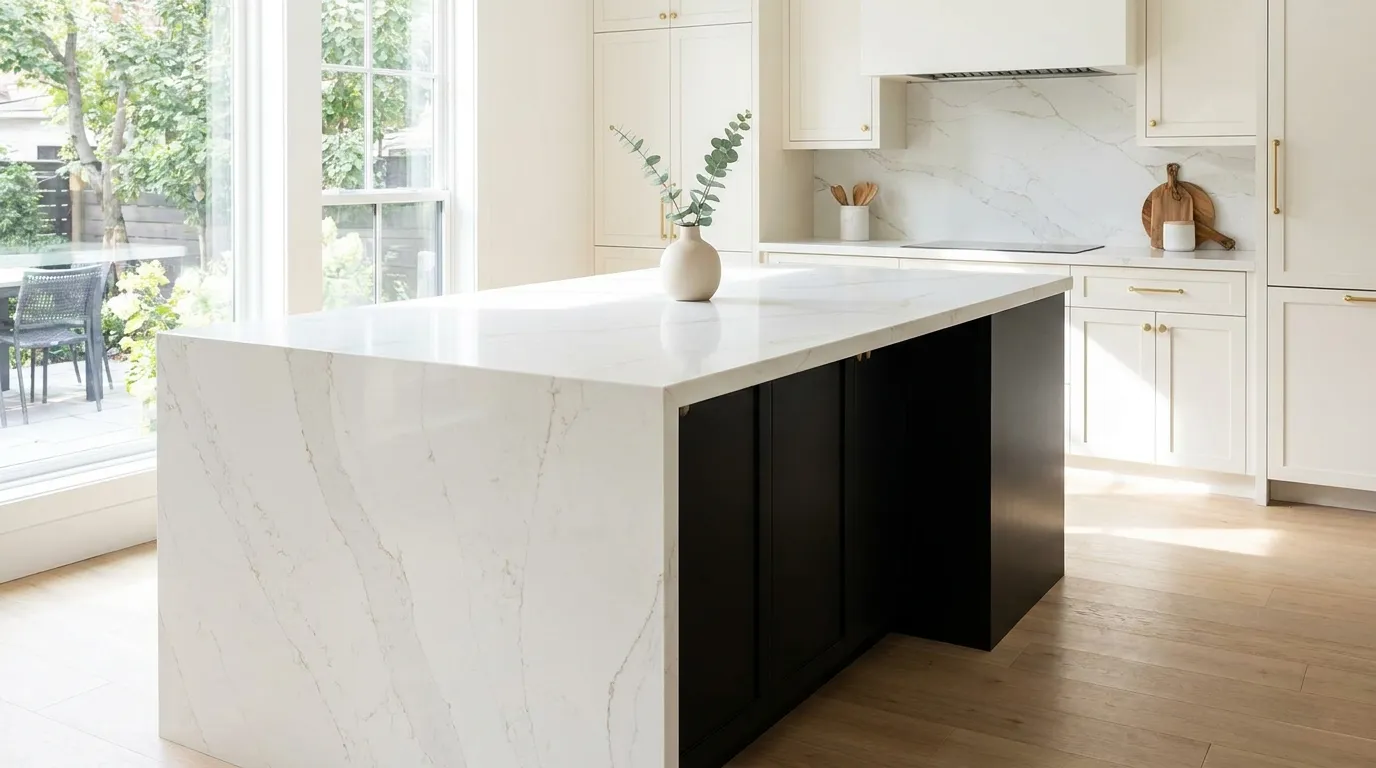
2. Waterfall Quartz Countertop with Veined Marble Look
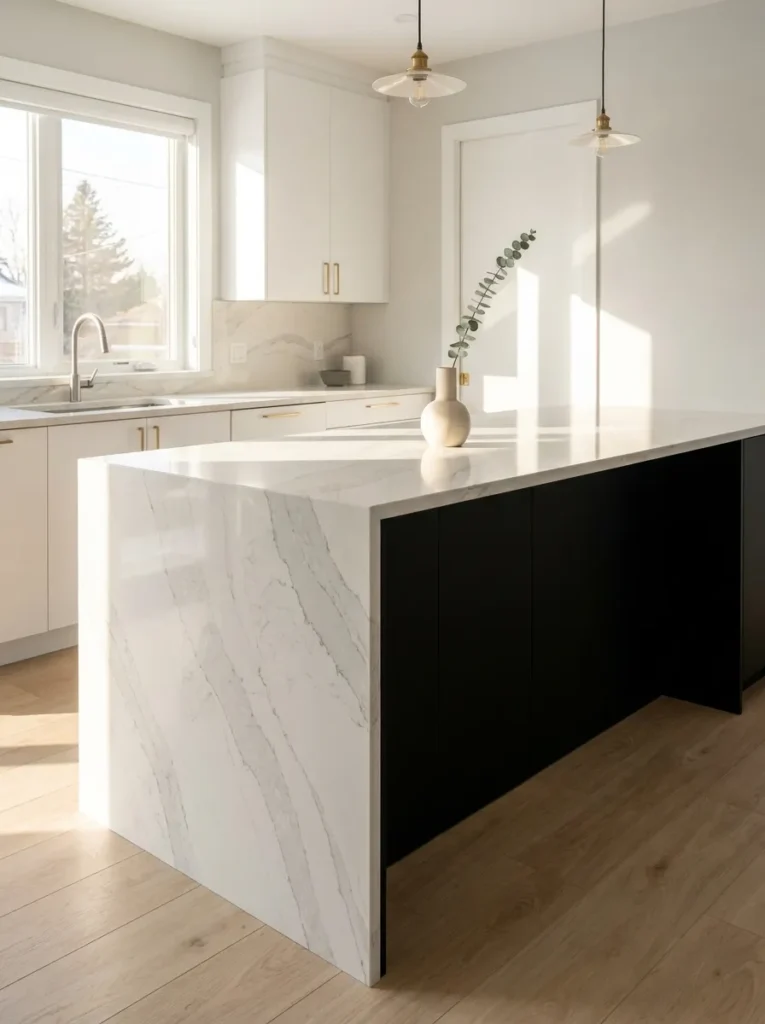
Vibe: Grounded, the kind of surface that makes a whole kitchen feel finished.
Why it works: A waterfall edge extends the countertop material down the sides of the island, eliminating the visual break where stone meets cabinet. This uses continuous line to make a mid-size island read larger and more custom than it is.
How to get it: Choose a quartz with soft, widely-spaced veining rather than dense marbling — it hides seams better on a waterfall install and photographs more calmly under kitchen lighting.
Shop the Look
| Item |
|---|
| Matte black cabinet pull hardware set |
| Small ceramic bud vase neutral glaze |
| Woven seagrass basket for counter storage |
| Marble-look coaster set round |
| Brass drawer knob hardware set |
Also view: 13 Vintage Grandma House Ideas That Feel Like a Warm Hug
3. Layered Pendant Lighting in Brass and Glass
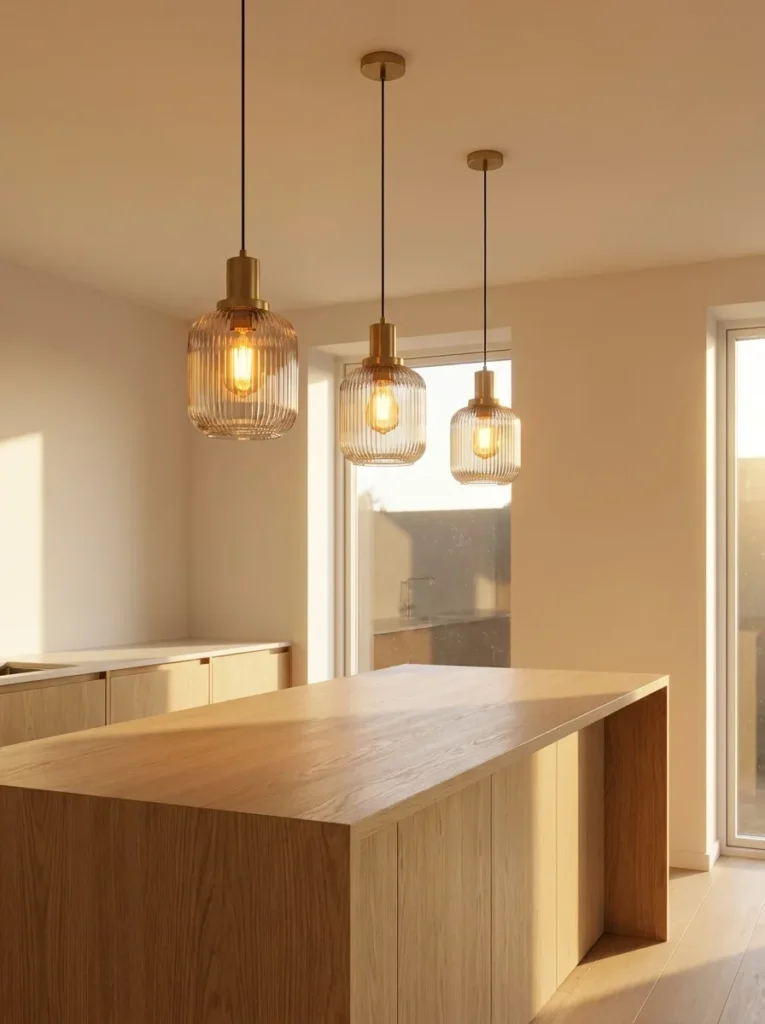
Vibe: Luminous, the room glows instead of just being lit.
Why it works: Staggering pendant heights by two to three inches breaks the rigid symmetry of matched fixtures and creates visual rhythm — a principle borrowed from gallery lighting design, where varied height keeps the eye moving instead of settling flat.
How to get it: Hang pendants 30 to 36 inches above the countertop, spaced evenly along the island’s length, and choose warm 2700K bulbs so the brass finish glows rather than looks cool and metallic.
Quick Win: Swapping stock bulbs for warm-toned 2700K LEDs in existing fixtures costs under $15 and changes the entire mood of the space.
Shop the Look
| Item |
|---|
| Brushed brass ribbed glass pendant light |
| Warm white 2700K LED bulb 3-pack |
| Brass ceiling canopy kit adjustable |
| Amber glass pendant shade replacement |
| Dimmer switch kit for pendant lighting |
4. Counter-Height Stools with Woven Rush Seats
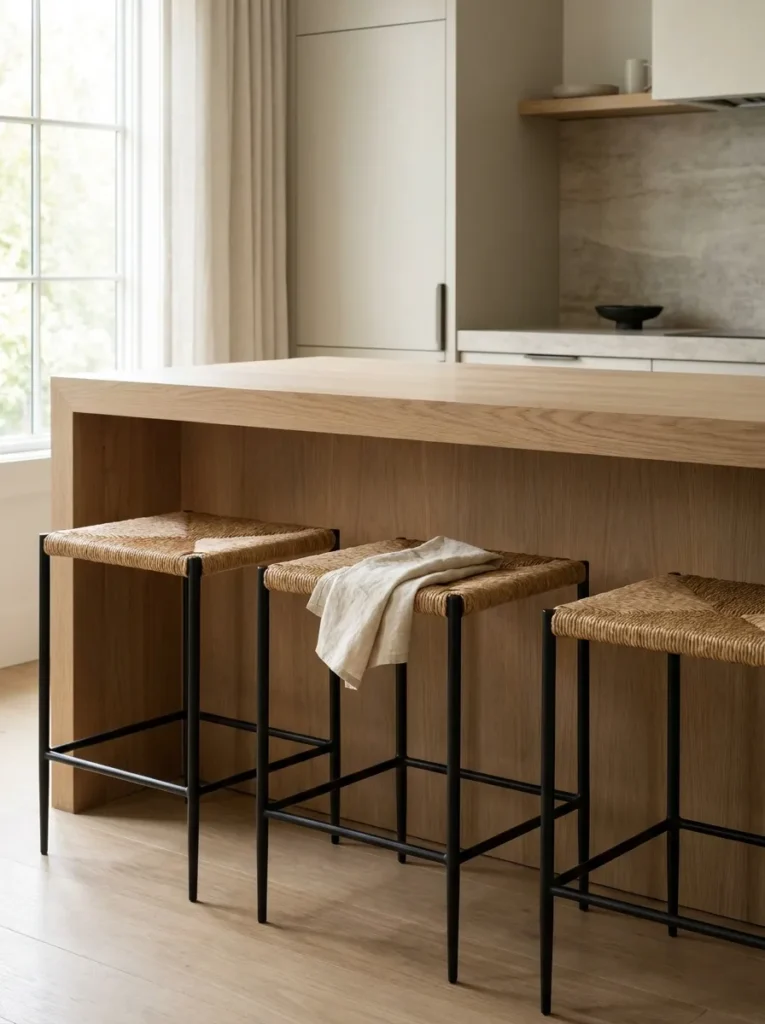
Vibe: Textural, the kind of detail people notice on their way to sit down.
Why it works: Woven rush introduces organic texture without adding visual weight — unlike upholstered stools, the open weave lets light pass through, so a row of three doesn’t crowd the sightline to the rest of the kitchen.
How to get it: Choose stools with slim black steel legs rather than thick wood ones; the contrast keeps the woven seat as the visual feature instead of competing with a bulky frame.
Shop the Look
| Item |
|---|
| Woven rush seat counter stool black legs |
| Linen napkin set neutral tone |
| Round leather seat cushion tie-on |
| Footrest bar stool floor protector set |
| Small woven placemat set natural fiber |
5. Curated Ceramic Vignette on the Island Ledge
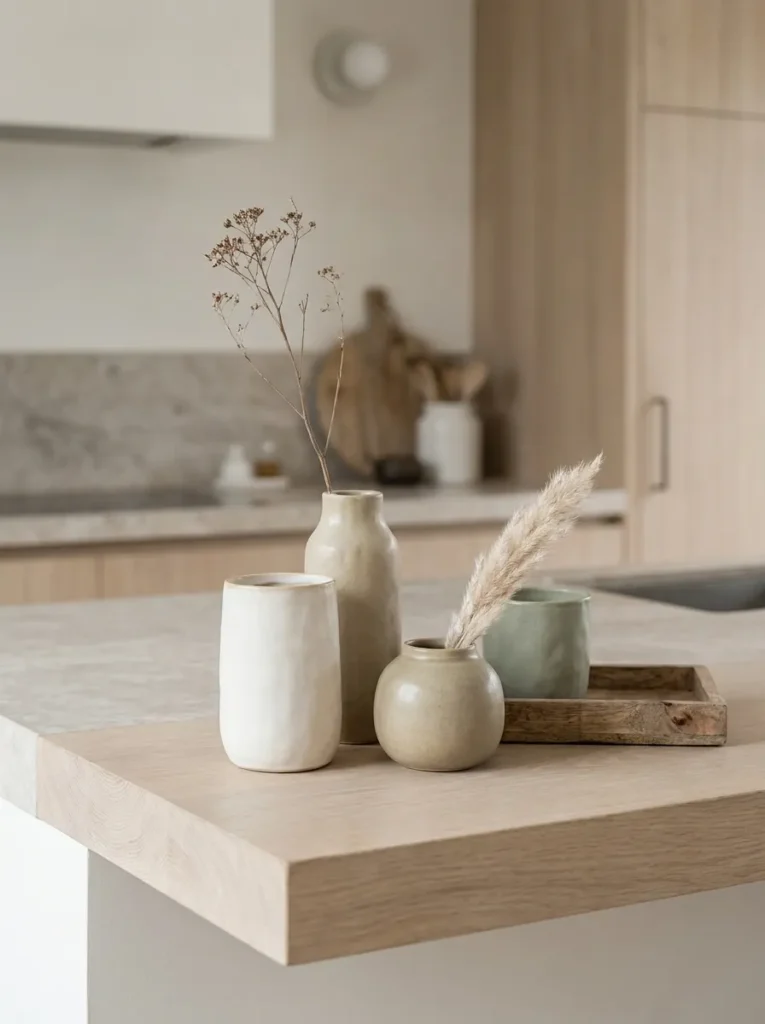
Vibe: Hushed, like a still-life someone left just for a moment.
Why it works: Grouping objects in odd numbers with varied height creates a triangular visual path for the eye, a basic styling principle that prevents a flat, evenly-spaced look. Matte stoneware also absorbs light rather than bouncing it, keeping the vignette calm.
How to get it: Group three ceramic pieces of different heights — tallest at the back — on a small wood tray so the cluster reads as one intentional object rather than scattered items.
Quick Win: A single dried pampas stem in an existing vase adds height to a vignette for less than $10.
Shop the Look
| Item |
|---|
| Handmade stoneware vase set of 3 |
| Dried pampas grass stem natural |
| Small acacia wood catchall tray |
| Ceramic pinch bowl sage green |
| Matte stoneware vase tall neutral |
6. Two-Tone Island Base in Sage Green and White Oak
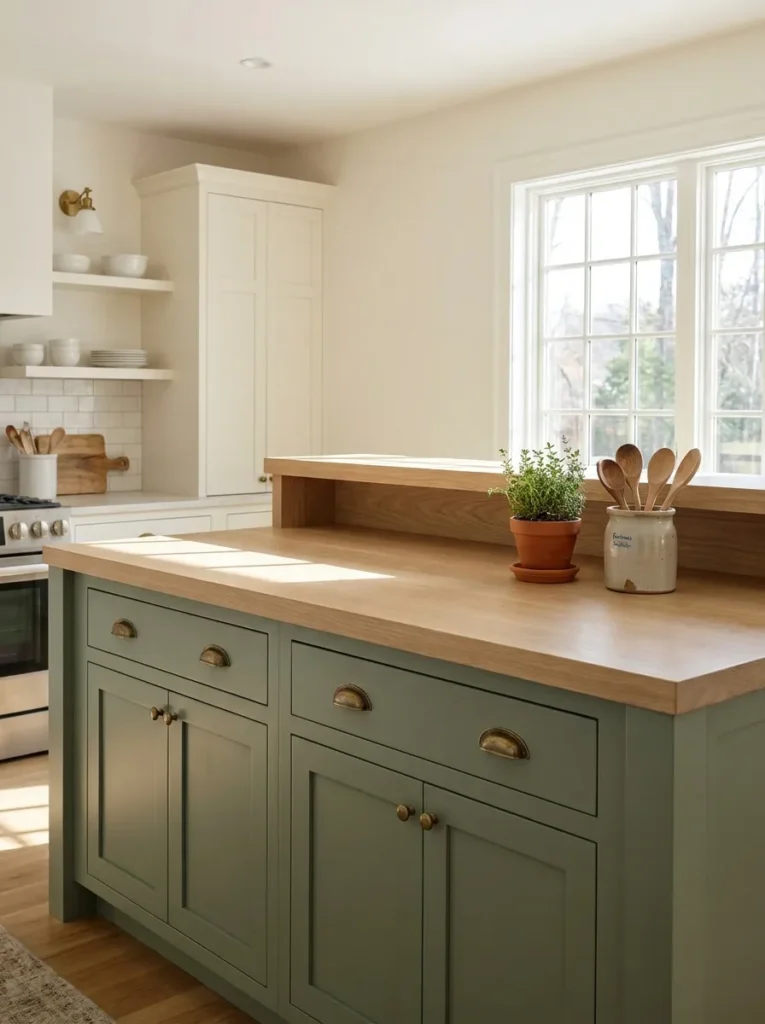
Vibe: Grounded, a color choice that feels like it belongs outdoors and indoors at once.
Why it works: Pairing a muted, earthy paint color with raw wood grain creates tonal contrast without high saturation — sage green reads as neutral enough to anchor a kitchen long-term while still standing apart from an all-white scheme.
How to get it: Paint the island base in a matte sage green like Farrow & Ball’s Card Room Green or Benjamin Moore’s Saybrook Sage, and leave the countertop edge or a shelf in natural white oak for contrast.
Shop the Look
| Item |
|---|
| Ceramic utensil crock sage green |
| Small potted herb basil terracotta |
| Brass cabinet pull set of 6 |
| Oak cutting board with handle |
| Woven dish towel set sage stripe |
7. Reclaimed Wood Island Top for Texture Contrast
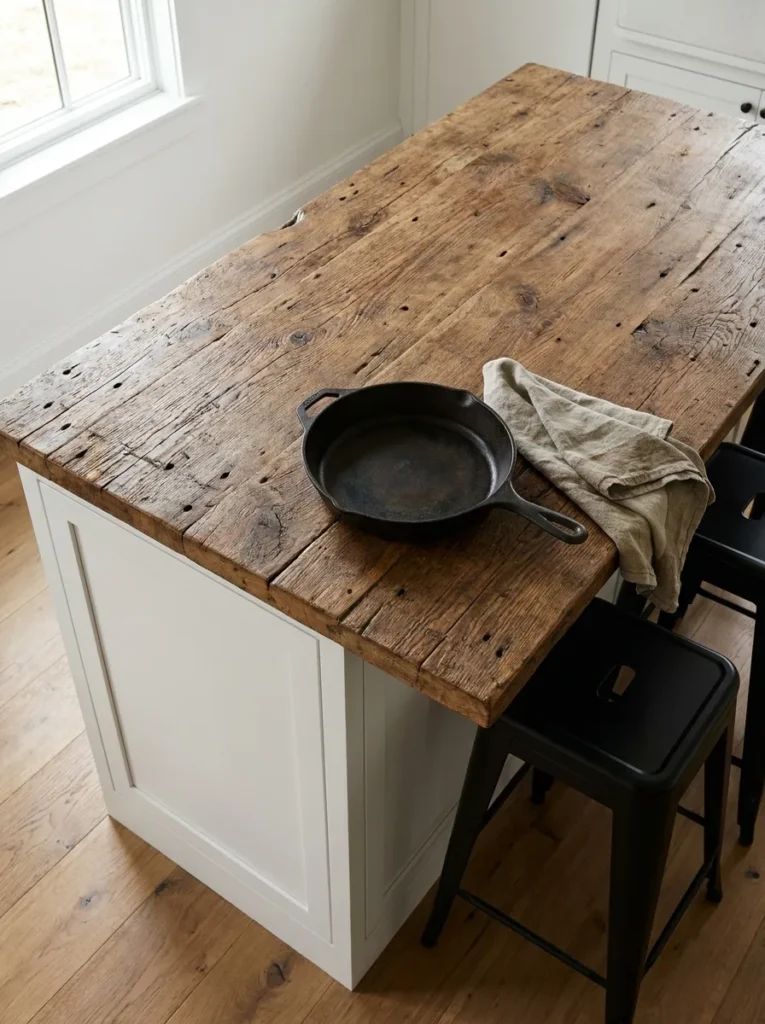
Vibe: Raw, a surface with a history instead of a showroom finish.
Why it works: Reclaimed wood carries visible imperfection — knots, saw marks, uneven grain — which reads as texture layering against a smooth, uniform cabinet base. The contrast between rough and refined is what keeps the look from feeling like a theme.
How to get it: Seal reclaimed wood with a food-safe mineral oil rather than polyurethane, which flattens the grain’s texture; reapply oil monthly on the working surface to keep the wood looking alive rather than plasticky.
Quick Win: A small reclaimed wood serving board on an existing quartz island gives the same texture contrast for under $30.
Shop the Look
| Item |
|---|
| Reclaimed wood serving board large |
| Cast iron skillet 10-inch |
| Linen kitchen towel set striped |
| Food-safe mineral oil wood conditioner |
| Wire dish rack industrial style |
8. Define the Kitchen Zone with an Island “Runway”
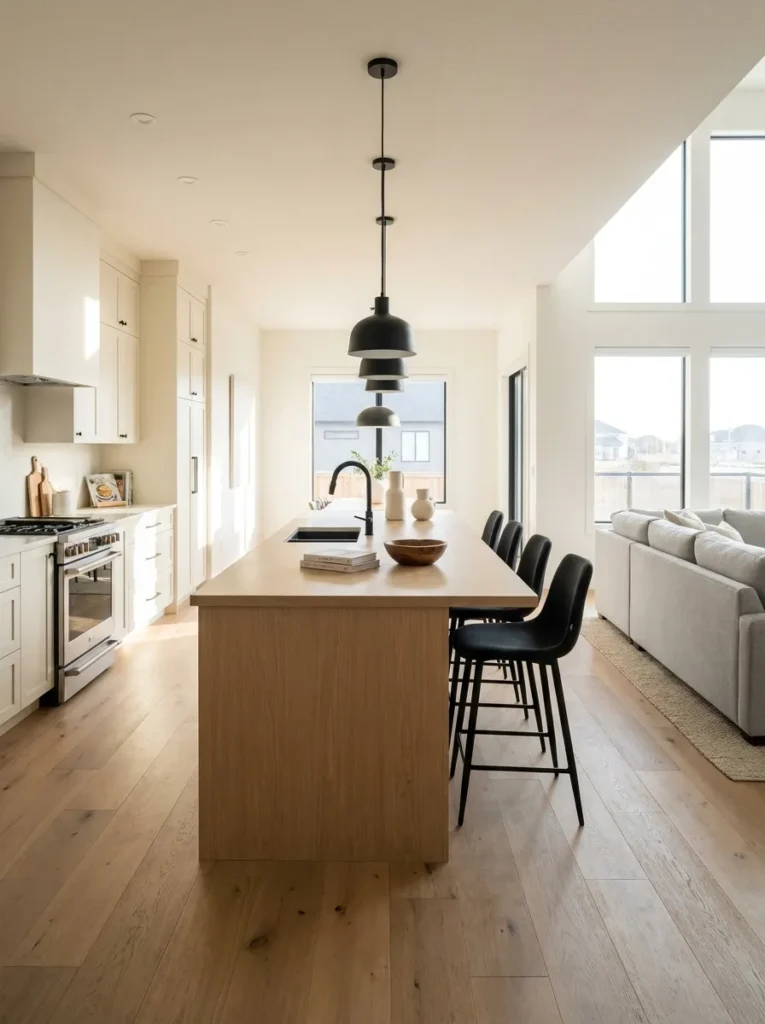
Vibe: Open, a layout that lets the whole room breathe.
Why it works: Positioning the island parallel to the main walkway with at least 42 inches of clearance on each side uses negative space to define the kitchen zone without walls — a layout principle that keeps sightlines open in an open-concept plan.
How to get it: Measure 42 to 48 inches from the island’s edge to the nearest cabinet run on the work side, and 36 inches minimum on the seating side, so foot traffic never has to squeeze past a seated guest.
Shop the Look
| Item |
|---|
| Slim profile pendant light fixture |
| Low pile area rug neutral runner |
| Floor transition strip oak finish |
| Adjustable height bar stool set |
| Wall-mounted magnetic knife strip |
9. Under-Cabinet LED Strips for Task Glow
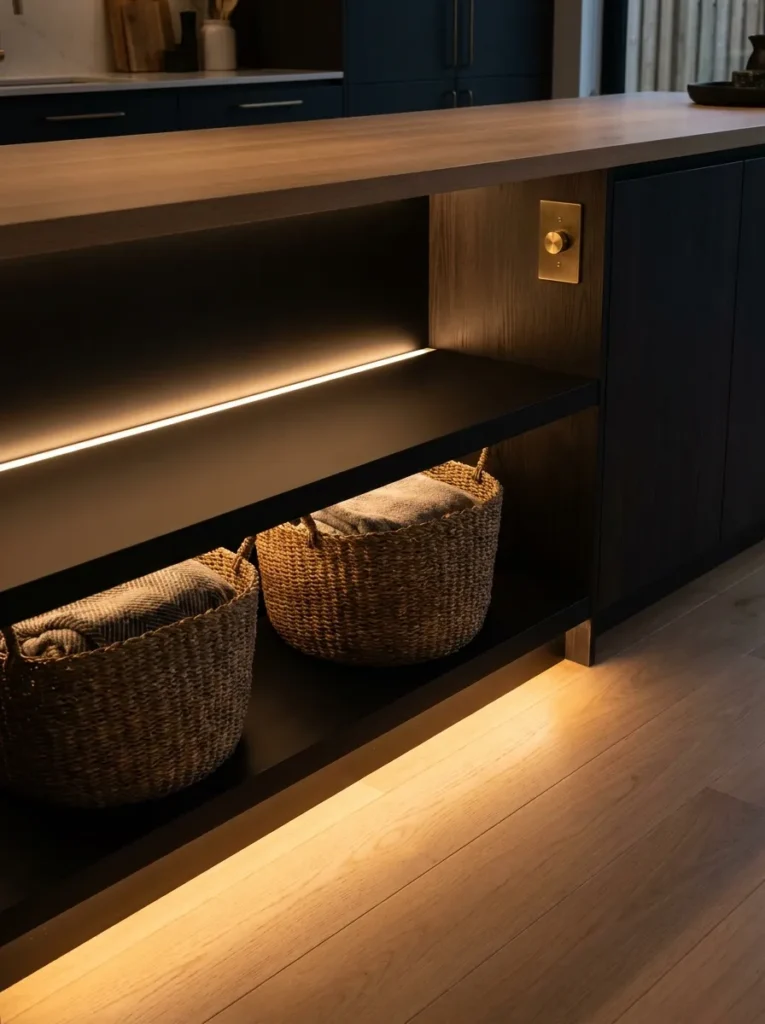
Vibe: Moody, the kind of glow that makes a kitchen feel open late at night.
Why it works: Uplighting or underlighting a lower shelf creates a secondary light source below eye level, which softens harsh overhead shadows and adds depth — the same technique used in retail display lighting to make objects feel three-dimensional.
How to get it: Install a dimmable warm-white LED strip along the underside of the island’s lower shelf or toe-kick, wired to its own switch so it can run independently of the main kitchen lights.
Quick Win: A battery-powered, stick-on LED strip under an existing shelf achieves the same glow with zero wiring for under $25.
Shop the Look
| Item |
|---|
| Dimmable warm white LED strip kit |
| Battery-powered stick-on LED puck lights |
| Woven storage basket set for open shelf |
| Toe-kick LED lighting kit |
| Smart dimmer switch wireless |
10. Open Shelving Base Instead of Closed Cabinets
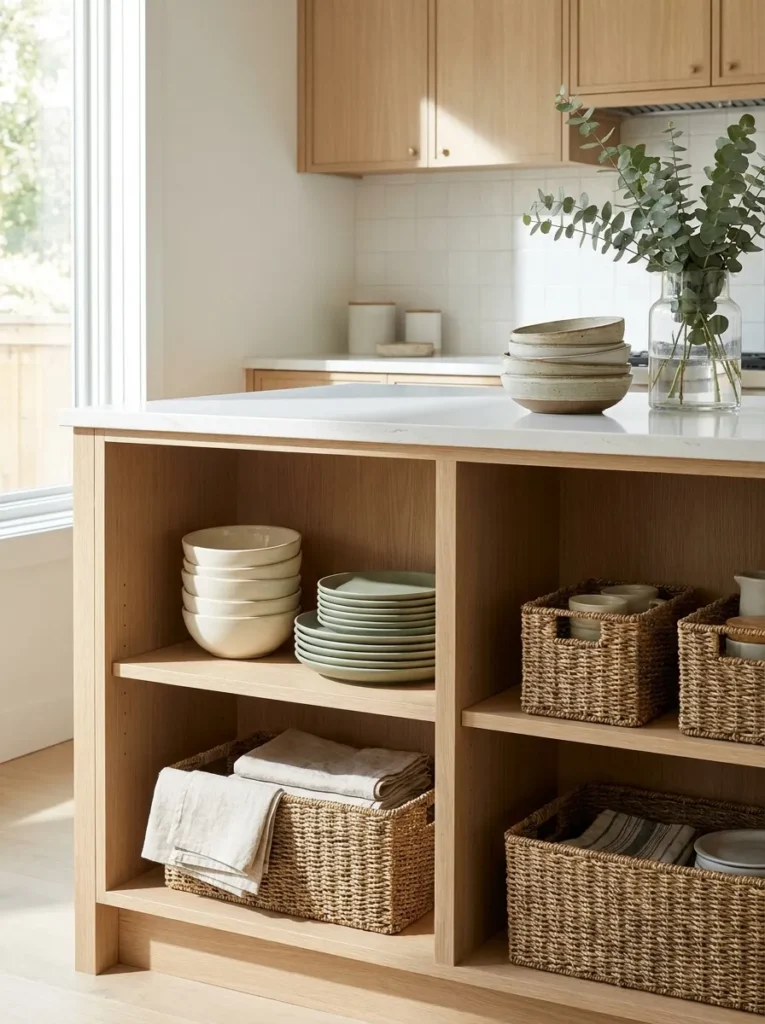
Vibe: Airy, storage that shows instead of hides.
Why it works: Removing cabinet doors trades visual weight for functional display — open shelving forces intentional organization, which uses negative space between objects to keep the base from feeling cluttered even while storing everyday items.
How to get it: Reserve open shelving for uniform-looking items — matching ceramic bowls, woven baskets, or a single set of glassware — and keep mismatched everyday clutter in a closed drawer elsewhere on the island.
Shop the Look
| Item |
|---|
| Stackable ceramic bowl set cream |
| Woven basket with handles set of 2 |
| Linen napkin storage basket |
| Ceramic dinner plate set matte |
| Wood shelf riser for cabinet storage |
11. Slim Rolling Island for Compact Kitchens
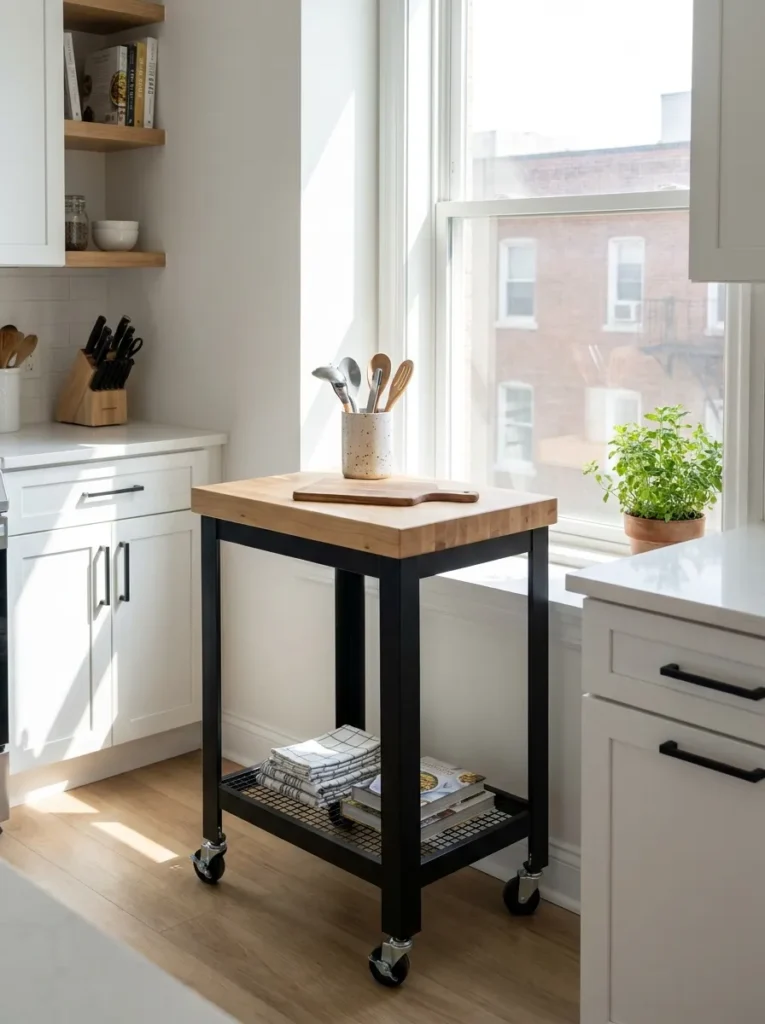
Vibe: Nimble, a piece of furniture that works as hard as a built-in.
Why it works: A rolling cart on locking casters solves the core small-space problem — fixed square footage — by making the island’s position temporary rather than permanent, so the kitchen can expand for cooking and contract for walking through.
How to get it: Choose a cart no wider than 24 to 30 inches with a butcher block top and locking caster wheels, and store it against an open wall when not in active use to free up floor space.
Quick Win: Adding a set of locking caster wheels to an existing narrow console table turns it into a mobile prep island for under $20.
Shop the Look
| Item |
|---|
| Rolling kitchen cart butcher block top |
| Locking caster wheel set of 4 |
| Slim wood cutting board with handle |
| Ceramic utensil holder crock |
| Under-shelf wire storage basket |
12. A Live-Edge Wood Cutting Board Display
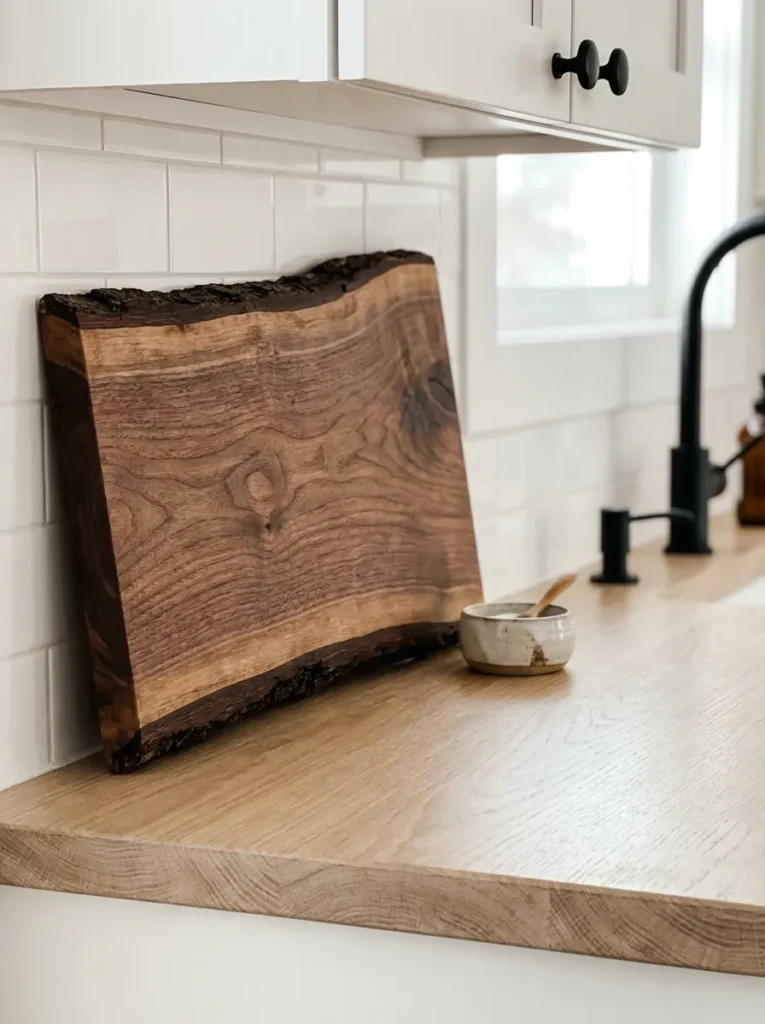
Vibe: Warm, an everyday tool treated like a piece of art.
Why it works: Displaying a live-edge board upright rather than storing it flat in a drawer uses vertical negative space behind the island, adding visual interest at counter height where the eye naturally lands.
How to get it: Lean the board against the backsplash or a plate rack rather than a wall, angled slightly so the bark edge and grain catch the light from above.
Shop the Look
| Item |
|---|
| Live-edge walnut cutting board large |
| Ceramic salt cellar with lid |
| Wood plate rack countertop stand |
| Small olive oil cruet glass |
| Linen apron neutral tone |
13. Matte Black Hardware Against Warm Wood Tones
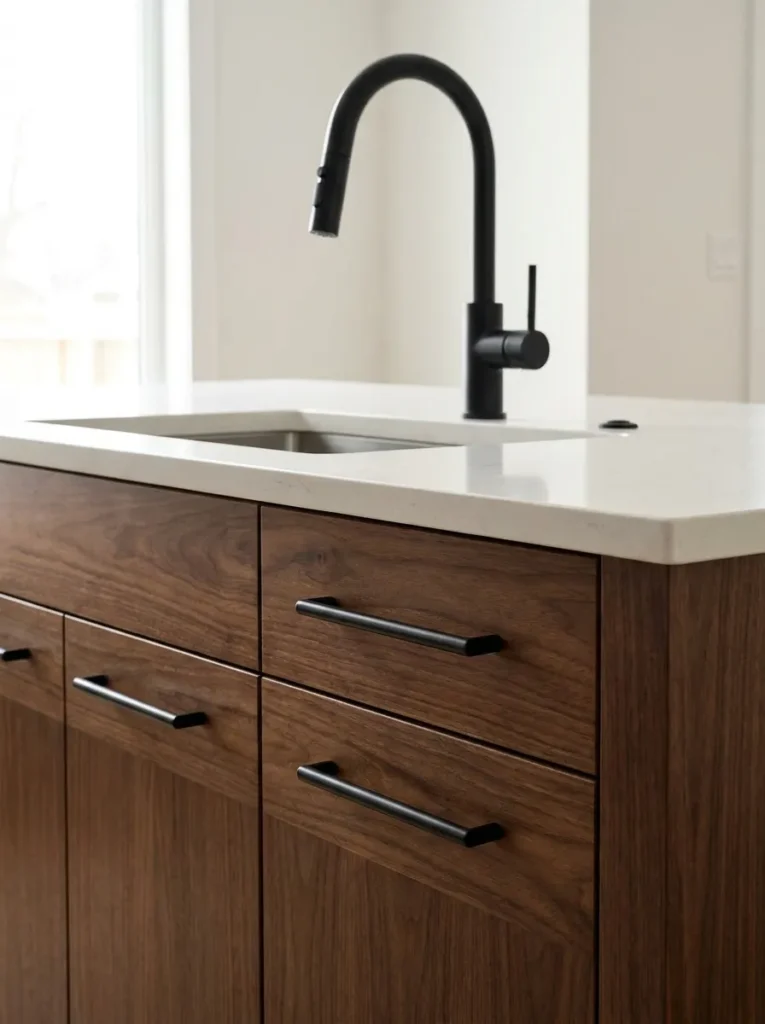
Vibe: Grounded, small details carrying the whole design.
Why it works: Matte black absorbs light rather than reflecting it, which creates strong visual weight in small doses — using it only for hardware and fixtures keeps that weight anchored at the island’s edges instead of overwhelming the wood.
How to get it: Match every metal touchpoint on the island — pulls, faucet, and any exposed brackets — to the same matte black finish; mixing a shiny black with a matte one is the detail that most often breaks this look.
Quick Win: Matte black spray paint made for metal can update existing brass hardware in an afternoon for under $15.
Shop the Look
| Item |
|---|
| Matte black bar pull hardware set |
| Matte black gooseneck kitchen faucet |
| Matte black spray paint for metal |
| Matte black cabinet hinge set |
| Matte black soap dispenser countertop |
14. Hand-Glazed Zellige Tile Backsplash Behind the Island
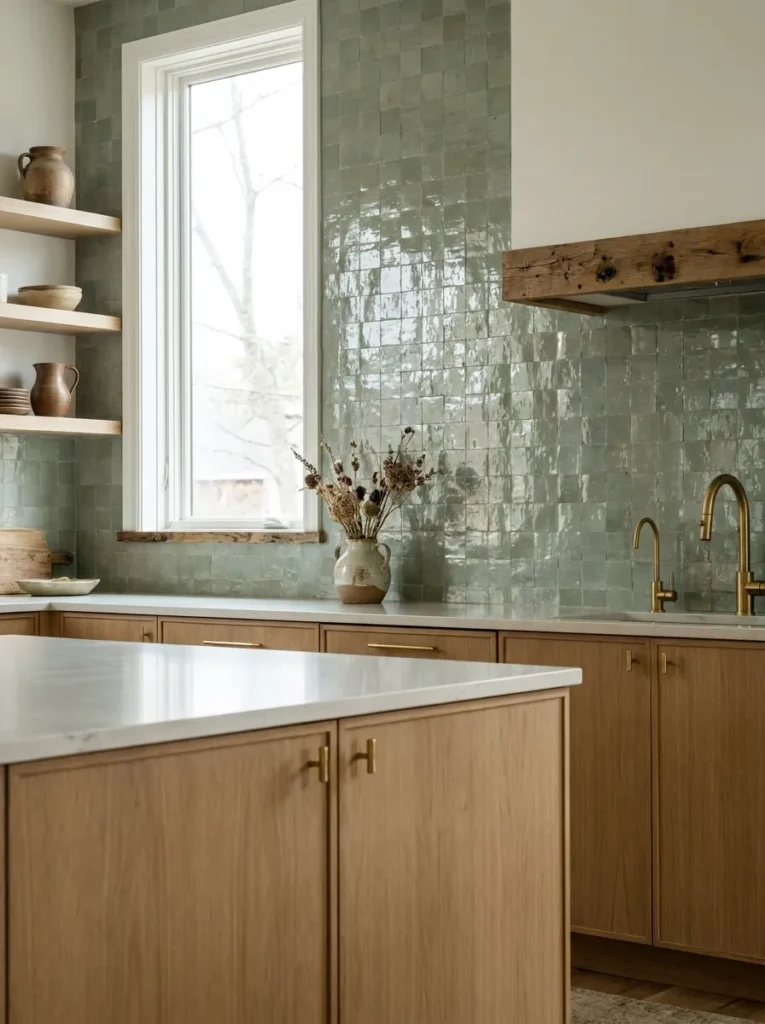
Vibe: Luminous, a wall that changes with the light throughout the day.
Why it works: Handmade zellige tile has slight variations in thickness and glaze that catch light unevenly, unlike machine-made ceramic, this irregularity is what gives the surface visual depth instead of a flat, printed look.
How to get it: Install zellige tile in a simple running bond pattern rather than a busy herringbone, so the tile’s natural texture stays the focal point instead of competing with a complicated layout.
Shop the Look
| Item |
|---|
| Hand-glazed zellige tile sage green sample pack |
| Brass switch plate cover single |
| Small ceramic bud vase for ledge |
| Grout float tool for tile installation |
| Tile edge trim brass finish |
How to Start Your Style-and-Function Island Transformation
The single best first move is swapping your island’s hardware to matte black or brushed brass, matched throughout — pulls, faucet, and any exposed brackets. Hardware touches every surface a hand actually uses, so it anchors the whole island’s finish before you spend a dollar on paint or tile.
The most common mistake is mixing finishes — a brass faucet with chrome cabinet pulls, or a warm oak island next to cool gray flooring with no bridging tone. This breaks the look because the eye reads mismatched metals and undertones as unfinished, even if every individual piece is well-chosen. Fix it by picking one metal finish and one wood undertone, then checking every new item against both before buying.
Three items under $50 create immediate impact: a matte terracotta ceramic fruit bowl, a warm 2700K LED bulb three-pack for existing pendants, and a live-edge walnut serving board styled upright against the backsplash.
A full island refresh with new hardware, lighting, and styling typically takes a single weekend and $150 to $400. A complete rebuild — new countertop, cabinet paint, and tile — realistically runs six to eight weeks and $2,500 to $6,000 depending on materials.
Frequently Asked Questions About Style-and-Function Kitchen Islands
What is the difference between a functional kitchen island and a decorative one?
A functional island prioritizes prep space, storage, and seating first, while a purely decorative island focuses on visual impact even if it sacrifices counter space. The style-and-function approach layers decor — like a ceramic vignette or pendant lighting — onto a base that still works hard every day, so nothing on the island is there purely for show.
What colors work best for a kitchen island that needs to feel both stylish and practical?
Warm white, greige, and sage green are the most versatile choices because they pair with both warm wood tones and cool metal hardware without clashing. Deep charcoal or matte black also works well for a bold anchor piece, especially paired with brass fixtures for contrast.
How much does it cost to style an existing kitchen island without renovating?
A styling refresh using new hardware, a lighting update, and a few decor pieces typically costs between $150 and $400. Swapping cabinet pulls alone runs $30 to $80 for a full set, while a ceramic vignette with two or three pieces adds another $40 to $60.
Does a functional decor style work with an existing farmhouse or modern kitchen?
Yes — the style-and-function approach is built to layer onto almost any existing kitchen because it relies on materials and lighting rather than a single rigid aesthetic. A farmhouse kitchen can add matte black hardware and a live-edge board, while a modern kitchen can add the same pieces in brass with cleaner lines.
What is the most popular lighting choice for kitchen islands right now?
Staggered brass and glass pendant lighting is currently the most searched island lighting style, followed closely by warm under-cabinet LED strips for ambient task lighting. Both options add warmth through 2700K bulb temperature rather than relying on cool, bright overhead lighting alone.
Ready to Create Your Dream Kitchen Island?
These 14 ideas cover color, material, lighting, layout, and small-space solutions, so there’s a starting point here no matter the size of your kitchen or your budget. Transforming an island doesn’t happen all at once, and starting with one hardware swap or one styled vignette is exactly the right way to begin. Today, pick a single idea from this list — the terracotta bowl, the pendant bulb swap, or the live-edge board — and bring it home this week. Once the pieces come together, the island stops feeling like a countertop and starts feeling like the place your whole home gathers around. Save your favorites now, so the next time you’re standing in the tile aisle or scrolling for hardware, you already know exactly what you’re building toward.