14 Apartment Inspiration Ideas for Budget-Friendly Decor
Budget-friendly apartment decor is the art of making a rented or small space feel intentional using thrifted finds, smart layering, and a handful of well-chosen pieces instead of a full furniture budget. This article gives you exactly 14 apartment inspiration ideas for budget-friendly decor, each one built around a specific technique you can copy this weekend.
This look feels resourceful and calm at once like a space that was curated slowly, not bought all in one trip. Light bounces off mirrors and glass instead of expensive fixtures. Texture does the heavy lifting where big spending would normally sit. Nothing here feels temporary, even though most of it cost under $50.
Here are 14 ideas worth saving and stealing.
Why Budget-Friendly Apartment Decor Works So Well
Budget-friendly apartment decor isn’t a single design movement it’s a resourcefulness-first approach that borrows from mid-century thrifting culture, IKEA-hacking communities, and the renter-decor boom that took off on Pinterest and TikTok over the past several years. It draws heavily from Scandinavian minimalism’s “fewer, better things” philosophy and bohemian layering’s love of texture, but strips out the expensive originals in favor of accessible substitutes.
The core palette leans warm and neutral: greige walls (even on renter-safe peel-and-stick paper), warm white linens, dusty sage or terracotta blush accents, and brushed brass or matte black hardware. Materials favor what’s affordable and durable rattan, unfinished pine, cotton rope, ceramic, and secondhand walnut or oak. These materials photograph well and age gracefully, which matters when you can’t replace them often.
This style is trending now because renters are staying in apartments longer amid high home prices, and Pinterest search data shows sustained growth in searches like “small apartment decor ideas” and “rental-friendly decor.” Post-pandemic, people want their homes to feel finished even without ownership, and secondhand shopping has shed its stigma in favor of feeling resourceful and design-savvy.
Small spaces can absolutely achieve this style arguably better than large ones. Prioritize vertical storage, mirrors, and one anchor piece of furniture per room before adding decor. Limits exist: you can’t fake structural elements like built-in shelving without committing to a semi-permanent hack, so know that some looks (like full shiplap walls) require more effort than a weekend allows.
Style at a Glance
| Element | Trait 1 | Trait 2 |
|---|---|---|
| Philosophy | Fewer, better pieces | Resourceful over expensive |
| Materials | Rattan, unfinished wood, cotton rope | Ceramic, linen, secondhand walnut |
| Color palette | Warm white, greige, dusty sage | Terracotta blush, warm charcoal |
14 Ideas Worth Stealing
1. A Greige Accent Wall Without the Paint Commitment
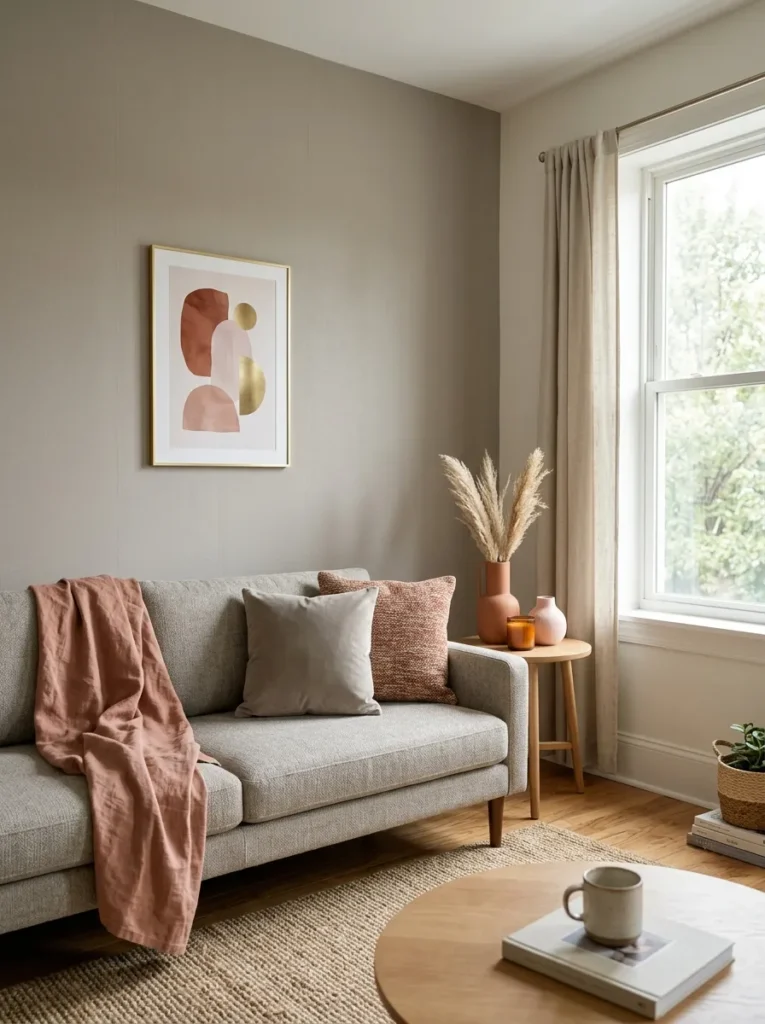
Vibe: The room feels grounded, like it’s finally settled into itself.
Why it works: Color contrast anchors a room without adding a single new object this is the design principle of negative space paired with tonal depth. A single greige wall against warm white trim creates visual weight on one side of the room, which balances furniture on the other, so the eye has somewhere to land.
How to get it: Use removable peel-and-stick wallpaper in a matte greige tone rather than paint, since it satisfies most lease agreements and comes off cleanly at move-out. Apply it only to the wall behind your sofa or bed the “headboard wall” so the investment covers the smallest possible surface.
Quick Win: A 3-foot-wide roll of textured greige peel-and-stick paper behind a bed frame gives the illusion of a full accent wall for under $30.
Shop the Look
| Product |
|---|
| Greige textured peel-and-stick wallpaper roll |
| Ceramic bud vase set neutral tones |
| Ivory linen throw blanket |
| Brushed brass wall hook set |
| Terracotta blush ceramic planter small |
2. Rattan Everywhere, But Never Matching
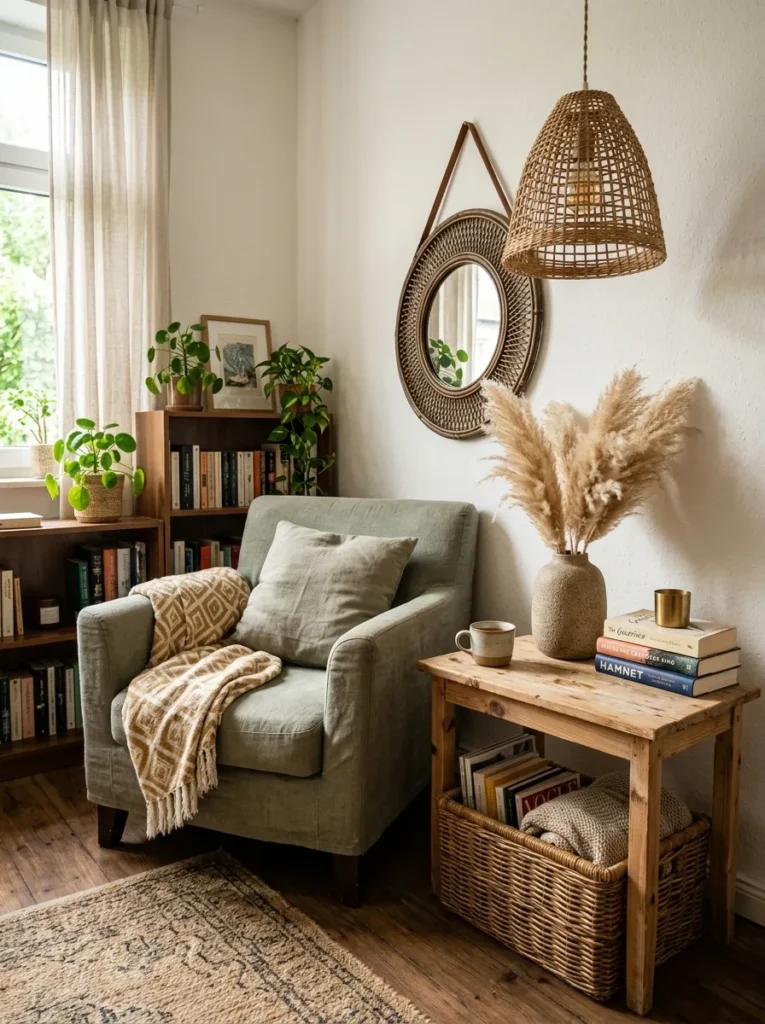
Vibe: The corner feels layered, like texture built up over time rather than all at once.
Why it works: Material repetition without matching is a texture-layering principle using the same material (rattan) in different weaves and shapes creates cohesion while avoiding the flat, showroom look of a matching set. It reads as collected, not purchased in one trip.
How to get it: Buy rattan pieces from different sources a mirror from one thrift store, a basket from a home goods clearance bin, a pendant shade from an online marketplace so the weave patterns naturally differ. Keep every rattan piece within the same tan-to-honey color family so they still feel related.
Shop the Look
| Product |
|---|
| Rattan wall mirror round natural |
| Rattan storage basket with handles |
| Rattan pendant lamp shade natural |
| Unfinished pine side table small |
| Stoneware vase for dried grass |
3. One Warm Lamp Instead of Overhead Light
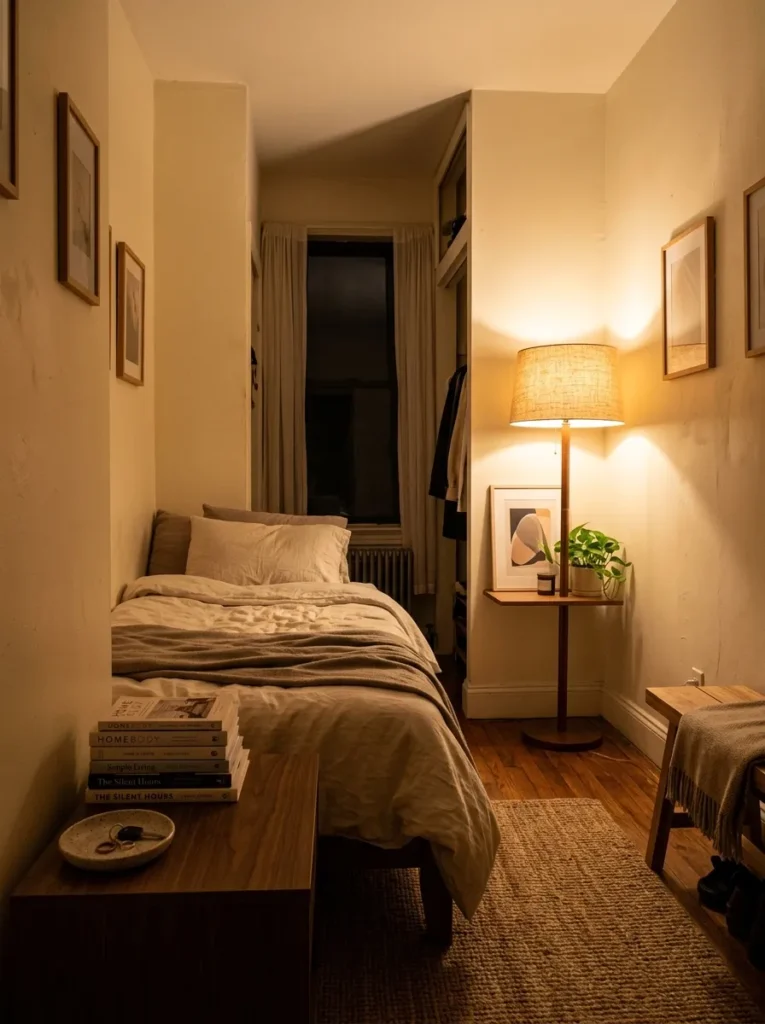
Vibe: The room feels hushed, like the end of a long day.
Why it works: This uses the design principle of light behavior over light quantity a single warm-bulb source at a lower height casts long, soft shadows that make a small room feel larger and more intimate than a bright overhead fixture ever could. Overhead lighting flattens a room; a floor lamp sculpts it.
How to get it: Swap your ceiling light’s bulb for a warm 2700K bulb and add one floor lamp with a linen or paper shade positioned in a corner rather than centered. Turn the overhead light off entirely in the evening and rely on the lamp as your only source.
Quick Win: A single warm-white 2700K smart bulb costs under $15 and instantly changes the mood of an entire room without buying a new fixture.
Shop the Look
| Product |
|---|
| Warm 2700K smart LED bulb |
| Linen shade floor lamp walnut base |
| Ceramic trinket dish small |
| Stack of hardcover decorative books |
| Brass bulb pull chain switch |
4. A Single Statement Chair Instead of a Full Set
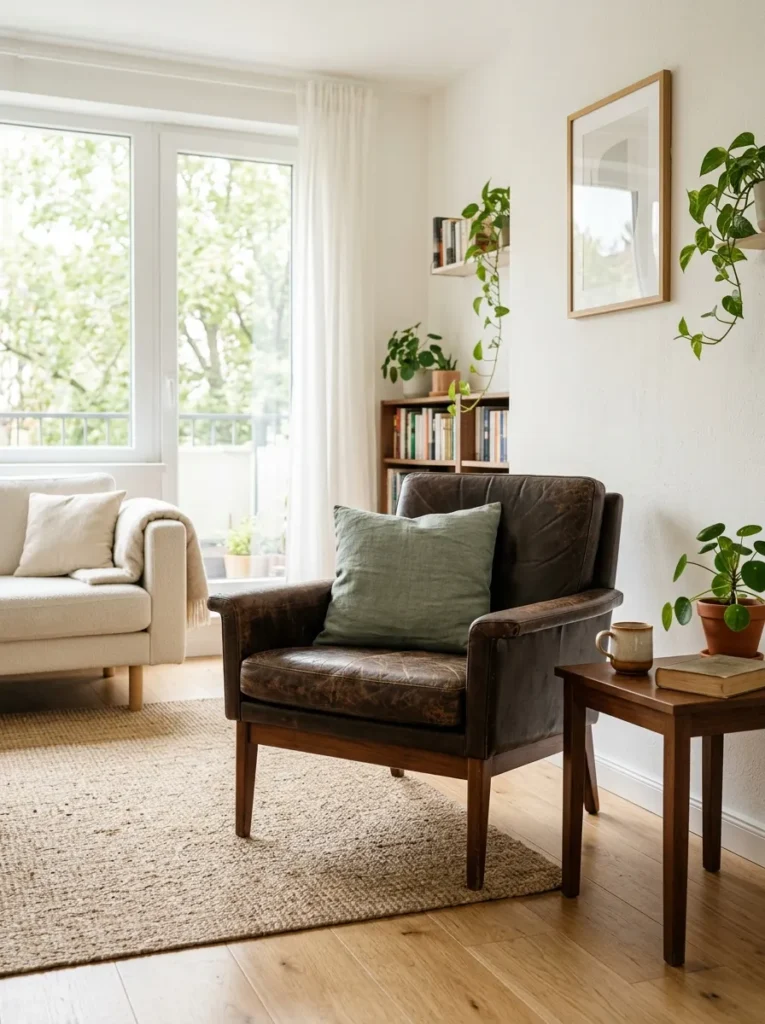
Vibe: The room feels intentional, like every inch was considered before anything was added.
Why it works: This applies the principle of visual weight distribution one substantial, well-made piece placed with generous negative space around it reads as more expensive than a full matching set crammed into the same footprint. Scale matters more than quantity in small rooms.
How to get it: Save your furniture budget for one secondhand accent chair in real leather or solid wood rather than a full living room set from a big-box store. Leave at least two feet of open floor space around it so the chair has room to “breathe.”
Shop the Look
| Product |
|---|
| Dark walnut leather accent chair |
| Small round side table walnut |
| Dusty sage throw pillow cover |
| Woven jute area rug small |
| Brass reading lamp clip-on |
5. Terracotta Blush as Your One Bold Color
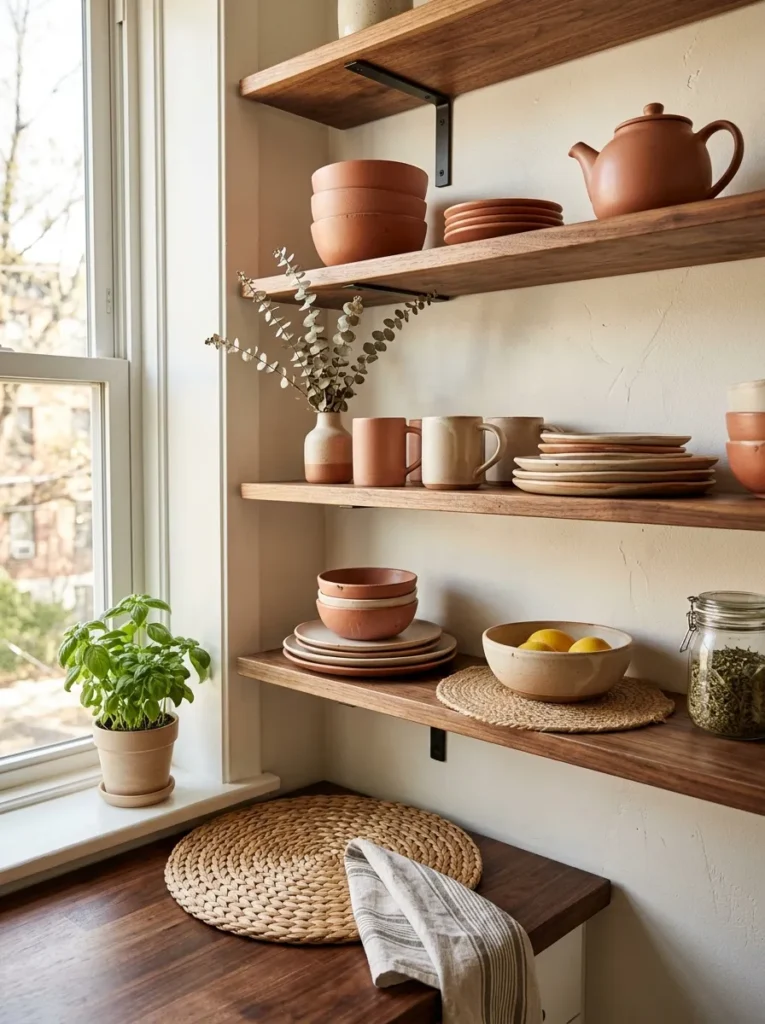
Vibe: The corner feels sun-warmed, even under gray light.
Why it works: Committing to one accent color across a small number of visible objects rather than scattering many colors creates cohesion through repetition, a core color theory principle. Terracotta blush reads as warm and grounding without overwhelming a neutral base.
How to get it: Choose three to five terracotta blush ceramic pieces mugs, a bowl, a small vase and display them together on open shelving instead of hidden in cabinets. Keep everything else in the room neutral so the color has room to stand out.
Quick Win: A single terracotta blush ceramic mug displayed upright on a shelf, rather than stacked in a cabinet, does more visual work than an entire matching dish set.
Shop the Look
| Product |
|---|
| Terracotta blush ceramic mug set |
| Open wood wall shelf set |
| Woven cotton placemats set |
| Dried eucalyptus stem bundle |
| Matte ceramic serving bowl blush |
6. Framed Prints Instead of Original Art
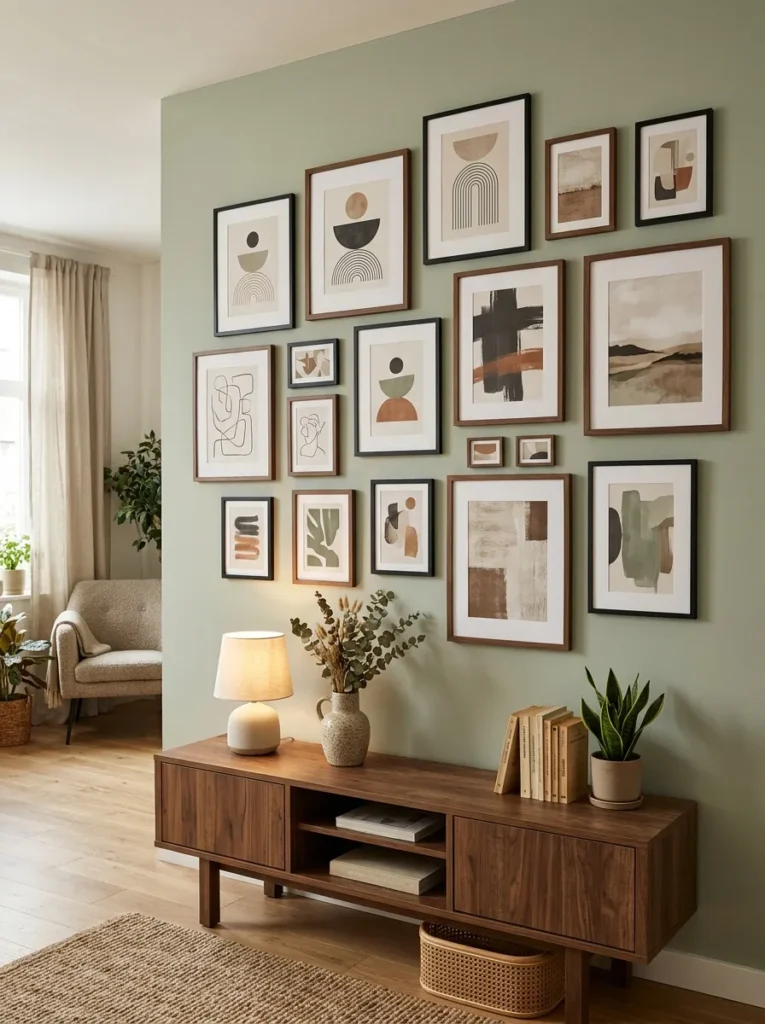
Vibe: The wall feels layered, like a collection built over seasons.
Why it works: This uses the design principle of grid rhythm with intentional imperfection mixing frame finishes while keeping consistent spacing between pieces creates visual interest without chaos. It mimics the look of a curated art collection at a fraction of the cost.
How to get it: Print three to five abstract or botanical images from a stock photo site and frame them in a mix of thin black and walnut frames from a discount retailer. Lay the arrangement out on the floor first to test spacing before hanging a single nail.
Shop the Look
| Product |
|---|
| Thin black picture frame set |
| Walnut wood picture frame set |
| Abstract neutral tone canvas print |
| Small console table entryway |
| Ceramic table lamp warm base |
7. Cotton Rope and Cane Instead of Solid Doors
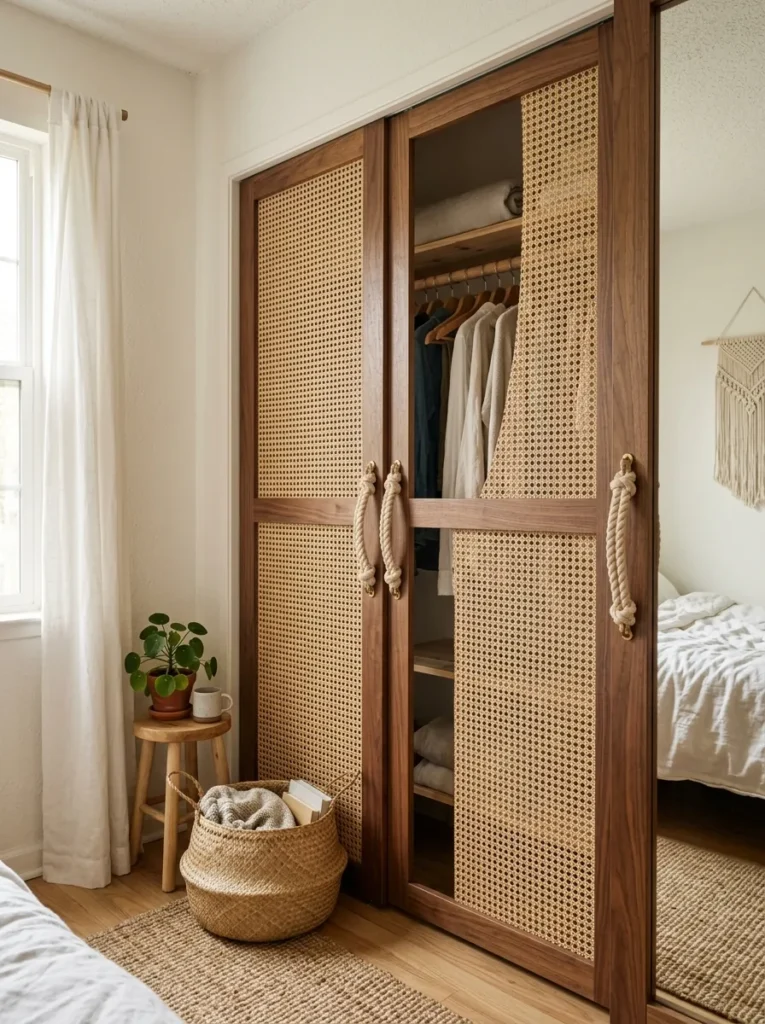
Vibe: The closet feels airy instead of like an afterthought.
Why it works: Substituting an inexpensive material cane webbing panels or cotton rope hardware for a builder-grade flat surface changes the entire texture story of a functional object using contrast in material finish, a principle borrowed from high-end furniture design at a renter-friendly cost.
How to get it: Adhere a peel-and-stick cane webbing panel to a flat closet or cabinet door and swap plastic knobs for cotton rope or leather pulls that screw into the existing holes. Both changes are fully reversible at move-out.
Quick Win: Cotton rope drawer pulls cost under $2 each and can transform an entire dresser in under twenty minutes.
Shop the Look
| Product |
|---|
| Peel-and-stick cane webbing panel |
| Cotton rope drawer pull set |
| Leather tab cabinet pull set |
| Woven storage basket floor |
| Natural wood drawer knob set |
8. The Corner Nook That Does Double Duty
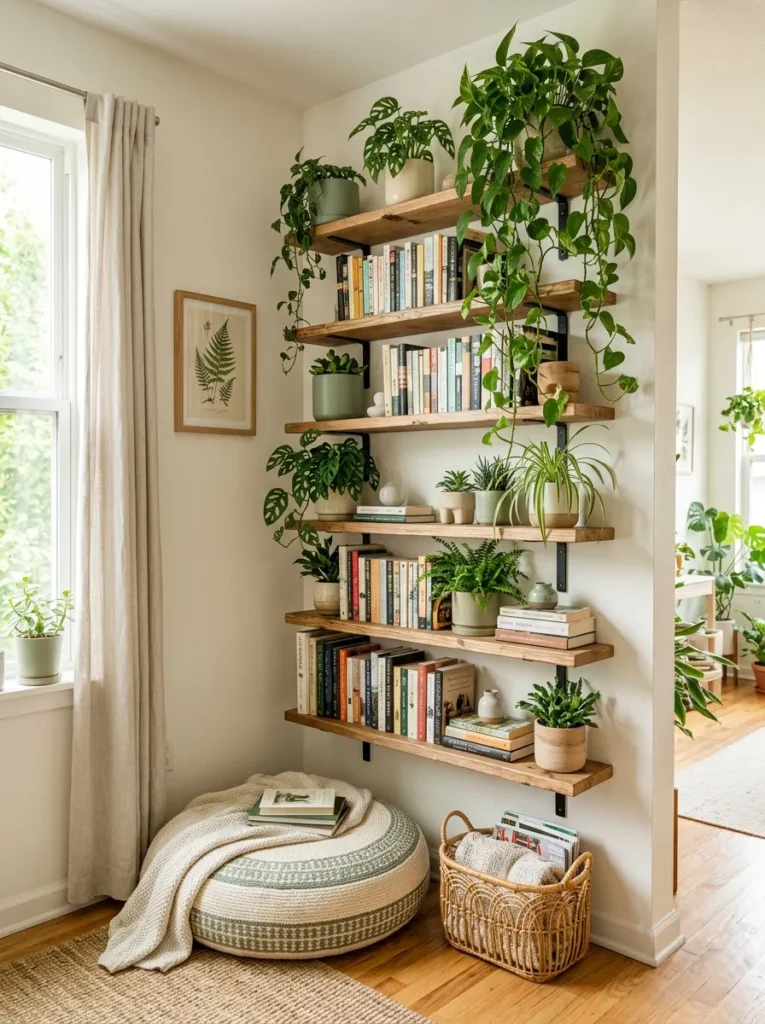
Vibe: The corner feels open, even though it’s doing two jobs at once.
Why it works: This is a small-space adaptation using vertical zoning building upward with floating shelves instead of outward with floor furniture frees up square footage while still giving a space two clear functions. It’s the same negative space principle applied specifically to compact footprints.
How to get it: Install two or three floating shelves at staggered heights on one wall and use the floor beneath for a single cushion or low stool rather than a chair. Let trailing plants on the top shelf soften the vertical lines.
Shop the Look
| Product |
|---|
| Floating wood wall shelf set |
| Floor cushion round natural fabric |
| Trailing pothos artificial plant |
| Small woven plant basket |
| Wall-mounted book ledge |
9. A Secondhand Coffee Table with Storage
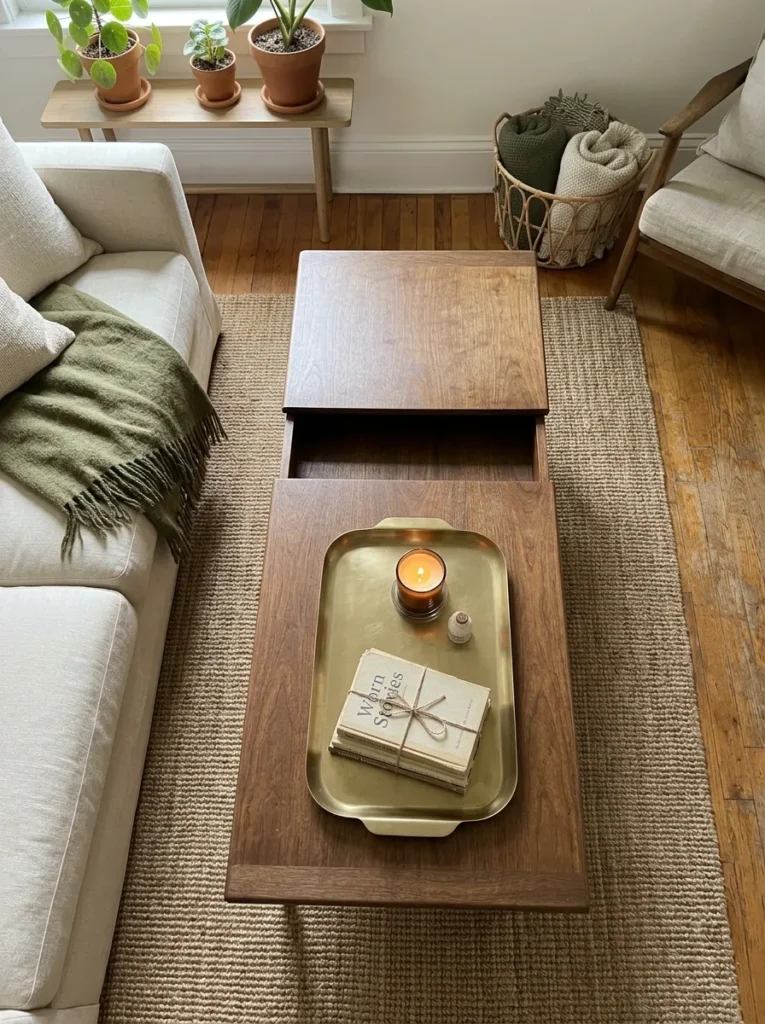
Vibe: The table feels grounded, like it’s earned its spot in the room.
Why it works: Choosing function-first furniture a coffee table with internal storage solves the small-apartment clutter problem while adding visual weight low in the room, balancing taller pieces like lamps or shelving. It’s proportion working in your favor.
How to get it: Search secondhand marketplaces specifically for “lift-top” or “storage” coffee tables in solid wood rather than laminate, since solid wood refinishes well if the surface is scratched. Style the top with one tray to keep remotes and clutter contained and out of view.
Shop the Look
| Product |
|---|
| Walnut lift-top coffee table |
| Brass serving tray round |
| Unscented pillar candle ivory |
| Stack of decorative hardcover books |
| Woven coaster set natural |
10. Dusty Sage as a Grounding Neutral
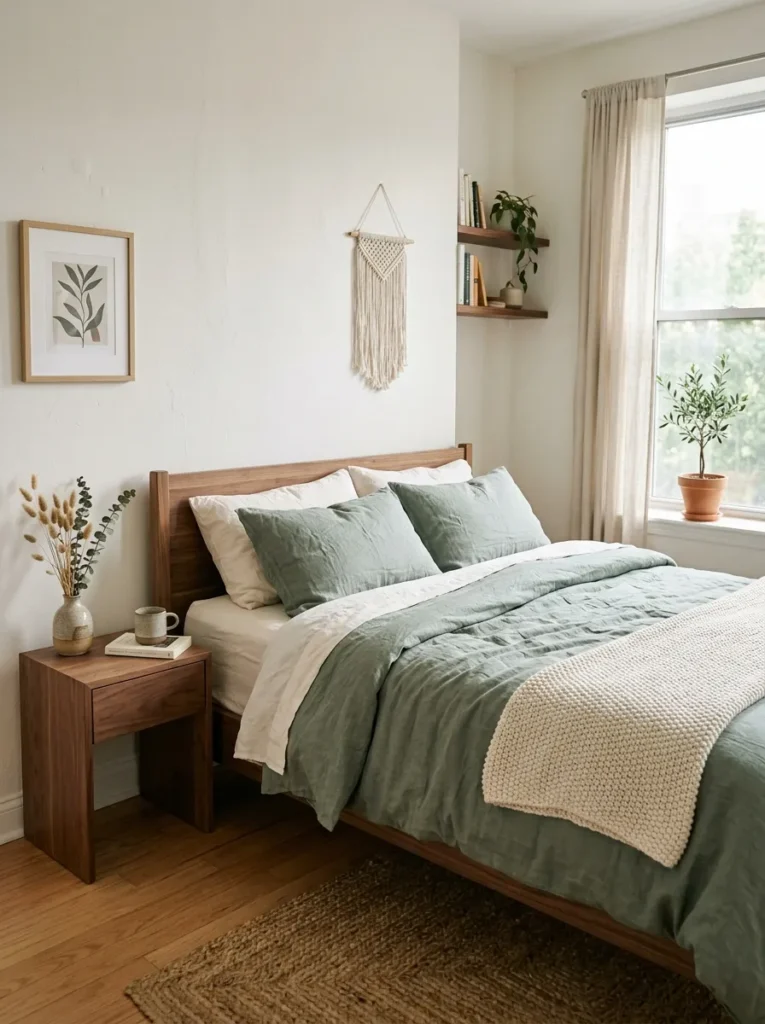
Vibe: The bedroom feels still, like a held breath.
Why it works: Dusty sage functions as a grounding neutral rather than an accent color here, meaning it can cover a large surface area bedding, a rug without overwhelming the space the way a saturated color would. This is color value control at work.
How to get it: Choose a dusty sage linen or cotton duvet cover as your largest color surface and keep every other textile in warm white or ivory. Add one small sage accent elsewhere in the room, like a vase, to echo the tone without repeating it exactly.
Quick Win: A dusty sage pillowcase set alone, layered over white sheets, gives 80% of the visual effect of a full sage bedding set for a fraction of the price.
Shop the Look
| Product |
|---|
| Dusty sage linen duvet cover |
| Warm white cotton sheet set |
| Knit throw blanket ivory |
| Ceramic bud vase sage tone |
| Matte wood nightstand small |
11. Candlelight for Evening Ambiance
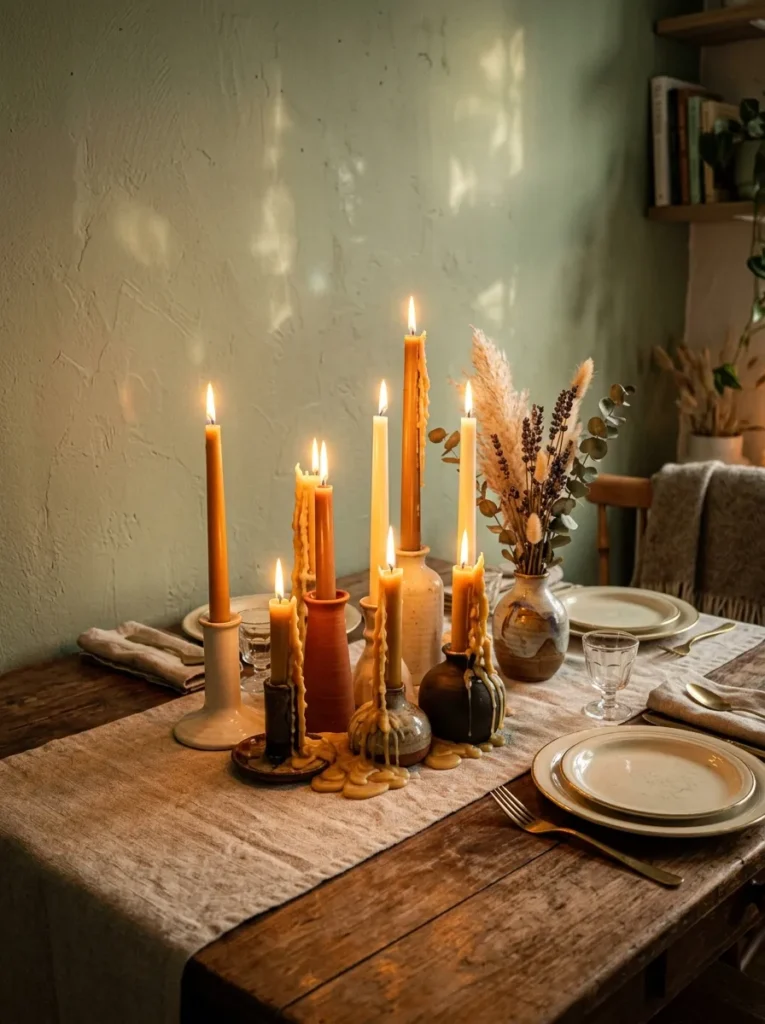
Vibe: The table feels romantic, in the quiet, unforced sense.
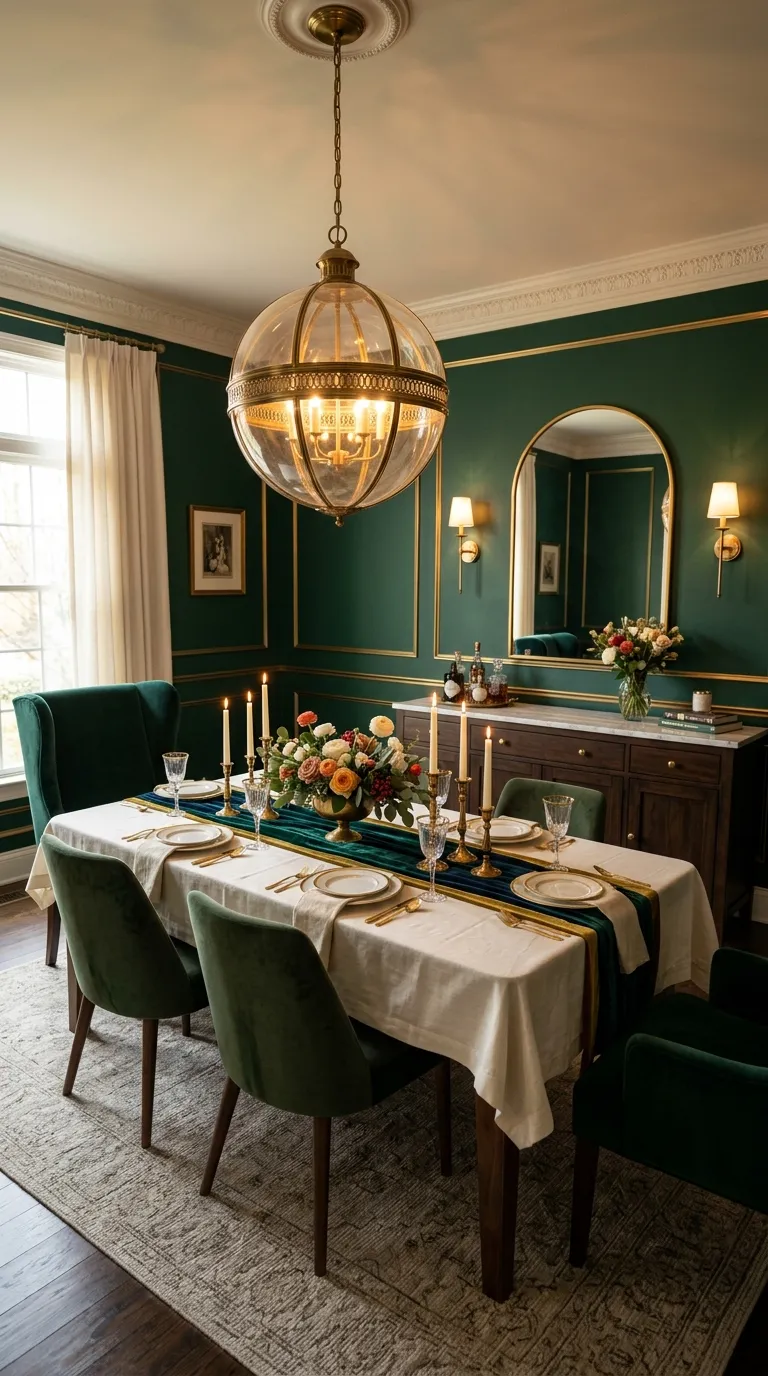
Why it works: Clustering multiple small light sources at varying heights rather than one large one creates depth and movement in a room after dark, a lighting principle used in restaurant design to make small spaces feel larger and warmer than they are.
How to get it: Group three to five taper candles in mismatched ceramic holders of varying heights down the center of a table instead of buying one matching candelabra. Light them in place of overhead lighting during dinner for an instant mood shift.
Shop the Look
| Product |
|---|
| Unbleached taper candle set |
| Mismatched ceramic candle holder set |
| Linen table runner ivory |
| Dried flower stem bundle |
| Brass candle snuffer small |
12. Unfinished Oak as Your Only Wood Tone
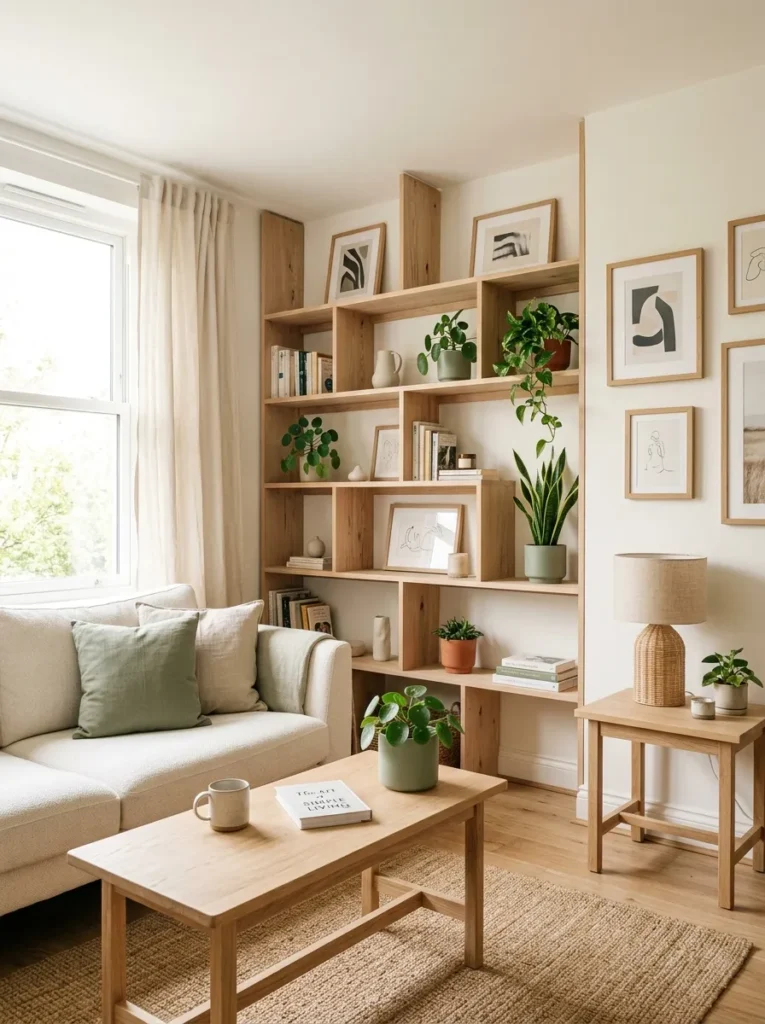
Vibe: The room feels luminous, almost weightless.
Why it works: Committing to a single wood tone across every piece rather than mixing walnut, oak, and pine removes visual competition between materials, which is the design principle of material consistency. It’s one of the fastest ways to make mismatched secondhand furniture look cohesive.
How to get it: Before buying any new wood piece, check that it’s unfinished or light oak-toned to match your existing furniture rather than a darker walnut or espresso finish. Sand and reseal any mismatched secondhand pieces with a clear matte sealant to unify their tone.
Quick Win: A can of clear matte wood sealant under $15 can visually unify three mismatched secondhand wood pieces in one afternoon.
Shop the Look
| Product |
|---|
| Clear matte wood sealant can |
| Light oak floating shelf |
| Unfinished oak picture frame set |
| Ivory linen curtain panel set |
| Small potted plant faux |
13. A Textile-Only Refresh for Rented Walls
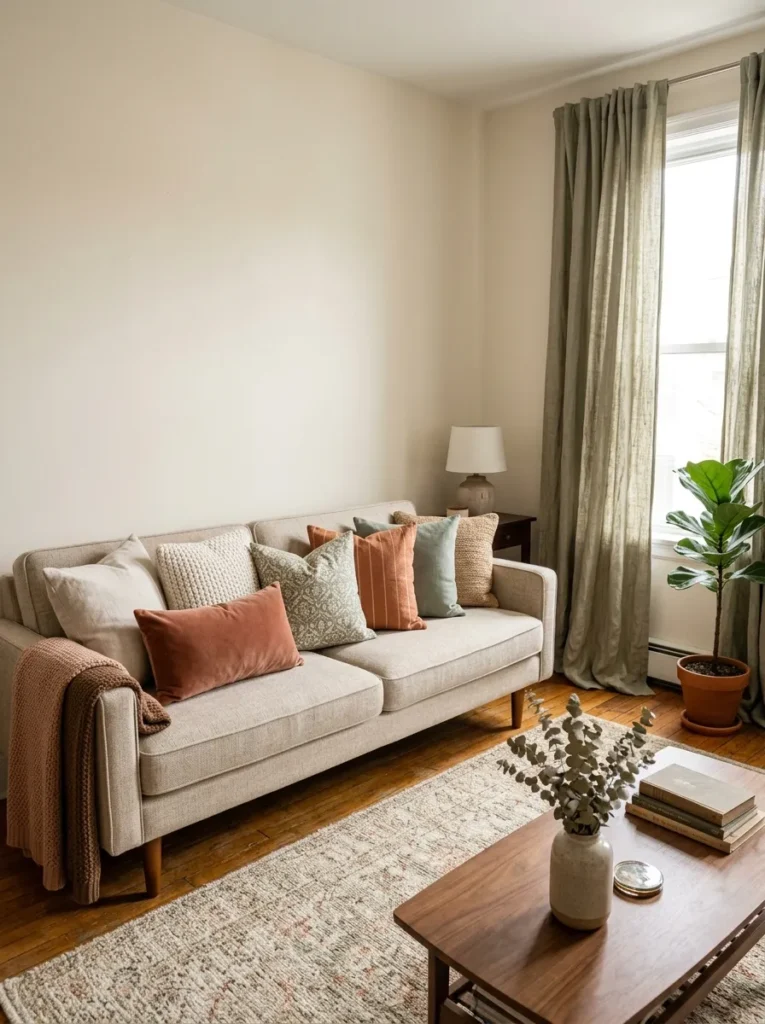
Vibe: The room feels layered, entirely through fabric alone.
Why it works: This proves the design principle that texture layering can carry a room’s transformation on its own new curtains, a rug, and pillow covers change scale, softness, and color simultaneously without touching a single wall, which matters most for renters who can’t paint or drill.
How to get it: Replace curtains, one area rug, and all throw pillow covers in a single shopping trip, choosing pieces that share at least one common color so they read as coordinated rather than random. Hang curtains as close to the ceiling as possible to add height.
Quick Win: Hanging curtain rods 4-6 inches above the window frame instead of directly on it makes ceilings look taller for the cost of a longer curtain rod.
Shop the Look
| Product |
|---|
| Ivory linen curtain panel set |
| Taupe jute area rug |
| Mixed texture throw pillow covers |
| Extendable curtain rod brass finish |
| Folded knit throw blanket |
14. Zoning a Studio with a Rug Instead of a Wall
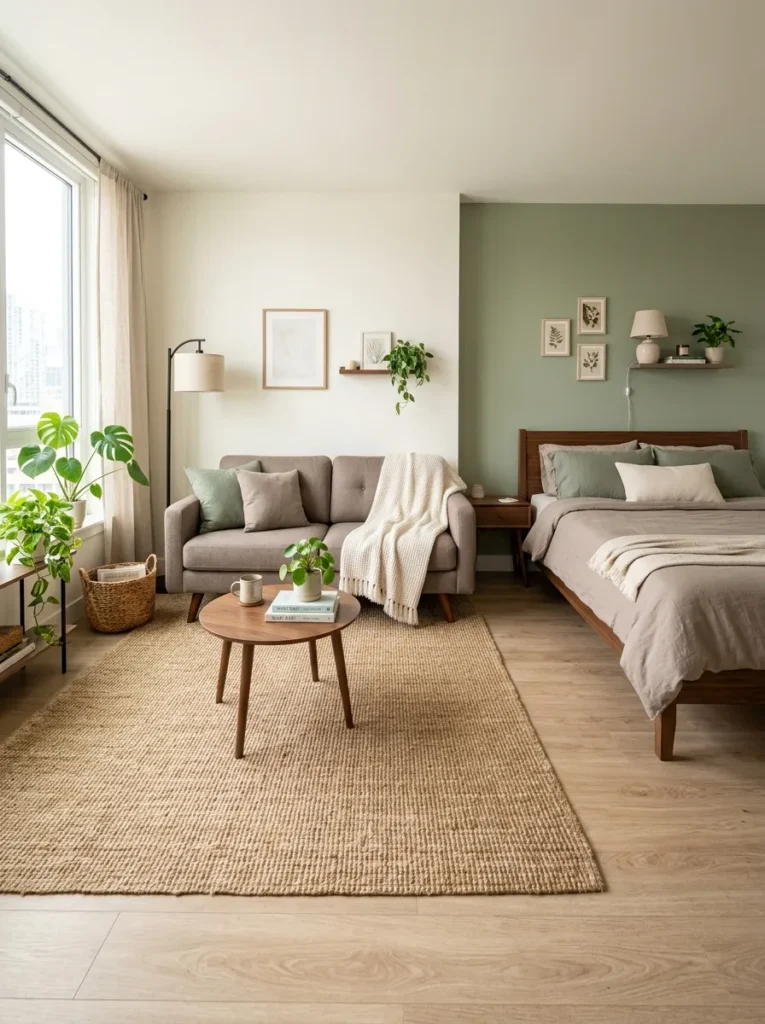
Vibe: The studio feels zoned, without ever feeling divided.
Why it works: This is a layout principle called visual zoning using a rug boundary, rather than a physical wall or curtain, to signal where one function ends and another begins. It preserves the sense of open space that makes a small studio feel larger while still organizing daily life.
How to get it: Place a rug under only your seating area, leaving bare floor visible around your bed area, so the boundary between “living” and “sleeping” reads clearly at a glance. Keep furniture on both sides at a similar height so neither zone visually overwhelms the other.
Shop the Look
| Product |
|---|
| Taupe jute area rug |
| Brushed brass floor lamp |
| Low profile platform bed frame |
| Folded linen throw blanket |
| Small woven storage basket |
How to Start Your Budget-Friendly Apartment Transformation
Start with paint or peel-and-stick wallpaper in a warm greige tone on a single accent wall this one move anchors every other decision, because it sets the undertone every future fabric, rug, and wood piece needs to complement. Everything else in this list becomes easier to choose once that undertone exists.
The most common mistake beginners make is buying decor before establishing a color undertone, which leads to a room full of mismatched warm and cool neutrals that never quite look right together. Fix it by choosing your wall or rug color first, then holding every future purchase up against a paint swatch before buying.
Three items under $50 that create immediate impact: a dusty sage linen pillowcase set, a single stem of dried pampas grass in a matte black ceramic bud vase, and a roll of cotton rope for swapping drawer pulls.
A starter version of this look one accent wall, new textiles, and updated hardware takes a single weekend and roughly $150–$300. A full room transformation including secondhand furniture typically takes three to six months of patient secondhand shopping and runs $500–$1,200 depending on how much furniture you’re replacing versus refreshing.
Frequently Asked Questions About Budget-Friendly Apartment Decor
What’s the difference between budget-friendly decor and minimalist decor?
Budget-friendly decor prioritizes cost and resourcefulness first, often layering in more texture and color than strict minimalism allows. Minimalism is defined by restraint regardless of price, while budget-friendly decor might use five terracotta blush mugs and a rattan mirror simply because they were affordable and available secondhand.
What color palette works best for a budget-friendly apartment?
Warm white, greige, dusty sage, and terracotta blush form the most forgiving palette because they photograph well in any light and mix easily with secondhand wood tones. Sticking to three or four colors total keeps mismatched furniture from thrifted sources looking intentional rather than accidental.
How much does a full budget-friendly apartment refresh actually cost?
A textile-only refresh — new curtains, a rug, and pillow covers — typically runs $150–$300. A fuller transformation including one or two secondhand furniture pieces and wall treatments generally lands between $500 and $1,200 spread across several months of shopping.
Does this style work with a lease that restricts painting or drilling?
Yes — peel-and-stick wallpaper, tension curtain rods, and adhesive floating shelves all avoid drilling or painting entirely and remove cleanly at move-out. Command-strip-mounted mirrors and cane webbing panels applied with removable adhesive are also fully renter-safe options.
What’s the single most searched element of this style on Pinterest?
Peel-and-stick wallpaper accent walls consistently rank among the most searched budget apartment decor terms, since they solve the two biggest renter frustrations — commitment and cost — in one purchase. Search volume tends to spike at the start of each new lease season, typically summer and early fall.
Ready to Create Your Dream Budget-Friendly Apartment?
These 14 ideas span color, material, lighting, layout, and small-space strategy, so there’s an entry point here no matter which corner of your apartment needs attention first. Starting with just one wall or one textile swap is not a compromise it’s the right way to build a space that actually holds together over time. Today, pick one thing from this list a warm bulb swap or a single dusty sage pillowcase and make that change before the week is out.
As the pieces come together, the apartment starts to feel less like a temporary stop and more like a place that’s genuinely yours. Save the ideas that speak to you now, because the terracotta mug or the rattan mirror you’re eyeing today might be exactly what next month’s paycheck goes toward.