13 Kitchen Island Ideas for Minimal Style Homes
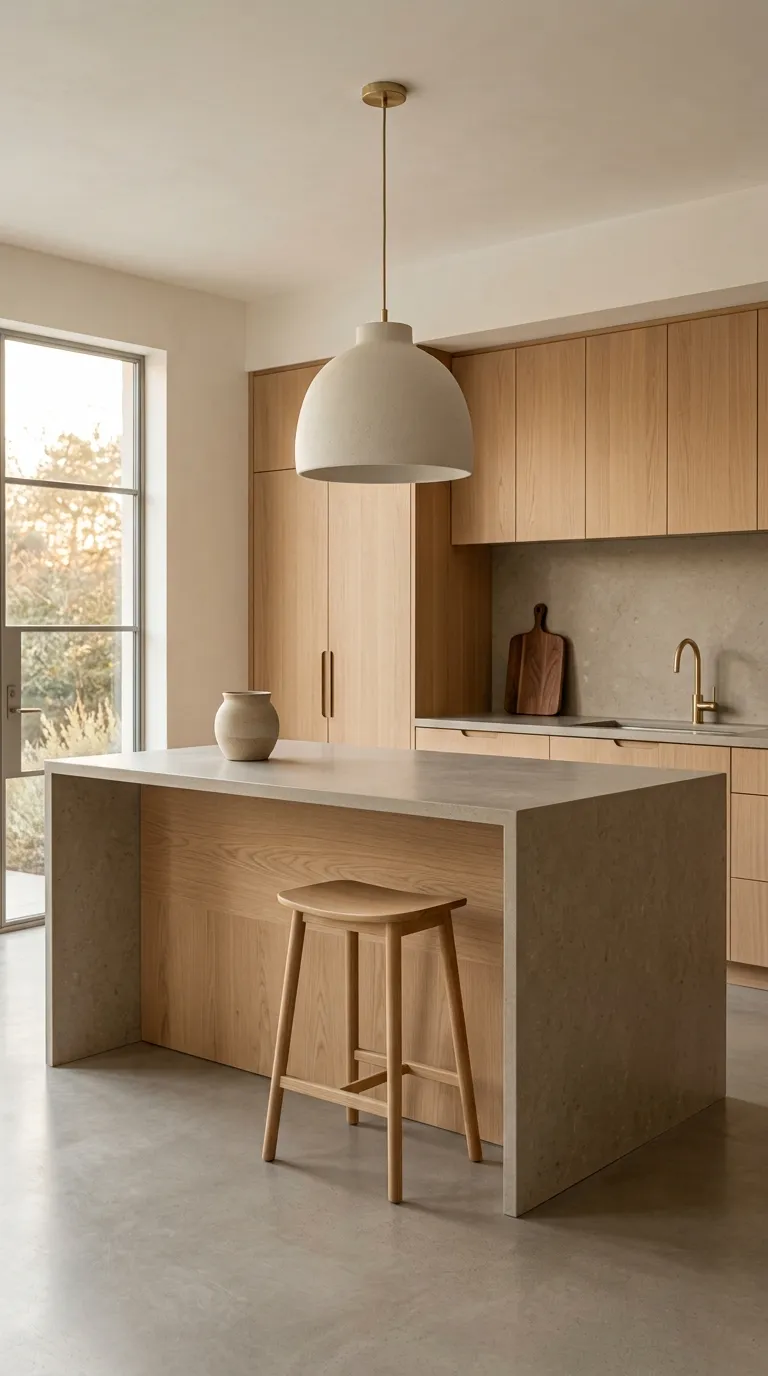
Minimalist kitchen design pares a room back to its essential materials, clean lines, and unbroken surfaces so nothing distracts from function and light. This article gives you 13 kitchen island ideas built specifically for minimal style homes, from waterfall-edge oak to sculptural pendant lighting.
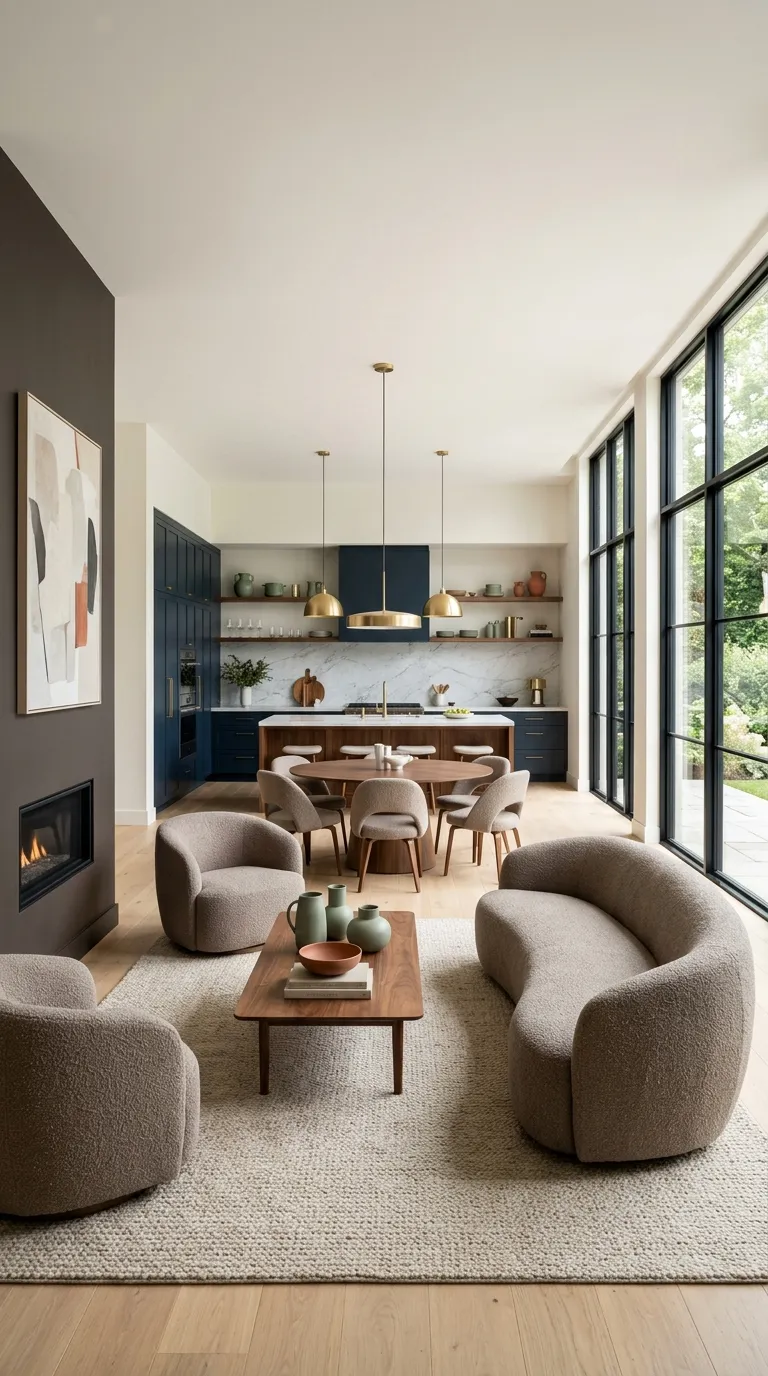
A minimalist kitchen feels quiet before it feels anything else counters cleared to bare stone, cabinetry that disappears into the wall, morning light pooling across a single slab of oak. There’s a stillness to it, an unhurried confidence that comes from restraint rather than absence. Every surface earns its place, and every material is chosen to age well and stay honest under daily use. Here are 13 ideas worth saving and stealing.
Why Minimal Style Kitchen Islands Work So Well
Minimalist design traces back to Japanese wabi-sabi principles and the mid-century modernist movement of the 1950s and 60s, later distilled by architects like John Pawson and brands like MUJI into what’s now loosely called “quiet modernism.” Unlike Scandinavian style, which layers in more texture and warmth, or industrial style, which keeps raw material exposed as a statement, minimalist kitchens prioritize unbroken lines, concealed storage, and a tightly edited material palette over decorative gesture. The kitchen island becomes the room’s single confident statement rather than one of many.
Core tones stay narrow on purpose: warm white, greige, warm charcoal, and matte black. Materials do the talking unfinished white oak, honed marble or quartz with subtle veining, brushed stainless steel, and matte lacquer slab fronts, paired with unlacquered brass or matte black hardware kept flush to the surface.
The style is trending on Pinterest alongside searches for “quiet luxury kitchen” and “Japandi kitchen island,” a natural extension of post-pandemic slow-living habits and lingering decluttering culture. People want kitchens that feel calm to cook in, not just photograph well.
Small spaces can absolutely achieve this look in fact, minimalism often reads better in a compact footprint, where a single material story is easier to control. Prioritize one hero material, hide small appliances, and resist adding a second accent color.
| Element | Value |
|---|---|
| Philosophy | Function first, decoration only where it earns its place |
| Key Materials | White oak, honed marble/quartz, brushed steel, matte lacquer |
| Key Colors | Warm white, greige, warm charcoal, matte black |
13 Kitchen Island Ideas for Minimal Style Homes
1. Waterfall-Edge Island in Unfinished White Oak
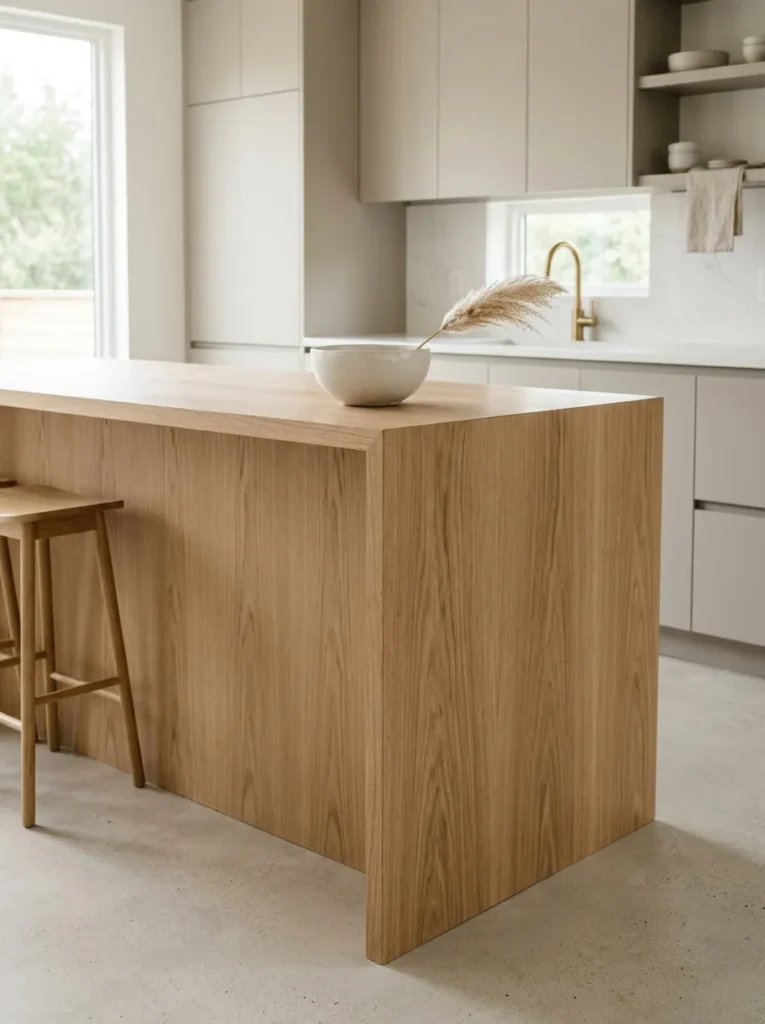
Vibe: Grounded, like the wood itself is holding the room steady.
Why it works: A waterfall edge uses continuous grain to eliminate visual seams, which reads as one solid mass rather than a countertop bolted to a base. This visual weight anchors an open-plan kitchen without adding a single decorative element. The unfinished oak also ages into a warmer patina over time, which fits minimalism’s honesty-of-material principle.
How to get it: Order a single oak slab cut long enough to wrap both the top and one full side panel, and have your fabricator miter the corner at 45 degrees so the grain lines up. Seal with a matte hardwax oil, not a glossy polyurethane, to keep the surface looking raw.
Shop the Look
- Matte hardwax oil wood finish, natural
- White oak cutting board, single slab
- Ceramic bud vase, unglazed stoneware
- Dried pampas grass stem, natural tan
- Handleless drawer pull, brushed brass flush cup
Also view: 14 Pallet Furniture Ideas for Garden Patio Style That Actually Hold Up Outdoors
2. Warm Charcoal Base with a Greige Stone Top
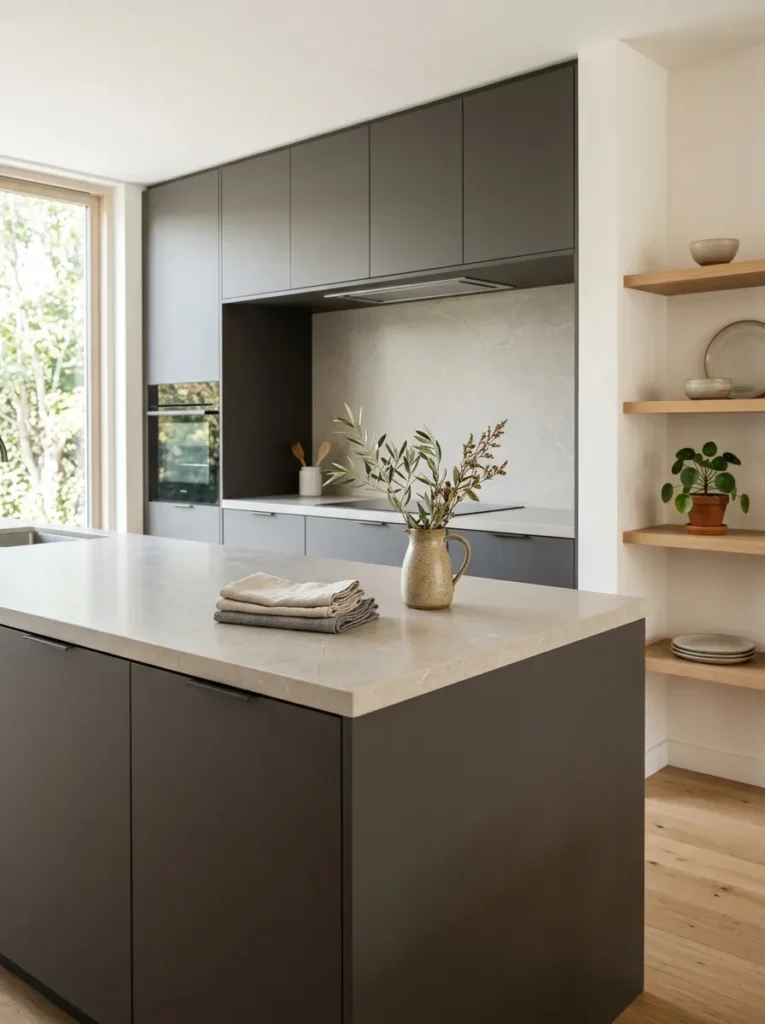
Vibe: Still, the kind of stillness that makes a bright room feel deliberate.
Why it works: Pairing a dark, matte base with a pale, honed top creates contrast without pattern, which keeps the eye calm while still giving the island visual definition against surrounding white walls. Honed (not polished) stone matters here the lack of shine keeps light diffused rather than reflected, which is central to the minimalist mood.
How to get it: Paint or order cabinetry in a warm charcoal matte lacquer, then top it with a honed quartz or marble in a warm greige with minimal veining. Keep every other surface in the kitchen white so the island stays the room’s single point of contrast.
Quick Win: Can’t replace the island? Paint just the base panels in a matte chalkboard-style charcoal for a weekend, budget-friendly version of this contrast.
Shop the Look
- Matte chalkboard-style charcoal cabinet paint
- Honed quartz countertop sample swatch
- Linen dinner napkin set, warm white
- Stoneware pitcher, unglazed matte finish
- Flush cabinet pull, matte black recessed cup
Also view: 14 Exterior House Paint Colors That Instantly Boost Curb Appeal
3. A Single Sculptural Pendant Instead of a Row of Three
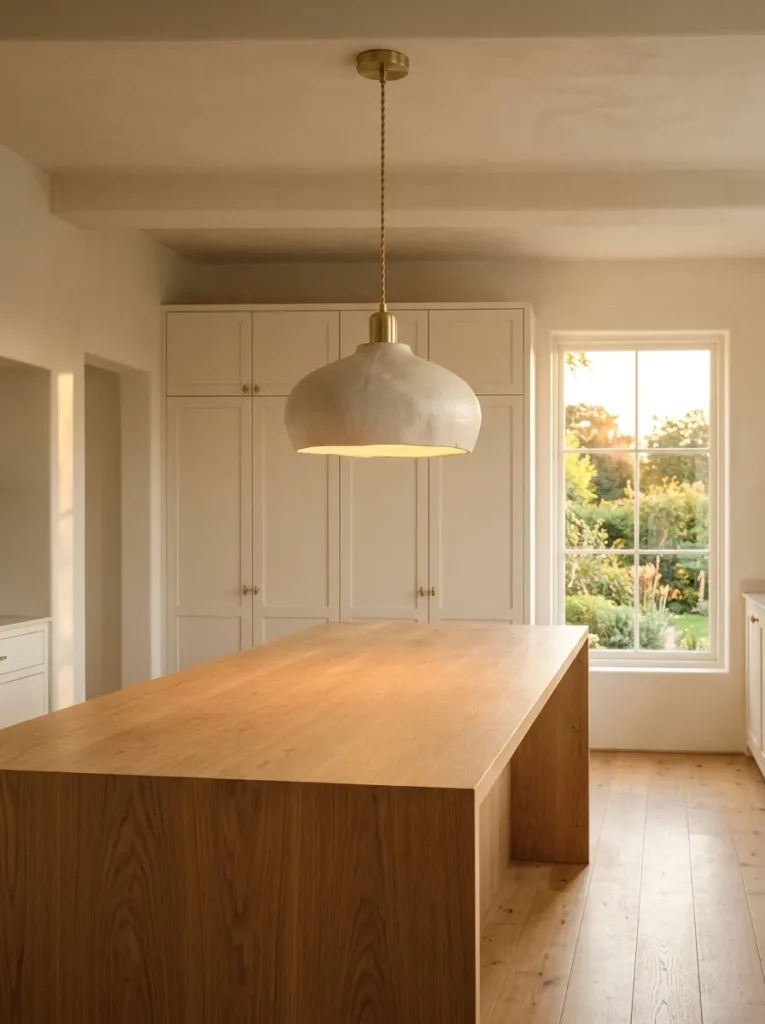
Vibe: Luminous, but quietly so one glow instead of a cluster of them.
Why it works: Minimalist rooms use negative space as a design tool, and lighting is no exception. A single oversized pendant creates one clear focal point, whereas three matching pendants introduce repetition that reads busier than intended in a pared-back room. The scale of the single fixture also lets it double as sculpture during the day.
How to get it: Choose one dome or gourd-shaped pendant in matte ceramic or frosted glass, sized roughly 16 to 20 inches wide, and hang it 30 to 34 inches above the counter, centered over the island’s midpoint rather than offset.
Shop the Look
- Matte ceramic dome pendant light, oversized
- Brushed brass ceiling canopy kit
- Dimmer switch, matte black rocker style
- Fabric-wrapped pendant cord, natural linen
- Warm white LED bulb, 2700K dimmable
Also view: 14 Home Color Combinations for Modern Style Homes
4. Slab-Front Cabinetry with Flush Integrated Pulls
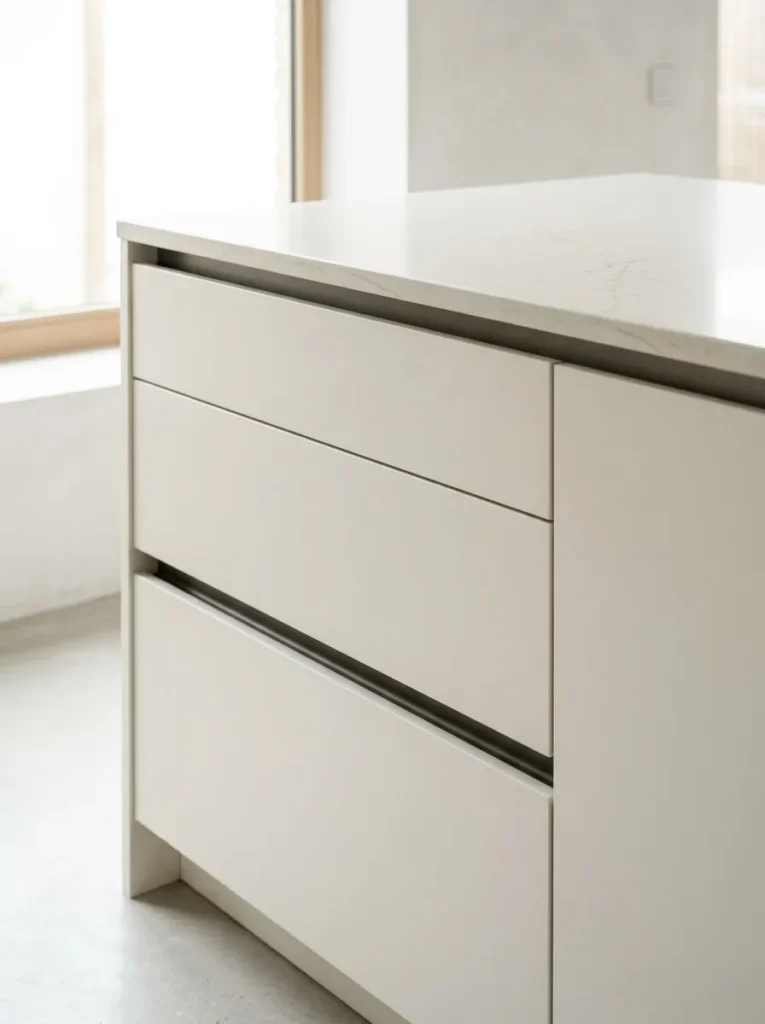
Vibe: Airy, uninterrupted, like the cabinetry has no seams at all.
Why it works: Removing visible knobs and pulls eliminates the small shadows and metal glints that fragment a flat surface visually. This is a principle of visual weight reduction the fewer interruptions on a plane, the larger and calmer it appears, even in a modest-sized kitchen.
How to get it: Specify a routed finger-pull channel along the top edge of each drawer and door front instead of applied hardware, and keep the panel material consistent one lacquer or laminate finish across the entire island, base to countertop edge.
Quick Win: Swap existing knobs for recessed edge pulls; it’s a same-day change that instantly reduces visual clutter.
Shop the Look
- Recessed edge cabinet pull, brushed nickel
- Matte lacquer cabinet panel refinishing kit
- Soft-close drawer slide hardware set
- Integrated toe-kick vent grille, matte black
- Cabinet touch-latch mechanism, push-to-open
5. A Single Ceramic Vessel Instead of a Cluster of Décor
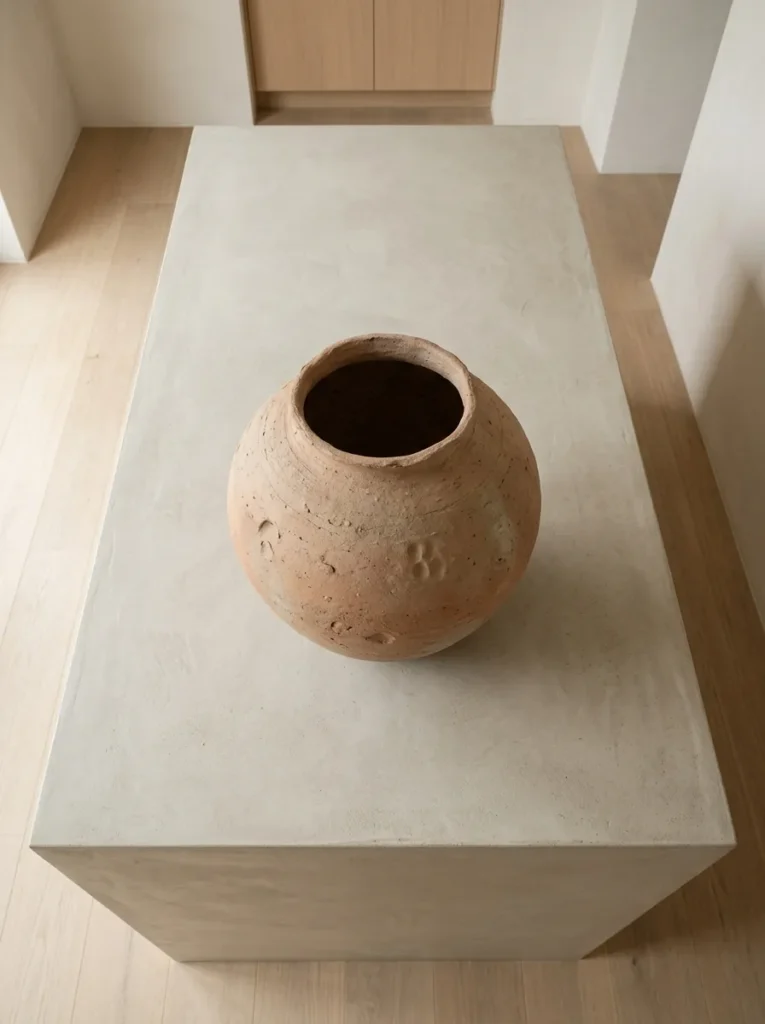
Vibe: Hushed, the way a counter feels when it’s been left alone on purpose.
Why it works: Minimalist styling relies on negative space to give the one chosen object visual authority. A cluttered vignette of three or four small items competes for attention, while a single sculptural vessel reads as intentional and gallery-like, letting the counter’s material stay visible around it.
How to get it: Choose one oversized ceramic vessel 10 to 14 inches tall in an unglazed, matte stoneware finish, and place it slightly off-center on the island rather than dead-center, which feels more natural and less staged.
Shop the Look
- Oversized unglazed stoneware vessel, matte
- Handmade ceramic bud vase, terracotta tone
- Small wood tray, unfinished ash
- Linen table runner, undyed natural
- Ceramic soap dish, matte stoneware
6. Honed Marble Countertop with Subtle Veining
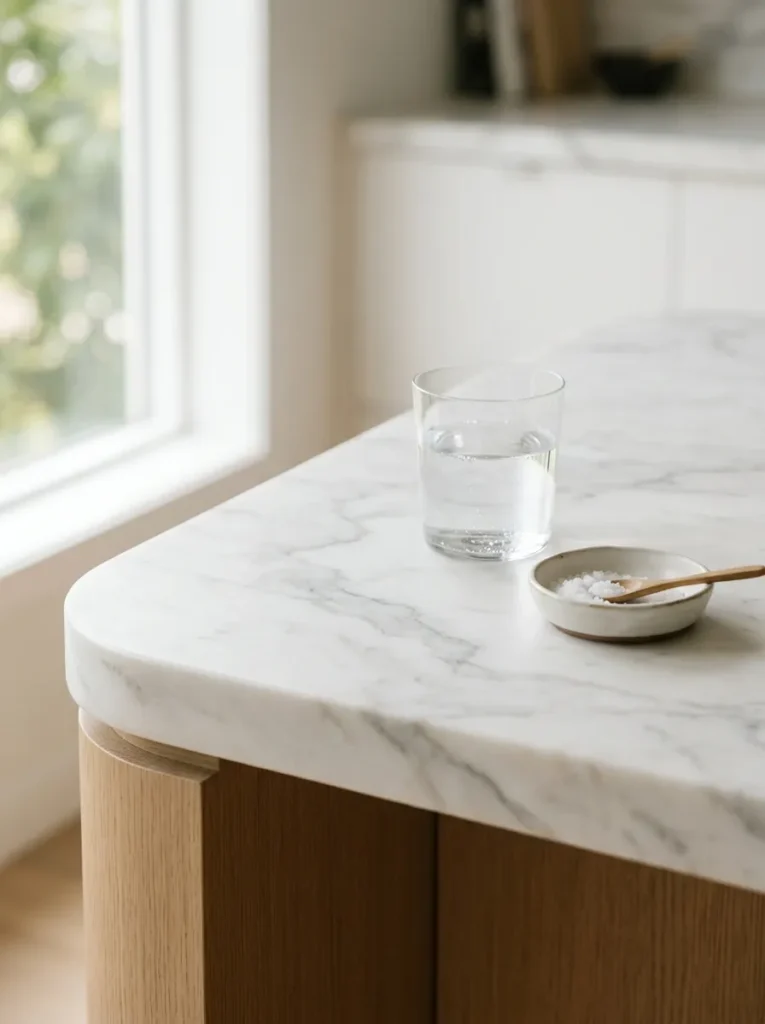
Vibe: Cool and still, like the surface itself is at rest.
Why it works: A honed (matte) finish scatters light softly across the stone rather than bouncing it in hard reflections, which keeps the surface visually quiet even under bright kitchen lighting. Subtle veining, rather than dramatic bookmatched pattern, keeps the stone from becoming a competing focal point.
How to get it: Ask your fabricator specifically for a honed not polished finish, and select a marble or quartz slab with light, thin veining rather than bold contrast veining, which reads busier once installed at full scale.
Quick Win: If full stone is out of budget, a honed quartz composite in a similar tone gives nearly the same visual calm at a lower price point.
Shop the Look
- Honed marble countertop sample, Carrara-style
- Eased-edge stone edge profile template
- Stone sealant, penetrating matte finish
- Ceramic trivet, unglazed round stoneware
- Glass tumbler set, clear ribbed minimal
7. Two-Tone Island — Light Oak Base, Black Steel Counter
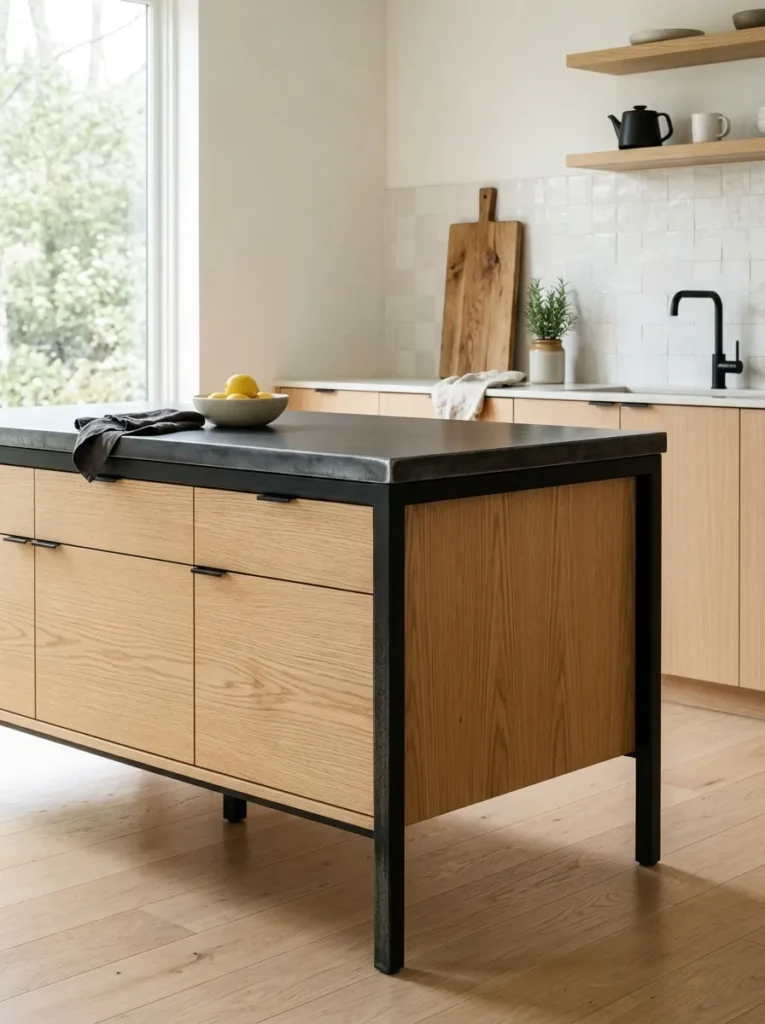
Vibe: Grounded with an edge, warm wood softened by cool steel.
Why it works: This idea uses material contrast instead of color contrast, which keeps the palette neutral while still giving the island depth. The thin black steel trim also visually lightens the island’s silhouette, since dark, slim lines read as less bulky than a solid wood mass would alone.
How to get it: Build the base in light white oak and cap the countertop edge in a thin matte black steel band, roughly half an inch thick, rather than a full steel slab top this keeps material cost lower while still delivering the contrast.
Shop the Look
- Matte black steel edge banding strip
- Light oak cabinet base panel set
- Black steel bar pull, thin profile
- Oak end-grain cutting board, rectangular
- Steel trivet, blackened matte finish
8. Under-Island Linear LED for Ambient Night Glow
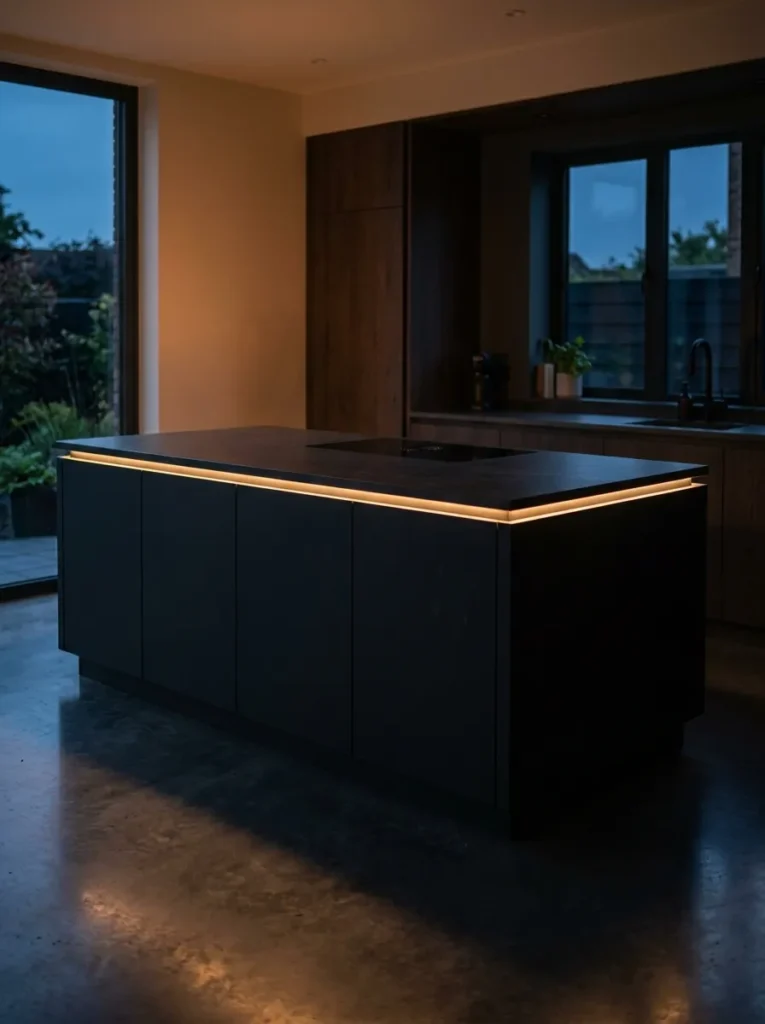
Vibe: Moody, the kitchen at its most private hour.
Why it works: Ambient under-cabinet lighting shifts the island’s visual weight downward and softens hard shadows, which is a classic technique for making a solid mass feel like it’s floating rather than sitting heavily on the floor. It also extends the room’s usability into evening hours without the harshness of overhead light.
How to get it: Install a warm-white, 2700K linear LED strip in a recessed channel along the underside of the island’s overhang, wired to its own dimmer switch separate from the main kitchen lighting circuit.
Quick Win: Battery-powered LED strips with adhesive backing achieve the same glow in under an hour with no electrician needed.
Shop the Look
- Warm white LED strip light, 2700K
- Recessed aluminum LED channel, low profile
- Wireless dimmer switch, battery operated
- Adhesive-backed LED tape, dimmable
- Low-voltage LED driver, plug-in
9. Backless Oak Counter Stools with Negative Space Beneath
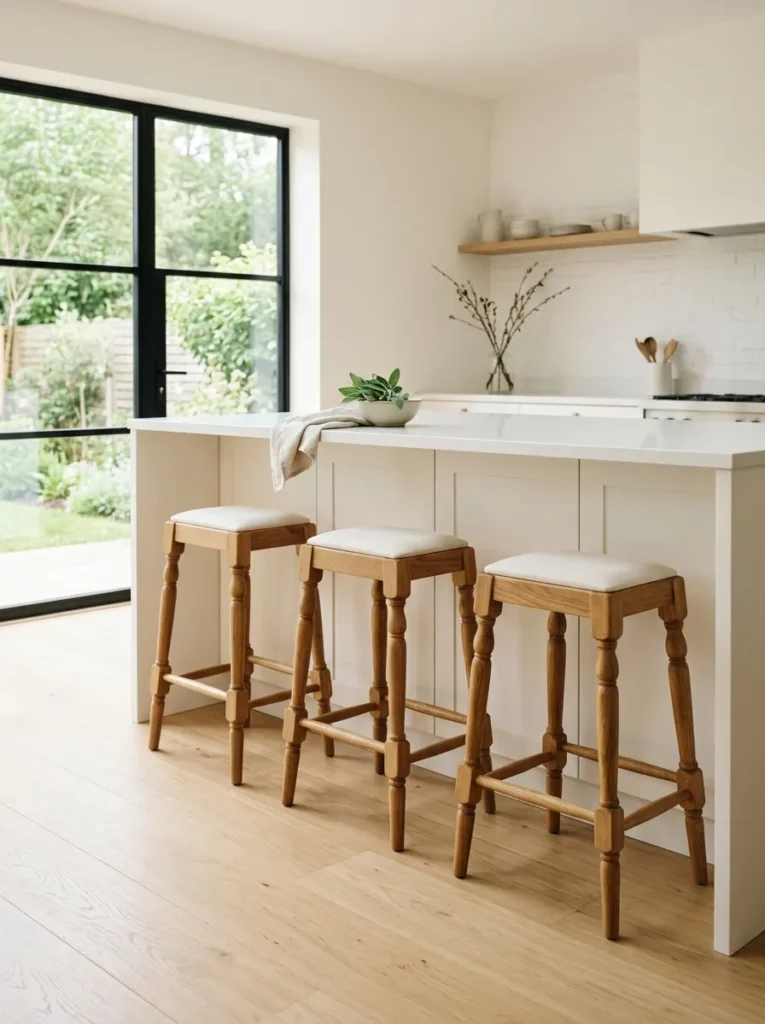
Vibe: Airy, letting the floor breathe beneath the seating.
Why it works: Backless stools with slim, turned legs create open sightlines to the floor, which prevents the island area from feeling boxed in a common issue when bulky, backed stools crowd the base. This use of negative space is a core minimalist technique for making a small footprint feel larger.
How to get it: Choose stools with a seat height matched precisely to your counter (typically 10 to 12 inches of clearance) and legs no thicker than an inch and a half, in the same wood tone as your island for visual continuity.
Shop the Look
- Backless oak counter stool, turned legs
- Wool felt seat pad, natural undyed
- Floor protector pads, clear adhesive
- Oak bar stool footrest ring
- Slim brass stool foot cap set
10. Ceramic Fruit Bowl and Wood Board as a Sculptural Duo
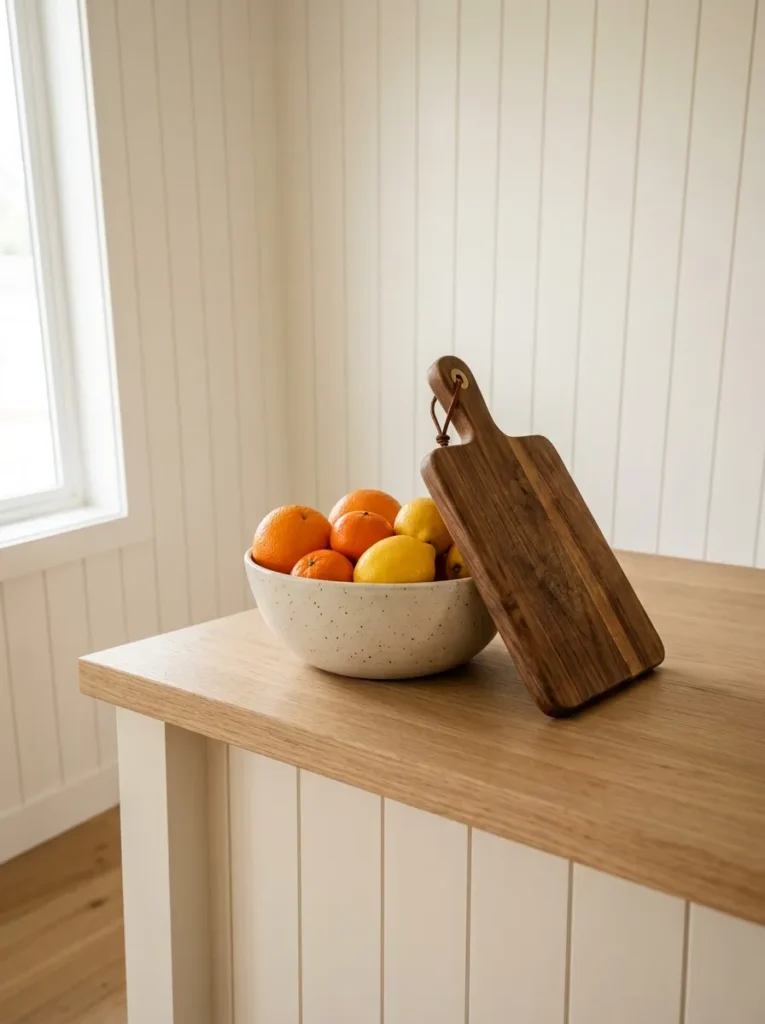
Vibe: Warm, a small everyday ritual made visible.
Why it works: Pairing one functional object (a cutting board) with one decorative-but-usable object (a fruit bowl) keeps styling purposeful rather than purely ornamental, which fits minimalism’s function-first philosophy. The warm wood tone and citrus color also introduce the room’s only pop of color without adding actual decor.
How to get it: Lean a walnut or oak end-grain board vertically against the backsplash rather than laying it flat, and set one matte ceramic bowl beside it filled with two or three pieces of fruit resist filling it completely.
Quick Win: Rotate the fruit for citrus in winter and stone fruit in summer to keep the color story seasonal without adding new décor.
Shop the Look
- Walnut end-grain cutting board, standing
- Matte ceramic fruit bowl, wide shallow
- Board stand, minimal wire frame
- Citrus knife, wood handle small
- Linen produce bag, undyed cotton
11. Brushed Stainless Steel Island for an Industrial-Minimal Hybrid
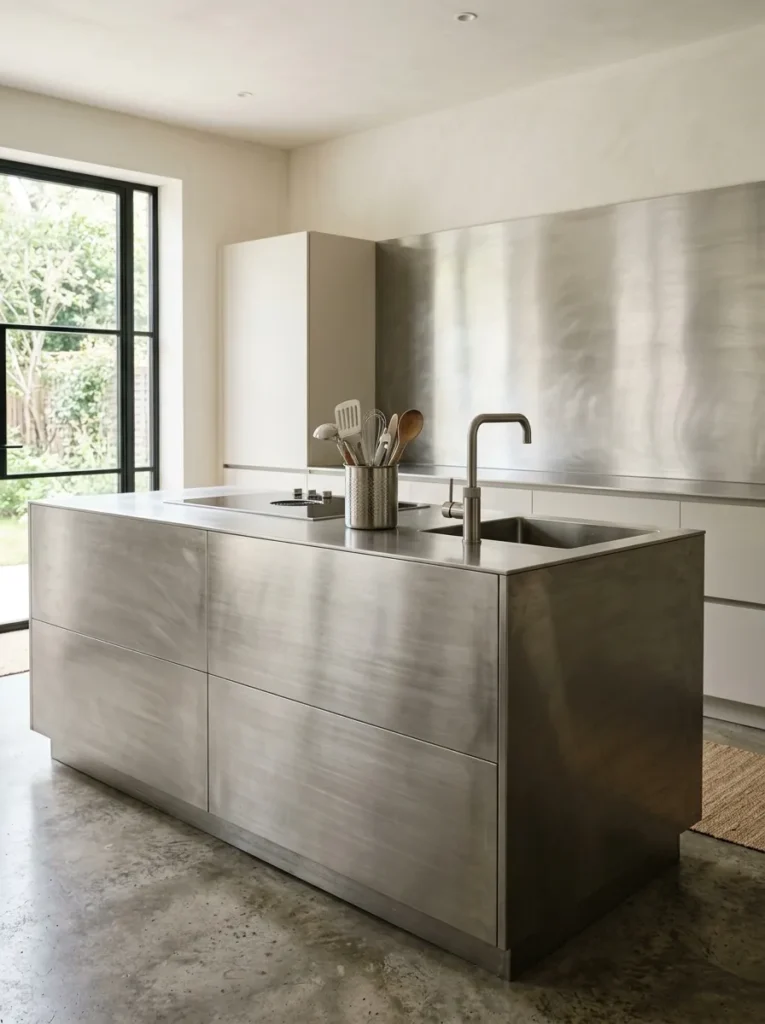
Vibe: Cool and precise, a working surface that looks like one.
Why it works: Brushed (not mirror-polished) stainless steel diffuses light the same way honed stone does, keeping the surface from becoming reflective and distracting. Its association with professional kitchens also reinforces the function-over-decoration principle at the heart of minimalism, while the material itself is durable enough for daily heavy use.
How to get it: Specify a brushed, not polished, steel finish with a fine directional grain, and keep the surrounding cabinetry in a matching or complementary matte white so the steel reads as material choice rather than a design statement.
Shop the Look
- Brushed stainless steel utensil crock
- Steel cleaning polish, streak-free formula
- Stainless steel trivet, brushed finish
- Steel bar cart shelf, brushed
- Magnetic steel knife strip, wall mount
12. Island as the Sole Zone Divider in an Open-Plan Kitchen
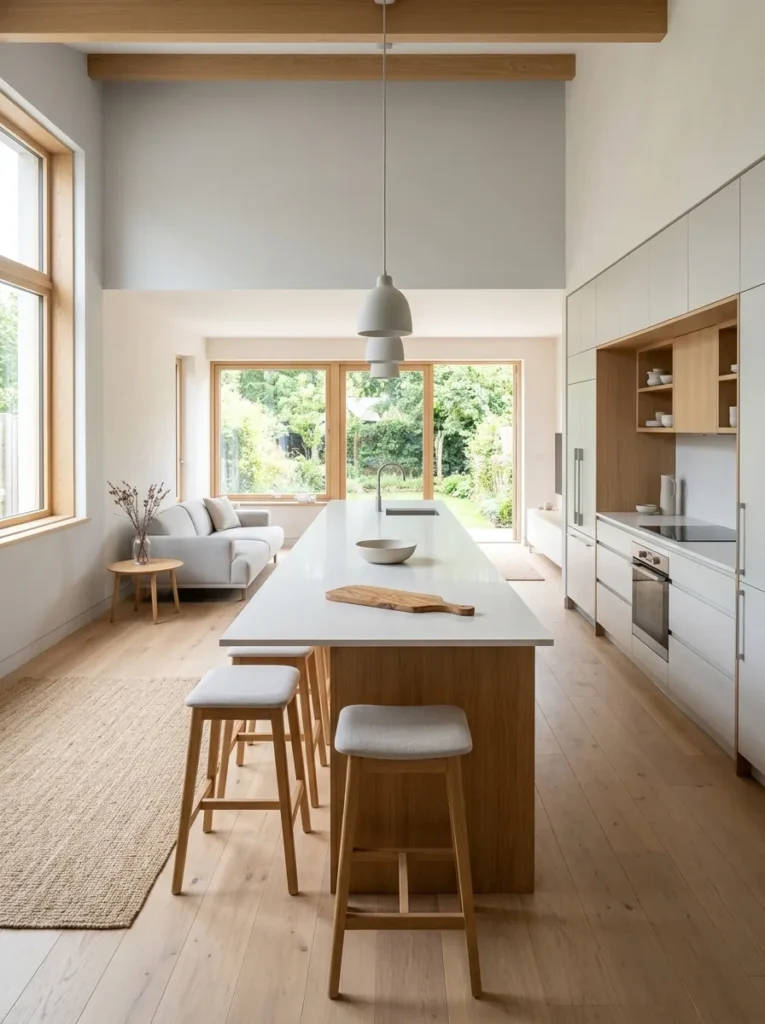
Vibe: Serene, a room that flows instead of stopping.
Why it works: In minimalist layouts, the island is often the only piece of furniture allowed to define a zone, replacing walls, rugs, or shelving units that would otherwise fragment the space visually. Keeping a minimum of 42 inches of clearance on all sides maintains the open, unobstructed sightlines that make the layout feel calm rather than cramped.
How to get it: Measure your walkway space before ordering aim for at least 42 inches of clearance between the island and any surrounding counters or walls, and choose a single rectangular island shape rather than an L-shape, which tends to fragment open-plan flow.
Shop the Look
- Measuring tape, kitchen-planning long reach
- Low-profile bar stool, stackable minimal
- Floor transition strip, matte aluminum
- Area rug, low-pile natural jute
- Furniture floor glides, felt bottom
13. A Slim Rolling Cart Island for Small Minimalist Kitchens
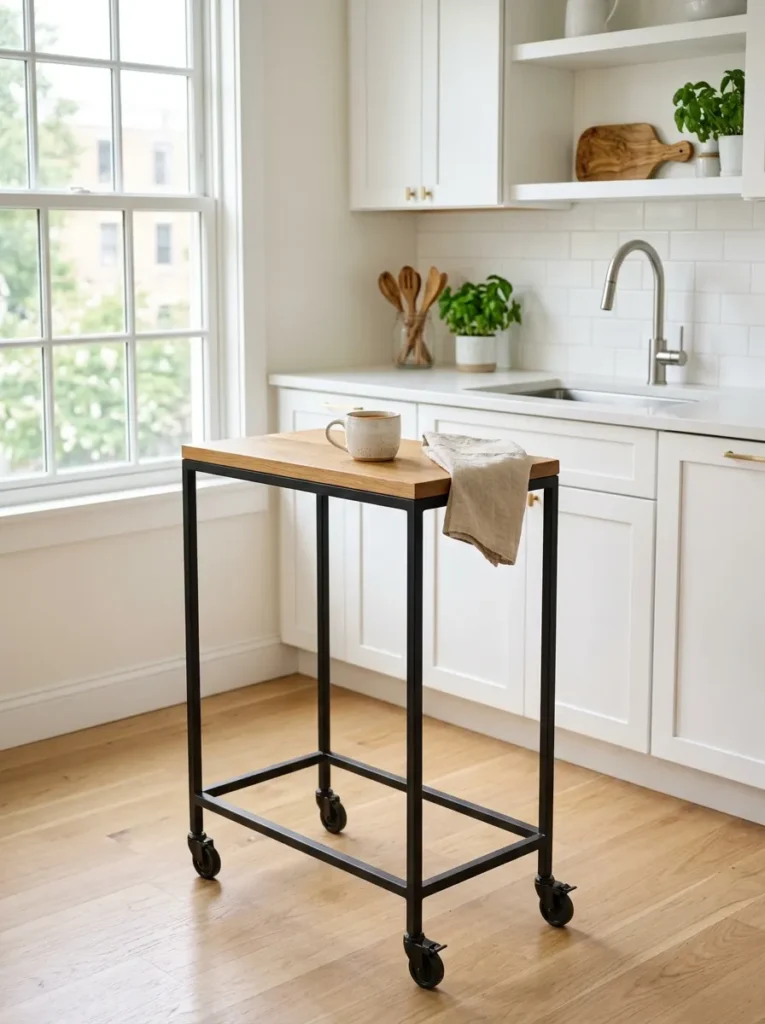
Vibe: Light on its feet, literally and visually.
Why it works: A rolling cart delivers island-style prep space and storage without committing a small kitchen’s floor plan to a fixed, oversized piece. Its slim steel frame and open shelving keep sightlines to the floor intact, which is essential in tight footprints where visual bulk reads as clutter fast.
How to get it: Choose a cart no wider than 18 to 24 inches with locking caster wheels, an oak or steel top, and open shelving rather than closed cabinets, so it can tuck against a wall when not in active use.
Quick Win: Look for a cart with a fold-down leaf it doubles your prep surface only when you need it, then collapses back to a slim footprint.
Shop the Look
- Slim rolling kitchen cart, locking casters
- Oak cart top, fold-down leaf style
- Ceramic mug, matte stoneware neutral
- Linen kitchen towel, undyed natural
- Small utility hook set, matte black
How to Start Your Minimalist Kitchen Transformation
Start with your island’s countertop material, not its color. A single honed quartz or white oak surface anchors every other decision cabinet tone, hardware finish, even stool selection so choosing it first prevents the mismatched patchwork that happens when paint or decor gets picked before the hero surface.
The most common mistake is over-decorating the counter once it’s finally clear. A newly minimalist island often gets filled right back up with small appliances, mail, and knickknacks within weeks. Fix it by giving every object a “home” inside a drawer or cabinet before it ever touches the countertop, and allow only one styled vignette to remain visible.
Three items under $50 that create immediate impact: a matte stoneware fruit bowl, a single stem of dried pampas grass in an unglazed ceramic bud vase, and a set of flush recessed cabinet pulls to replace bulky knobs.
A full island transformation new countertop, cabinetry refinish, and lighting typically takes four to eight weeks and runs from $2,000 for a budget refresh to $12,000 or more for stone and custom millwork. A weekend can achieve the styling and hardware swap alone; the material changes take longer and are worth the wait.
Frequently Asked Questions About Minimal Style Kitchen Islands
What’s the difference between a minimalist kitchen island and a Scandinavian one?
A minimalist island prioritizes an unbroken material and a single hero surface, while Scandinavian style layers in more texture — think wool, rattan, and painted wood alongside the stone or oak. Minimalism also tends to hide hardware entirely, whereas Scandinavian kitchens often feature visible black or brass pulls as a small design accent. Both share a light color base, but Scandinavian rooms carry more visual texture overall.
What color should a minimalist kitchen island be?
Warm white, greige, and warm charcoal are the most common choices, often paired as a two-tone base and top rather than a single flat color. Pure white can feel clinical in a minimalist context, so designers usually lean toward a slightly warmer off-white like an ivory or oat tone instead. Matte black or charcoal works well as a grounding accent on roughly a third of the island’s surface area.
How much does a minimalist island renovation cost?
A budget refresh — new hardware, paint, and countertop resurfacing — typically runs $1,500 to $3,000. A full rebuild with white oak cabinetry and a honed stone top generally falls between $6,000 and $15,000, depending on the island’s size and whether plumbing or electrical work is involved. Choosing quartz over natural marble can cut the countertop cost by roughly 20 to 30 percent.
Does a minimalist island work with an older or traditional home?
Yes, though it works best when the island is treated as one deliberate contrast point rather than an attempt to erase the home’s existing character. Pairing a clean-lined oak or matte lacquer island with original trim, moldings, or exposed beams often reads as more interesting than a fully matched minimalist kitchen. The key is keeping the island’s lines simple even if the rest of the room isn’t.
What’s the most important lighting choice for a minimalist kitchen island?
A single, well-scaled pendant light matters more than any other lighting decision, since it’s usually the room’s only visible fixture. Sizing it too small is the most common error — a pendant should measure roughly one-third the width of the island itself to read as intentional rather than accidental. Warm white bulbs at 2700K keep the glow consistent with the style’s overall warmth.
Ready to Create Your Dream Minimalist Kitchen?
From waterfall-edge oak to a single sculptural pendant, these 13 ideas cover the full range of color, material, lighting, and layout choices that make a minimalist island feel intentional rather than empty. You don’t need to tackle all of it at once swapping one detail at a time is exactly how this style is meant to come together.
Start today by clearing your island counter down to a single object and living with that stillness for a week before adding anything back. Once the room settles into its rhythm, you’ll notice the calm follows you into how you cook, gather, and end the day in that space. Save the ideas that spoke to you most, and start building your own quiet, honest kitchen one material at a time.