13 Vintage Grandma House Ideas That Feel Like a Warm Hug
Grandmillennial style is the layered, nostalgic look that mixes chintz florals, needlepoint, and heirloom furniture with a fresh, livable edit. This article walks through 13 vintage grandma house ideas covering color, materials, lighting, furniture, and layout.
The feeling is unmistakable: soft afternoon light through lace curtains, the smell of something baking, a chair that’s been sat in for forty years and somehow still fits your body perfectly. It’s cluttered in the way a life well-lived is cluttered never staged, always specific. There’s a stillness to it, a sense that nothing here was bought to impress anyone. Here are 13 ideas worth saving and stealing.
Why Vintage Grandma House Works So Well
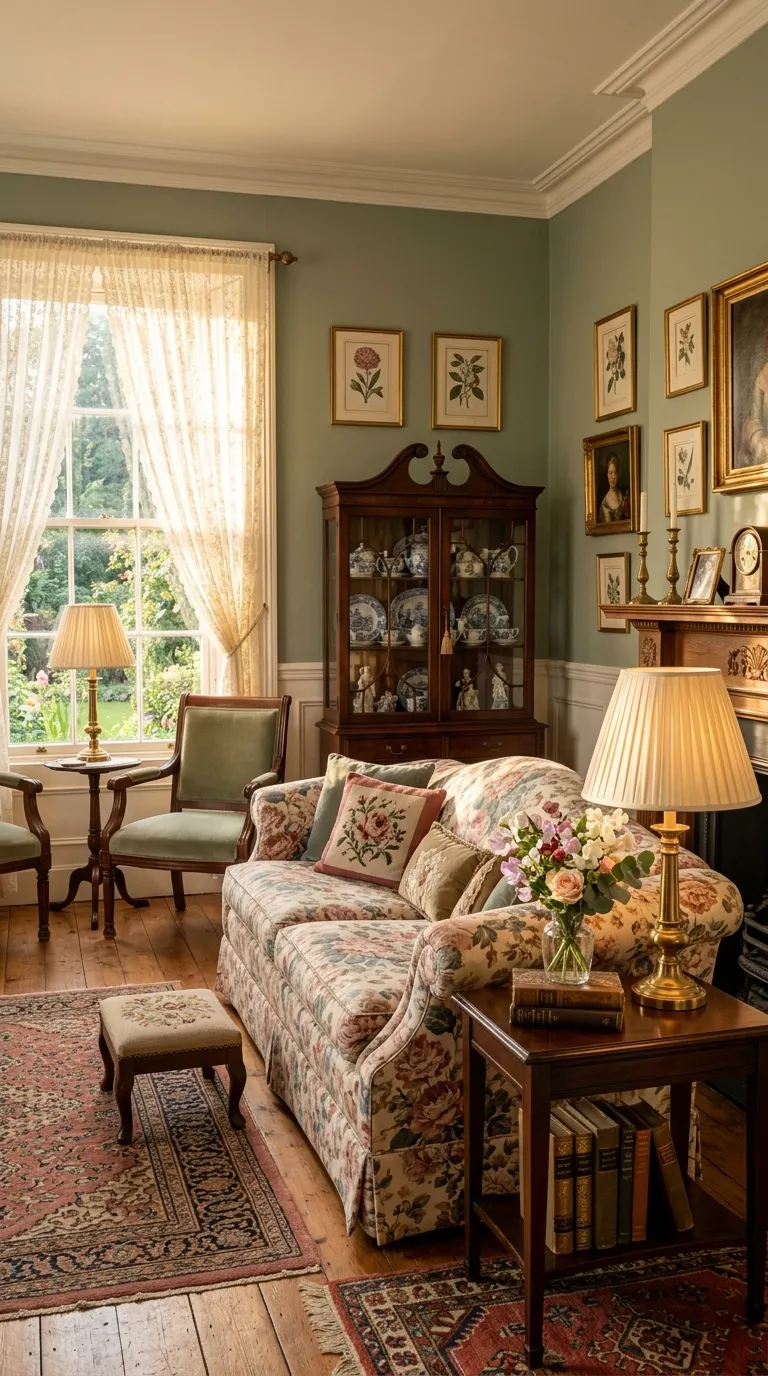
Grandmillennial design pulls from mid-century American and English cottage interiors the china cabinets, floral chintz, and needlepoint pillows found in homes decorated between the 1960s and 1980s, filtered through a millennial eye that keeps the sentimentality but edits the clutter. It’s distinct from full-on shabby chic because it isn’t distressed or precious; pieces look used, loved, and slightly imperfect on purpose.
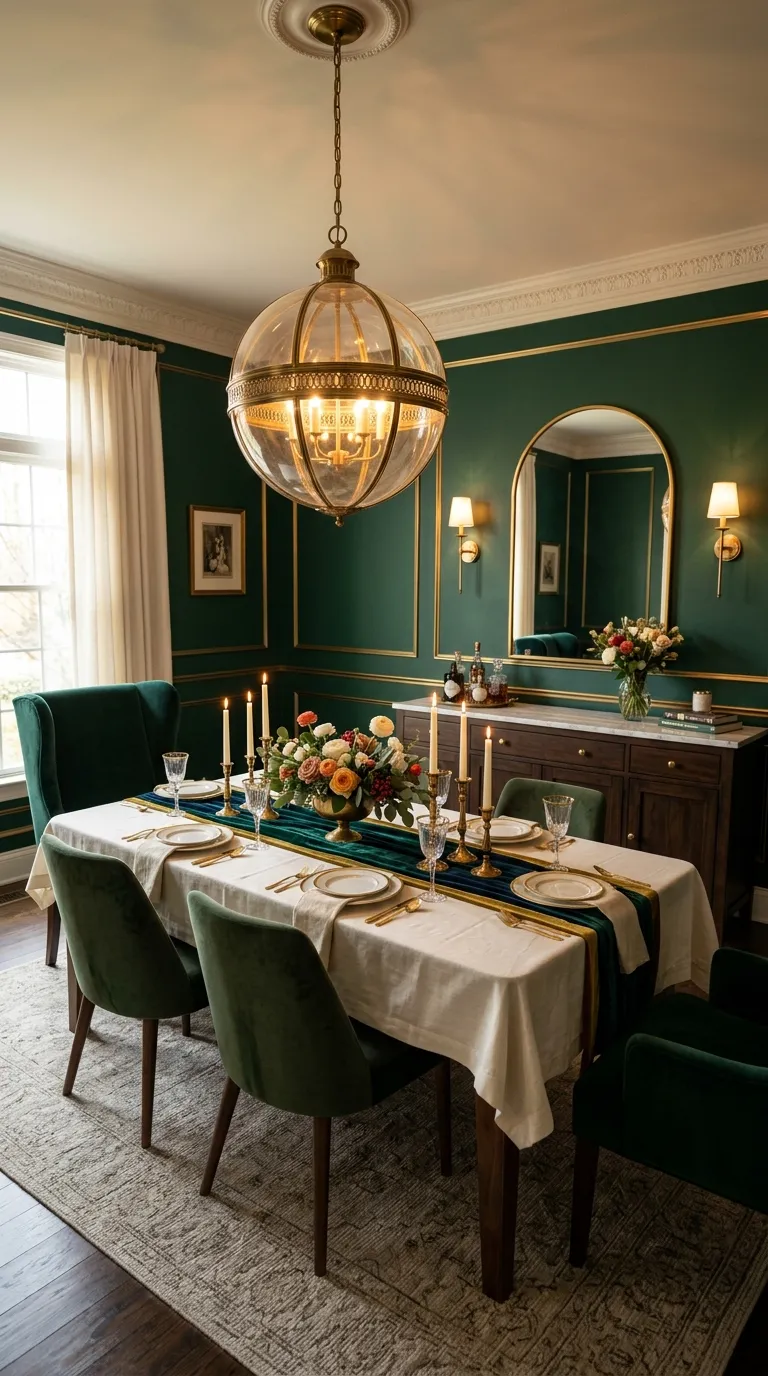
The palette leans dusty rose, sage green, buttercream, faded cornflower blue, and warm brass. Materials are tactile and specific: mahogany and cherry wood, chintz cotton, needlepoint wool, ruffled cotton trim, and hand-painted ceramic. Nothing here is glossy or industrial everything has some give to it.
The trend surged as a reaction to a decade of stark minimalism and gray open-concept builds. Pinterest search data shows steady growth in “grandmillennial” and “coastal grandmother” searches, and the pandemic-era return to slower, homier living gave people permission to bring back their grandmothers’ china instead of hiding it.
Small spaces can absolutely pull this off, but they need editing discipline. Prioritize one strong pattern (a wallpaper or a chintz sofa) and let everything else stay quieter, or the room tips into visual noise instead of warmth.
| Element | Philosophy | Key Materials |
|---|---|---|
| Core Value | Nostalgic maximalism, “new traditional” | Chintz cotton, needlepoint wool |
| Color Approach | Soft, dusty, faded tones | Mahogany, cherry wood, brass |
| Feeling | Lived-in, layered, personal | Lace, ruffled trim, ceramic |
13 Vintage Grandma House Ideas
1. A Chintz Floral Wallpaper Accent Wall
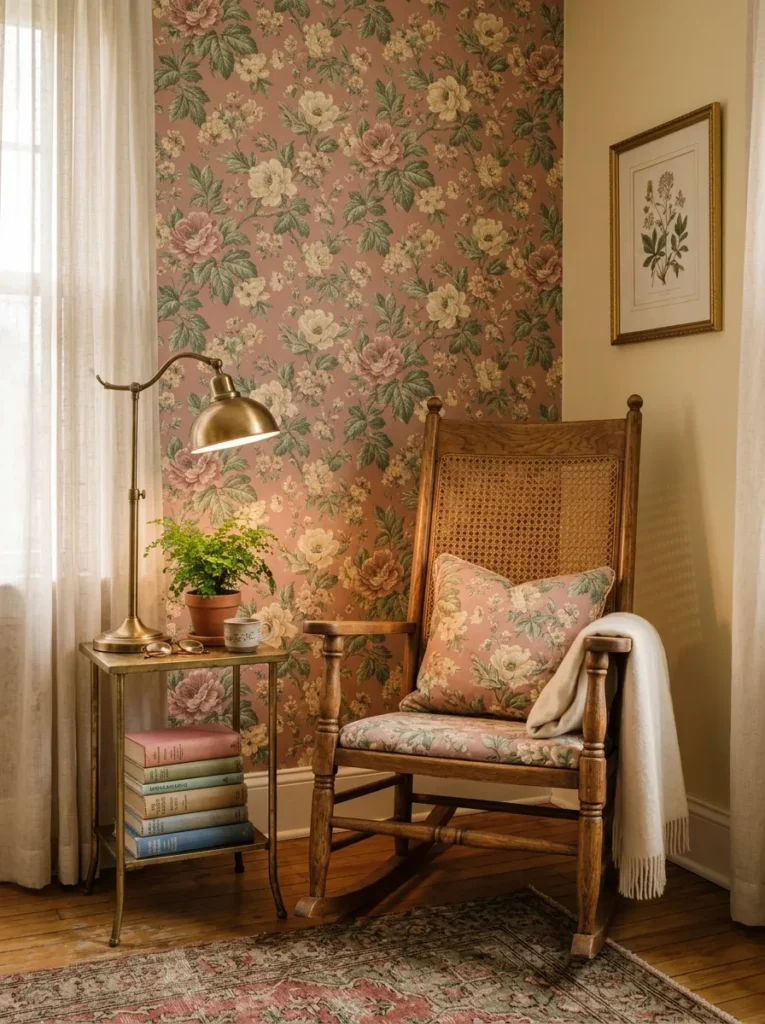
Vibe: hushed, like stepping into a room that’s been quietly loved for decades.
Why it works: wallpaper with a dense floral repeat creates visual weight in a small area without needing extra furniture, and the muted dusty rose and sage keep it from feeling loud. Pattern layering is the core principle here the busy print reads as calm because the color values stay close together rather than high-contrast.
How to get it: choose a wallpaper with a tone-on-tone floral (values within two shades of each other) rather than a high-contrast print, and apply it to just one wall ideally the one behind a bed headboard or reading chair so the pattern has a frame instead of overwhelming the whole room.
Quick Win: Removable chintz-print wallpaper panels let you test the look on a single wall for under $60 before committing to a full room.
Shop the Look
| Product |
|---|
| Chintz floral peel-and-stick wallpaper roll |
| Caned bentwood rocking chair vintage style |
| Brass articulating reading lamp |
| Cloth-bound decorative book set |
| Sage green velvet throw pillow cover |
2. Needlepoint and Chintz Upholstery Mixing
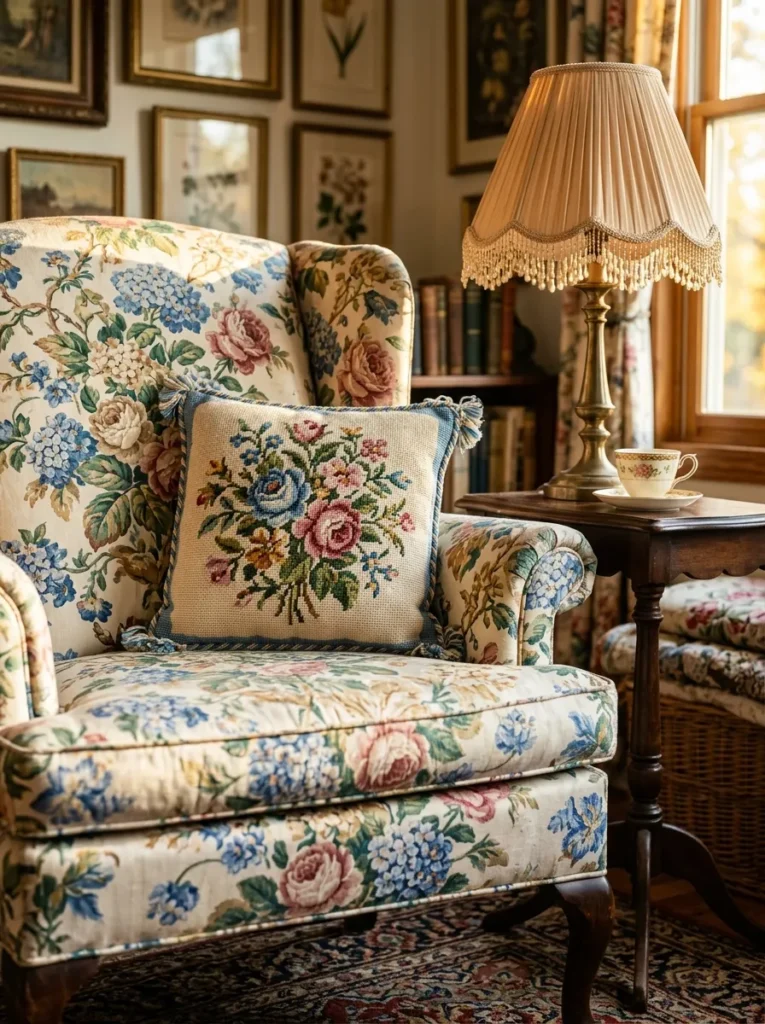
Vibe: layered, the kind of room where every texture tells you to slow down.
Why it works: mixing a large-scale chintz print with a small-scale needlepoint pattern uses proportion contrast the eye needs one bold statement and one intimate detail to read as intentional rather than mismatched. The wool texture of needlepoint against smooth cotton chintz adds tactile depth.
How to get it: reupholster one hero chair in a chintz floral, then add exactly one needlepoint pillow with a smaller, tighter pattern like a botanical or trellis motif so the scales don’t compete.
Shop the Look
| Product |
|---|
| Chintz floral upholstery fabric by the yard |
| Vintage-style needlepoint botanical throw pillow |
| Fringed linen lampshade for table lamp |
| Small brass and glass side table |
| Hand-painted porcelain teacup and saucer set |
3. Warm Brass Sconces Instead of Overhead Light
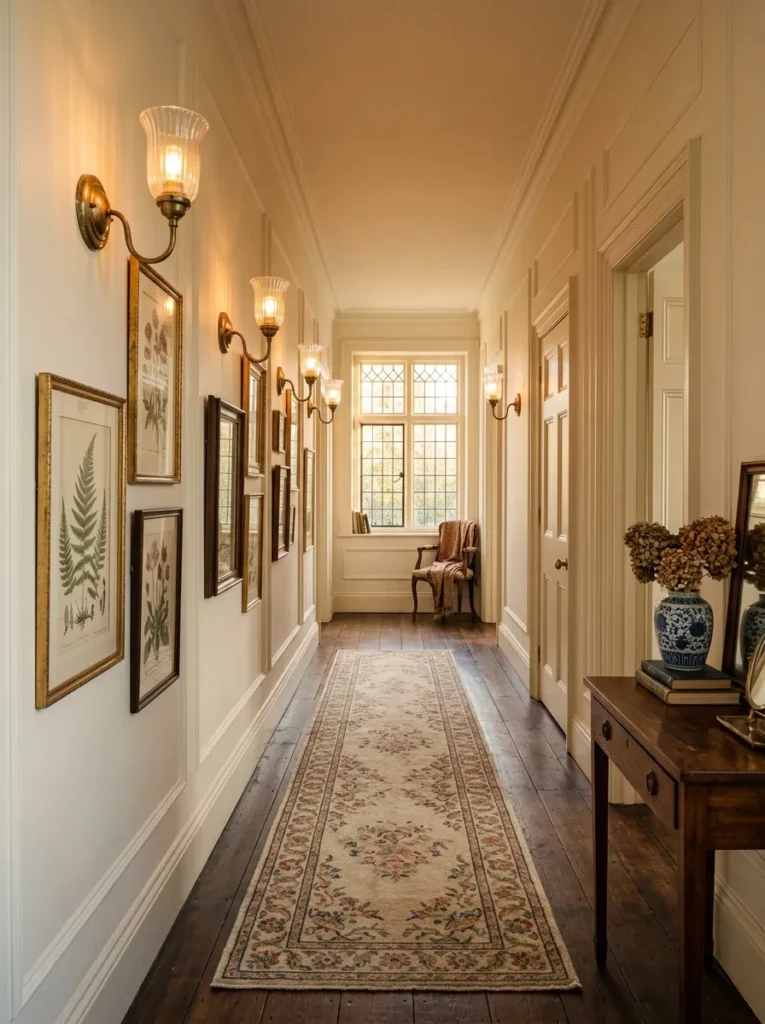
Vibe: romantic, like the light itself has been aged by decades of evenings.
Why it works: overhead lighting flattens a room and reads as clinical, while wall-mounted sconces create pools of warm light at eye level, which is how grandmother-era homes were actually lit before recessed lighting became standard. This is a light behavior principle light sources at human height read as cozier than light from above.
How to get it: swap a hallway or living room overhead fixture for two or three brass sconces with warm 2700K bulbs and fluted or ribbed glass shades, spaced roughly six feet apart.
Quick Win: Plug-in sconces with a cord cover kit avoid rewiring entirely and can be installed in an afternoon for under $45 each.
Shop the Look
| Product |
|---|
| Brass fluted glass wall sconce set of two |
| Plug-in wall sconce with cord cover kit |
| Warm white 2700K vintage-style bulbs |
| Faded floral runner rug with border |
| Framed vintage botanical print set |
4. A Mahogany Claw-Foot Furniture Anchor
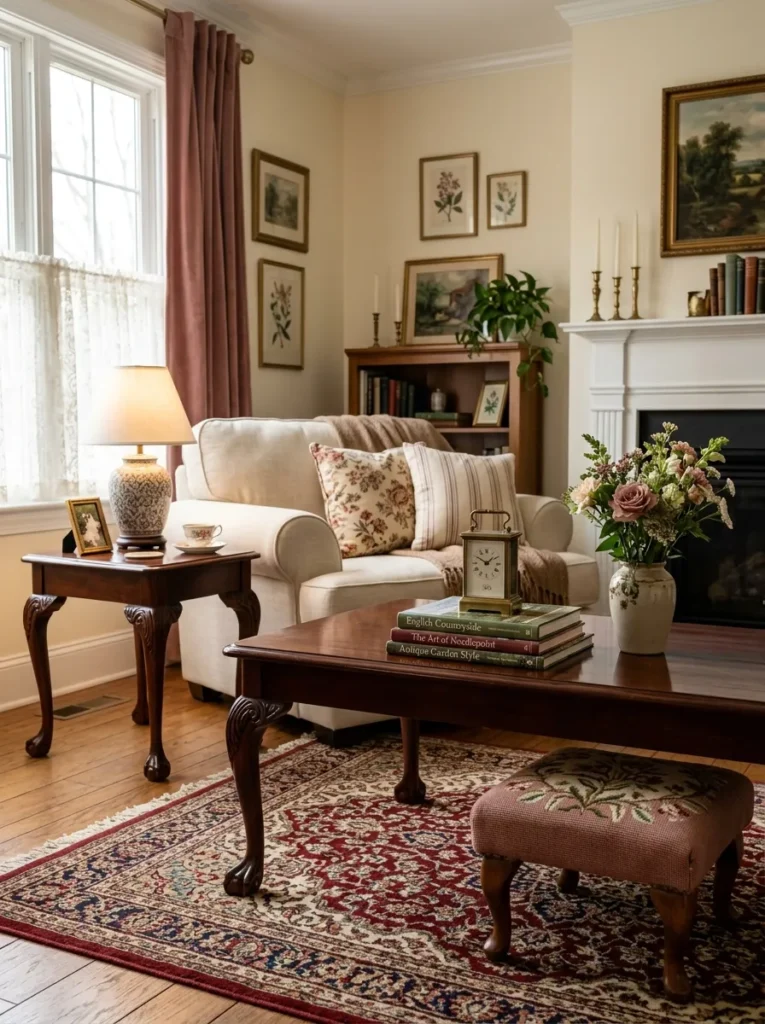
Vibe: still, the way a room settles once one substantial piece anchors it.
Why it works: a dark wood claw-foot piece adds visual weight low to the ground, which balances busier upholstery and wallpaper above it. This is a proportion principle a heavy, grounded silhouette keeps a pattern-rich room from feeling like it’s floating.
How to get it: source a single mahogany or cherry wood claw-foot coffee table (secondhand shops and estate sales are the most authentic route) and keep the rest of the wood tones in the room lighter so the dark piece reads as intentional contrast rather than clutter.
Shop the Look
| Product |
|---|
| Mahogany claw-foot coffee table vintage style |
| Matching mahogany side table |
| Needlepoint upholstered footstool |
| Small brass mantel clock |
| Vintage hardcover book bundle by color |
5. A Curated China Cabinet Display
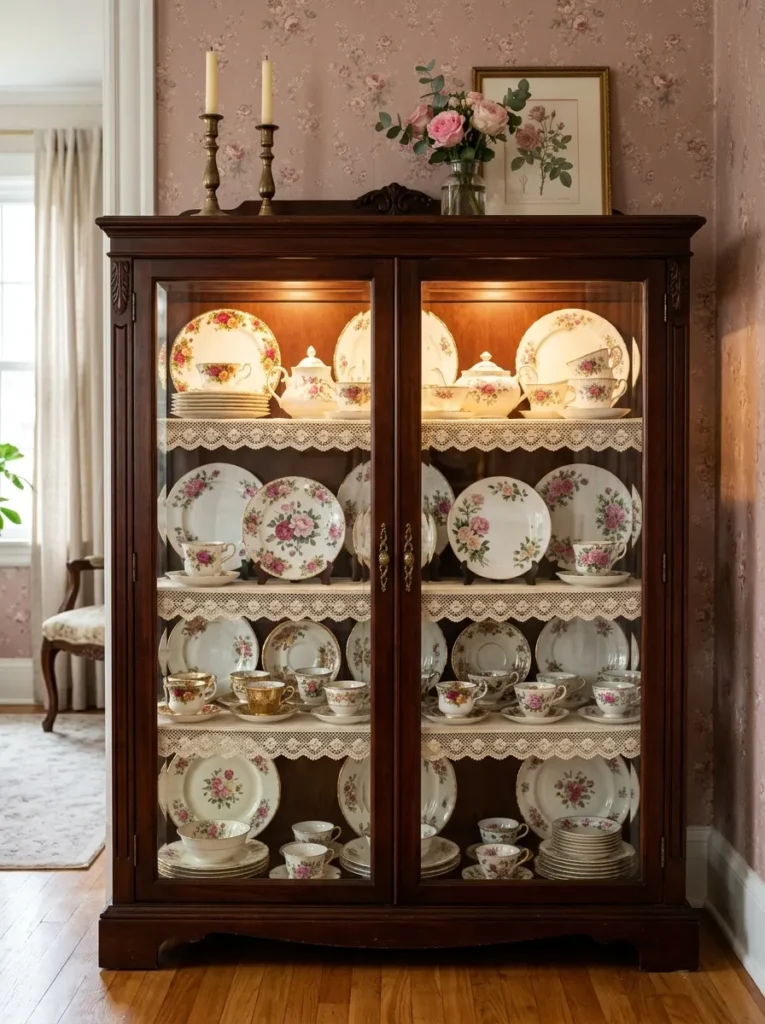
Vibe: sun-warmed, like an heirloom collection finally getting its own stage.
Why it works: a glass-front cabinet turns collected objects into a display rather than clutter by using negative space grouping pieces by color family with visible breathing room between them lets the eye rest instead of scanning chaos.
How to get it: arrange china by color rather than by set (all the rose-toned pieces together, all the sage-toned pieces together), and leave at least two inches of empty shelf space around each grouping so the collection reads as curated.
Quick Win: A secondhand glass-front cabinet under $150 instantly creates a focal point even before it’s filled.
Shop the Look
| Product |
|---|
| Mahogany glass-front china display cabinet |
| Floral hand-painted porcelain plate set |
| Brass taper candlestick pair |
| Lace-edge shelf liner roll |
| Small ceramic teacup and saucer collection |
6. A Dusty Rose and Sage Green Color Palette
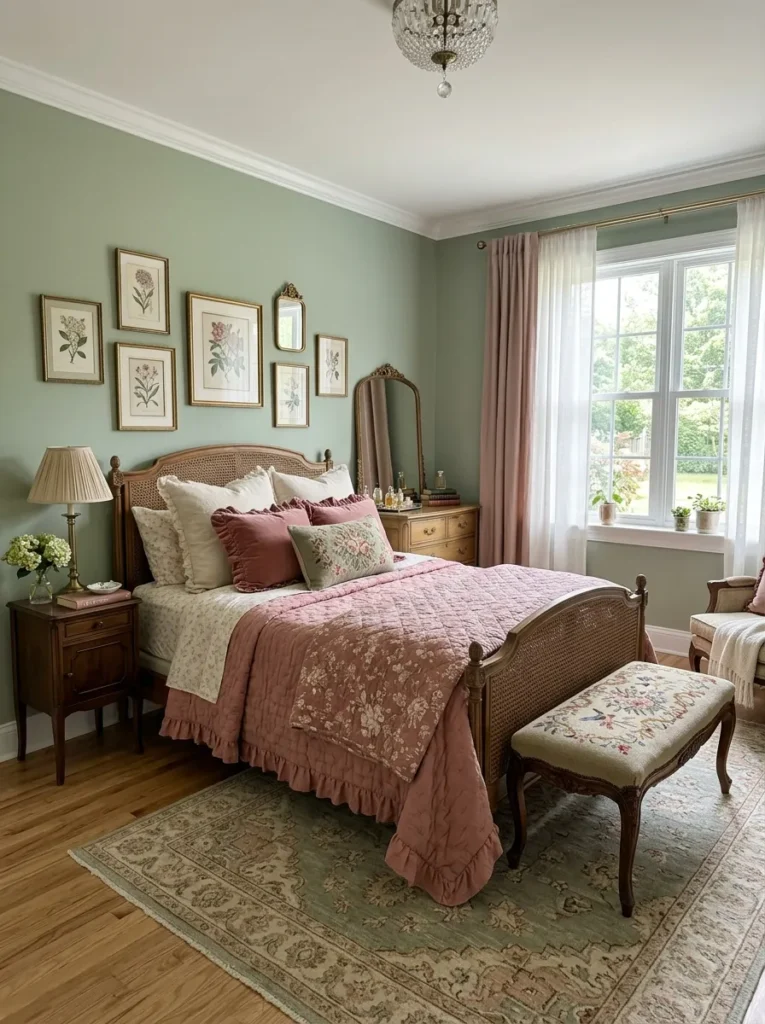
Vibe: luminous, the calm kind that comes from colors that don’t fight each other.
Why it works: sage and dusty rose sit close together in saturation and value, so they read as a cohesive family rather than clashing a color harmony principle where muted tones of roughly equal intensity feel restful together no matter how much pattern is layered on top.
How to get it: paint walls in a matte sage green like Sherwin-Williams Clary Sage or a comparable muted green, then bring in dusty rose through textiles only bedding, curtains, or a slipper chair so the color feels intentional rather than matched from a paint chip.
Shop the Look
| Product |
|---|
| Ruffled quilted dusty rose bedspread |
| Caned wood headboard queen size |
| Needlepoint upholstered bedroom bench |
| Sage green matte interior paint sample |
| Brass table lamp with fabric shade |
7. Ruffled Trim and Skirted Furniture Silhouettes
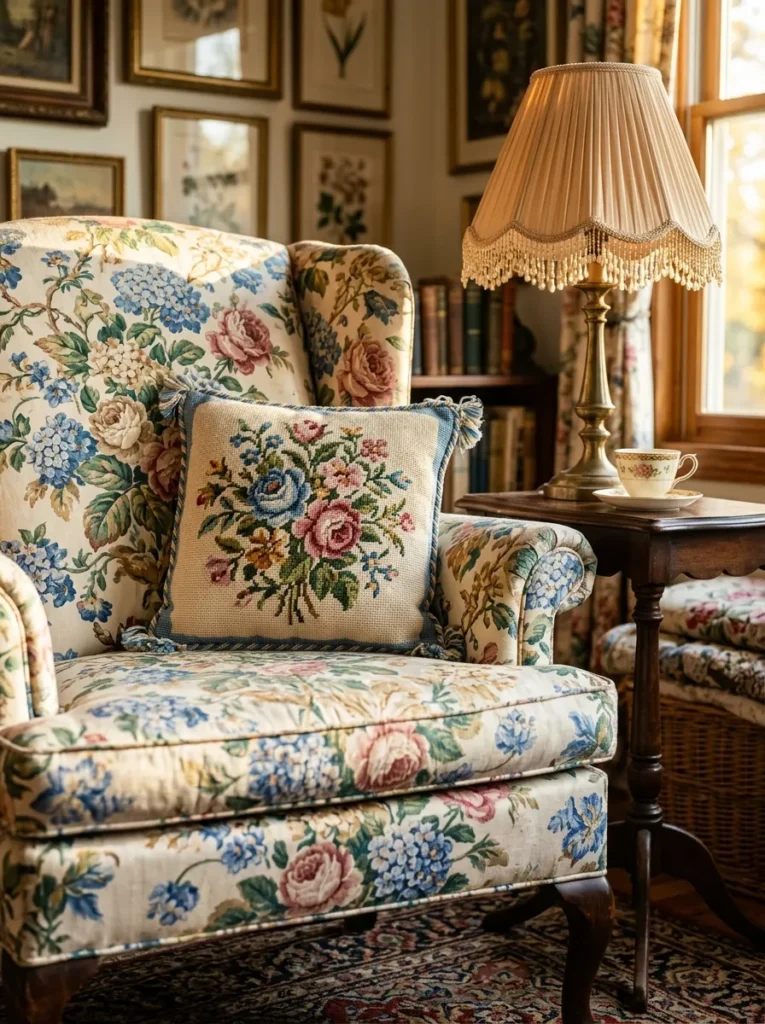
Vibe: soft, the visual equivalent of a hug.
Why it works: a skirted silhouette hides furniture legs entirely, which changes the room’s visual rhythm from angular and modern to rounded and traditional a silhouette principle where removing hard lines at the floor level softens the whole space’s read.
How to get it: choose one upholstered piece (an armchair or a sofa) with a box-pleated or gathered ruffle skirt that reaches the floor, rather than exposed tapered legs, to shift the whole room’s silhouette toward traditional softness.
Quick Win: A slipcover with a ruffled hem can convert an existing modern sofa for under $80 without reupholstering.
Shop the Look
| Product |
|---|
| Ruffled hem chintz armchair slipcover |
| Box-pleated skirted accent chair |
| Needlepoint lumbar throw pillow |
| Lace table runner cream |
| Brass upholstery tack trim strip |
8. A Gallery Wall of Vintage Frames for Small Rooms
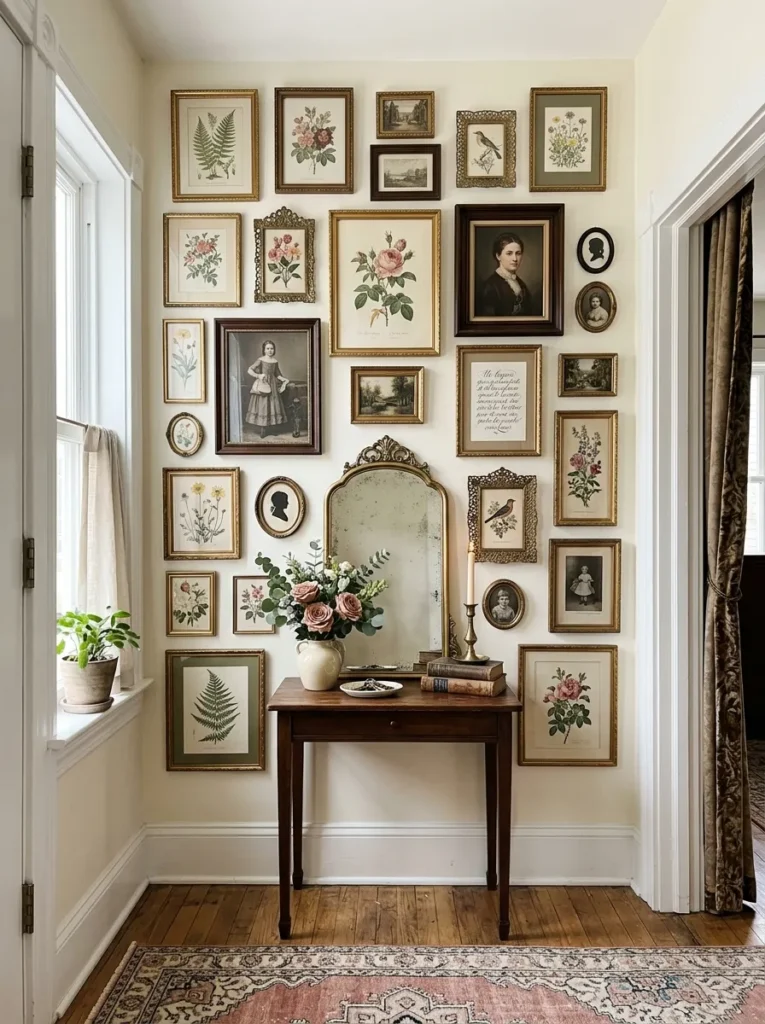
Vibe: layered, a small wall doing the work of a whole room.
Why it works: in a tight space, a floor-to-ceiling gallery wall uses vertical negative space instead of floor space, so the eye travels up rather than registering how narrow the room actually is an illusion technique that trades square footage for wall real estate.
How to get it: mix five to nine ornate vintage frames of varying sizes but similar gold or brass tones, arranged with even two-inch spacing, so the collection reads as one design gesture rather than scattered decor in a small hallway or entry.
Shop the Look
| Product |
|---|
| Ornate gold vintage picture frame set |
| Brass-edge wall mirror small |
| Slim console table for narrow entry |
| Botanical print art set framed |
| Brass wall hooks for entryway |
9. A Camelback Sofa With a Skirted Base
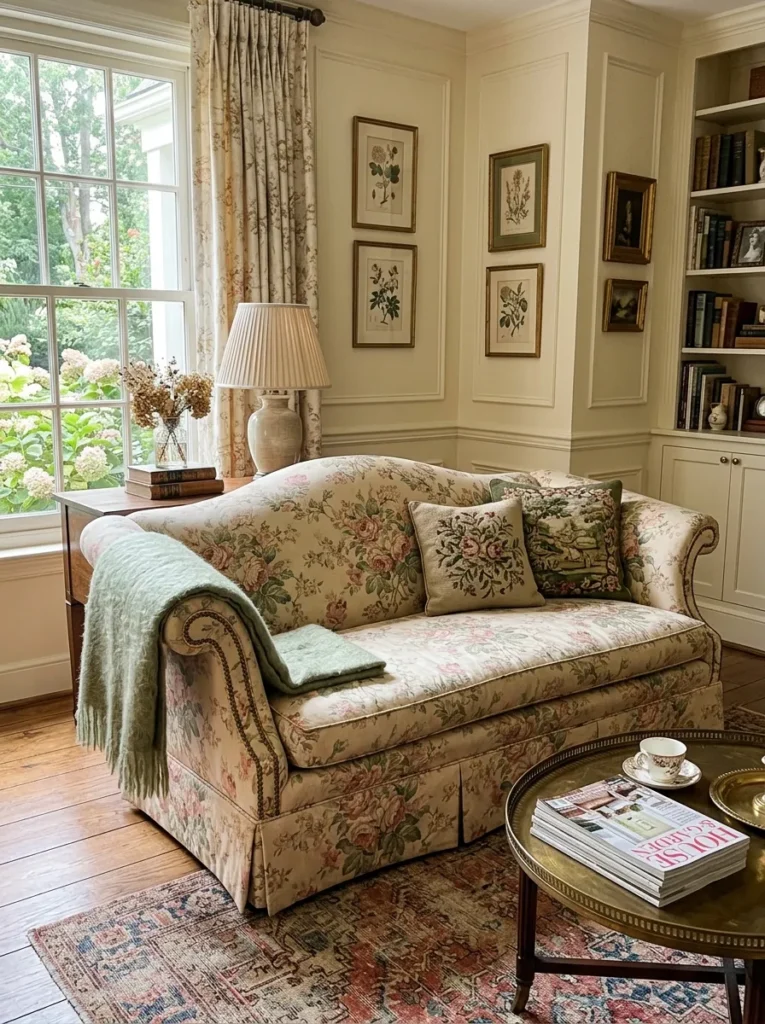
Vibe: grounded, the anchor piece a whole living room organizes around.
Why it works: a camelback silhouette’s curved top rail creates a soft focal point that traditional straight-arm sofas don’t, and pairing it with a skirted base removes visual clutter at the floor, letting the curve at the top do all the visual work a proportion principle balancing curve against straight lines elsewhere in the room.
How to get it: choose a camelback sofa in a muted floral chintz rather than a solid color, and pair it with straight-legged wood side tables nearby so the curved sofa silhouette has something angular to contrast against.
Shop the Look
| Product |
|---|
| Camelback sofa chintz floral upholstery |
| Needlepoint throw pillow pair |
| Mohair textured throw blanket |
| Brass nailhead trim sofa accent |
| Straight-leg wood side table pair |
10. Table Lamps With Fringed or Pleated Shades
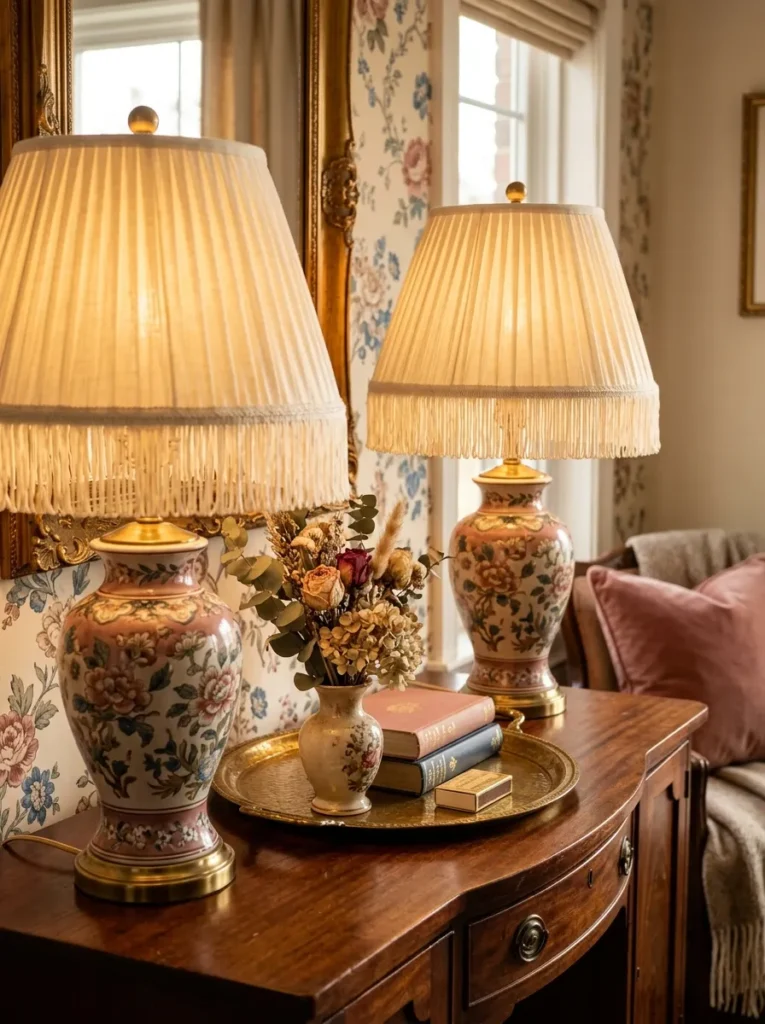
Vibe: warm, the specific glow that only a fabric shade can give.
Why it works: pleated or fringed fabric shades diffuse light more softly than hard plastic or metal shades, and the added trim casts a slightly patterned shadow on the ceiling a light behavior detail that makes ambient lighting feel handmade rather than store-bought.
How to get it: choose lamps with a hand-painted ceramic or porcelain base and a pleated linen shade trimmed in fringe or braid, and use a warm 2700K bulb rather than daylight-toned LED so the color temperature matches the era the style references.
Quick Win: A clip-on fringe trim kit can update an existing plain lampshade for under $20.
Shop the Look
| Product |
|---|
| Ceramic hand-painted table lamp pair |
| Pleated linen lampshade with fringe trim |
| Clip-on fringe trim kit for lampshades |
| Brass decorative serving tray |
| Small dried floral arrangement in bud vase |
11. Layering Doilies and Lace as Textile Accents
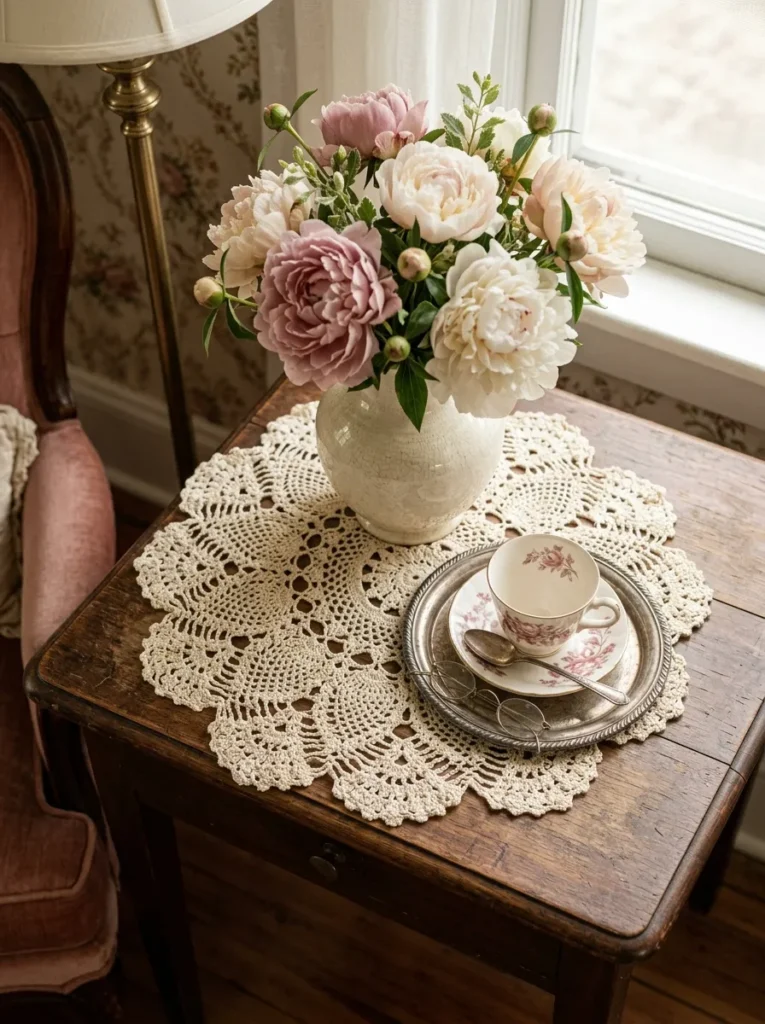
Vibe: still, a tiny detail that slows the whole room down.
Why it works: a crocheted or lace doily under a lamp or vase adds fine, intricate texture at a small scale, which contrasts against larger-scale furniture upholstery a texture layering principle where the smallest detail in a room often does the most to make it feel handmade.
How to get it: place one cotton crochet doily under a single object on each surface (a lamp, a clock, a vase) rather than covering every surface, so the detail reads as intentional styling instead of inherited clutter.
Shop the Look
| Product |
|---|
| Hand-crocheted cotton lace doily set |
| Silver-plated decorative serving tray |
| Ceramic bud vase for fresh florals |
| Antique-style lace table runner |
| Small porcelain trinket dish |
12. A Cozy Conversation Nook Layout
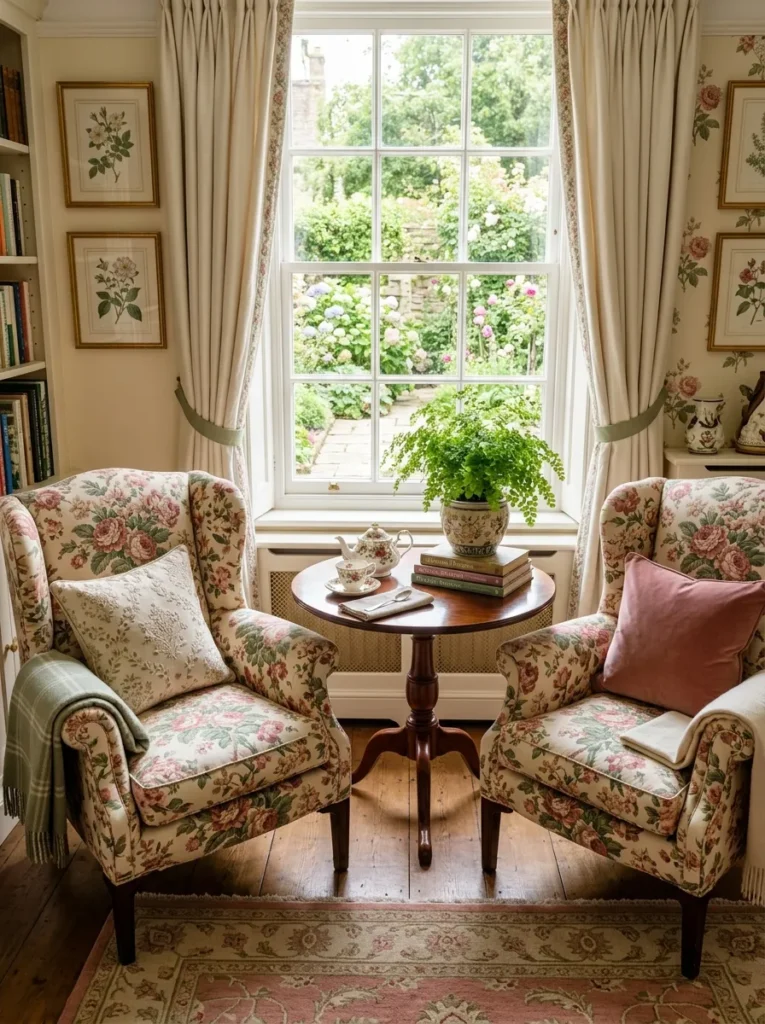
Vibe: inviting, a layout that says sit down and stay a while.
Why it works: angling two chairs toward each other rather than both facing a television creates a conversation-first traffic flow, which is a layout principle prioritizing human interaction over media consumption the hallmark of pre-television-era living rooms this style draws from.
How to get it: position two chairs at a slight inward angle (roughly 15 to 20 degrees) with a small round table between them near a window, and treat the television as secondary by placing it outside this seating cluster’s direct sightline.
Shop the Look
| Product |
|---|
| Chintz floral upholstered accent chair pair |
| Round mahogany side table small |
| Porcelain tea set for two |
| Potted fern in ceramic planter |
| Woven seagrass area rug |
13. A Collected Ceramic Figurine Display
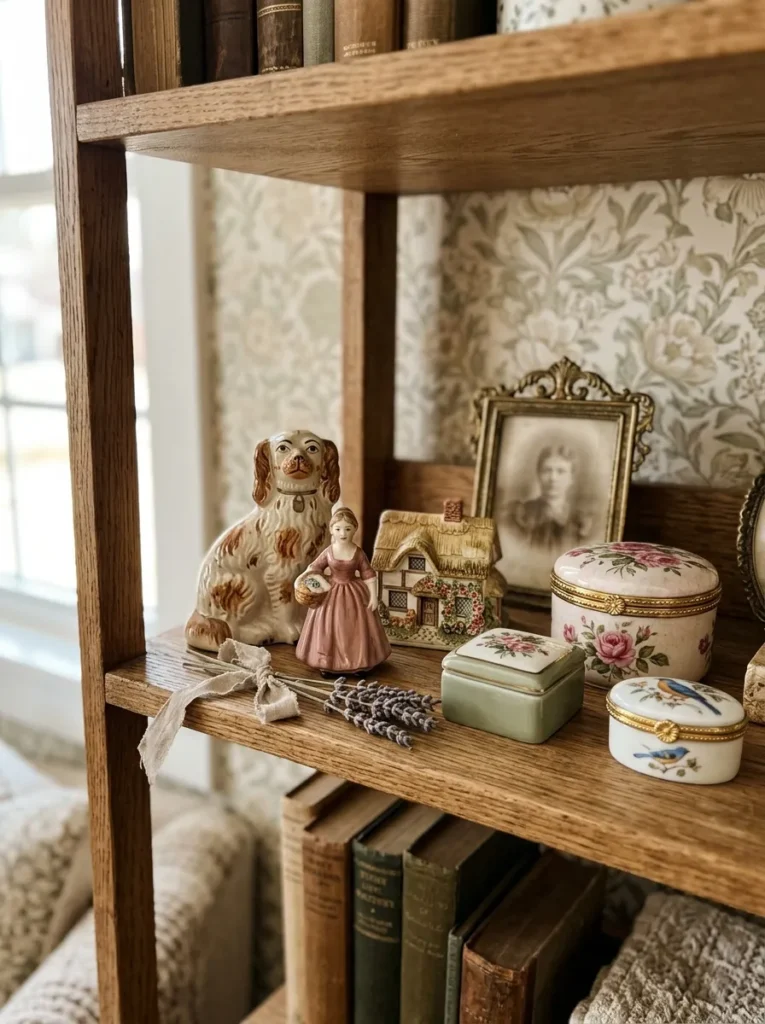
Vibe: sun-warmed, a shelf that feels like it’s been added to slowly over years.
Why it works: grouping small collected objects in odd numbers (three or five) at varied heights creates visual rhythm rather than a flat row, a display principle that keeps a small collection from reading as random clutter.
How to get it: group ceramic figurines and trinket boxes in clusters of three, varying height with small wood risers or books underneath the shortest pieces, and keep the color palette within two or three tones so the grouping feels edited rather than accumulated.
Quick Win: Small unfinished wood risers under $15 instantly add height variation to a flat figurine display.
Shop the Look
| Product |
|---|
| Hand-painted ceramic figurine set |
| Floral porcelain trinket box small |
| Small wood display risers set of three |
| Brass mini picture frame |
| Dried lavender bundle for styling |
How to Start Your Vintage Grandma House Transformation
The single first move is painting one wall or piece of furniture in a matte sage green like Clary Sage before buying anything else it’s the anchor tone the whole dusty-rose-and-brass palette builds around, and starting with color prevents a mismatched mix of secondhand finds.
The most common mistake is mixing too many wood species at once pairing honey oak with mahogany with painted white reads as accidental rather than collected. Fix it by choosing one dominant wood tone, ideally mahogany or cherry, and keeping every other wood piece within that same warm family.
Three items under $50 that create immediate impact: a hand-crocheted cotton lace doily set for under $15, a single stem of dried pampas grass in a small brass bud vase for under $20, and a fringed linen lampshade replacement for an existing lamp for under $35.
A starter version one accent wall, a lamp swap, and a few textiles can happen in a single weekend for under $200. A full room transformation with reupholstered furniture and a china cabinet typically takes two to four months and runs $1,500 to $4,000 depending on whether pieces are secondhand or new.
Frequently Asked Questions About Vintage Grandma House Style
What’s the difference between grandmillennial and shabby chic?
Grandmillennial style uses crisp, well-maintained chintz and needlepoint pieces that look cared-for, while shabby chic relies on intentionally distressed white-washed wood and worn edges. Grandmillennial leans traditional and polished; shabby chic leans rustic and weathered. Both share florals, but grandmillennial’s palette (dusty rose, sage) is more saturated than shabby chic’s typical all-white base.
What color paint works best for a grandma house living room?
Sherwin-Williams Clary Sage or a comparable matte sage green is the most reliable base, paired with a cream trim like Sherwin-Williams Alabaster. Dusty rose works better as an accent through textiles than as a wall color in most rooms, since a full rose wall can skew more Barbiecore than vintage. Faded cornflower blue is a strong alternative base for a bedroom.
How much does it cost to decorate a room in this style?
A starter room using secondhand chintz chairs, a thrifted china cabinet, and a few textile swaps can run $300 to $600. A fully reupholstered room with a mahogany coffee table, brass lighting, and a custom wallpaper wall typically runs $2,000 to $4,500, largely driven by reupholstery labor costs.
Does this style work with modern furniture already in the room?
Yes, in moderation — a modern straight-arm sofa can stay if it’s slipcovered in a chintz or floral fabric, and modern brass lighting fixtures usually blend in without changes. The pieces that clash hardest are matte black metal furniture and glossy white lacquer, which read as too cold against the warm, textured palette.
What’s the most important single element to get right?
Lighting color temperature matters more than most people expect — cool white LED bulbs (4000K and above) undercut every other design choice by making brass look green and chintz look flat. Swapping every bulb in the room to warm white 2700K is a five-minute fix that changes how every other element reads.
Ready to Create Your Dream Vintage Grandma House?
These 13 ideas span color, texture, lighting, and layout, but the room they add up to is really about one thing: making a space feel like it’s been lived in with care. You don’t need all thirteen at once painting one wall, swapping one lampshade, or thrifting one chintz chair is a real start, not a compromise.
Pick the one idea from this list that made you pause, and go find that single piece this week. Done right, this style gives you a room that feels like being held, the kind you don’t want to leave at the end of the night. Save the ideas that made you stop scrolling that instinct is usually the truest guide to your own version of this house.