14 Stylish Peel and Stick Wallpaper Ideas for Every Room
Peel and stick wallpaper ideas use self-adhesive, removable wallpaper — applied directly to smooth wall surfaces without paste, professional installation, or permanent wall commitment — to achieve the transformative visual impact of traditional wallpaper with the flexibility of a temporary installation, making it specifically appropriate for rental properties, rooms in transition, first-time wallpaper users, and anyone who wants to experiment with pattern, color, and texture before committing to a permanent decorating decision.
This article gives you exactly 14 ideas spanning accent walls, full-room transformations, ceiling applications, furniture surface updates, and pattern-mixing approaches so every room, every aesthetic, and every wall condition finds a peel and stick application that genuinely works.
Peel and stick wallpaper done well is indistinguishable from traditional wallpaper to anyone who is not looking for the seams. Done poorly — on textured walls, with insufficient overlap, in high-humidity rooms without appropriate ventilation — it reads as a temporary measure. The difference is entirely in the preparation, the pattern choice, and the application technique. Here are 14 ideas worth saving — and applying.
Why Stylish Peel and Stick Wallpaper Ideas Work for Every Room
Peel and stick wallpaper has existed as a product category since the early 2000s, but the generation of products available from approximately 2018 onward represents a significant material quality upgrade over its predecessors. Contemporary self-adhesive wallpaper products from brands including Chasing Paper, Tempaper, Walls Need Love, Spoonflower, and the Rocky Mountain Decals category use woven fabric or vinyl substrates with pressure-sensitive adhesive systems that are genuinely repositionable (the paper can be lifted and reapplied multiple times during installation without losing adhesion), genuinely removable (the adhesive releases from painted drywall without pulling the paint surface when the paper is removed after a period of use), and genuinely print-quality (digital and screen printing at 300+ DPI produces pattern resolution comparable to traditional wallpaper printing).
The material distinction between the two primary substrate types — vinyl-backed peel and stick and fabric or paper peel and stick — is important for room selection and application context. Vinyl-backed peel and stick (the more common format, available from most mass-market retailers) is more moisture-resistant, more forgiving of minor surface imperfections, and more durable under regular cleaning, making it the appropriate specification for kitchens, bathrooms, and high-traffic areas. Fabric or woven paper peel and stick provides a more authentic paper-like texture and appearance, a more forgiving application behavior (fabric stretches slightly to accommodate corner and curve applications), and a superior print depth that renders complex botanical, geometric, and artistic patterns with greater fidelity — making it the preferred specification for feature walls and rooms where visual quality is the primary objective.
The wall preparation requirement is the most consistent point of application failure for peel and stick wallpaper users — the product’s adhesive system is designed to adhere to smooth, clean, dry, sealed surfaces, and any deviation from this specification reduces both adhesion quality during installation and clean removal quality at the end of the installation period. The three surfaces that cause the most consistent problems are: textured wall finishes (orange peel, skip trowel, knockdown — the adhesive contacts only the texture’s raised points rather than the full surface, reducing total adhesion area), flat (matte) paint (some flat paints absorb rather than bond with the adhesive, causing the adhesive layer to compromise the paint surface rather than the wallpaper surface when the paper is removed), and freshly painted walls (paint requires a full 30-day cure before peel and stick wallpaper application — applying to a wall painted within the previous 30 days frequently results in paint removal when the paper is subsequently lifted).
Style at a Glance
| Element | Peel and Stick Core | Stylish Edge |
|---|---|---|
| Philosophy | Transformative impact, reversible commitment | Pattern and color experimentation without permanent investment |
| Materials | Vinyl-backed or woven fabric substrate | Digital print, 300 DPI, repositionable adhesive |
| Wall Requirement | Smooth, sealed, eggshell or satin painted, 30-day cured |
14 Stylish Peel and Stick Wallpaper Ideas for Every Room
1. Botanical Mural Accent Wall in a Living Room
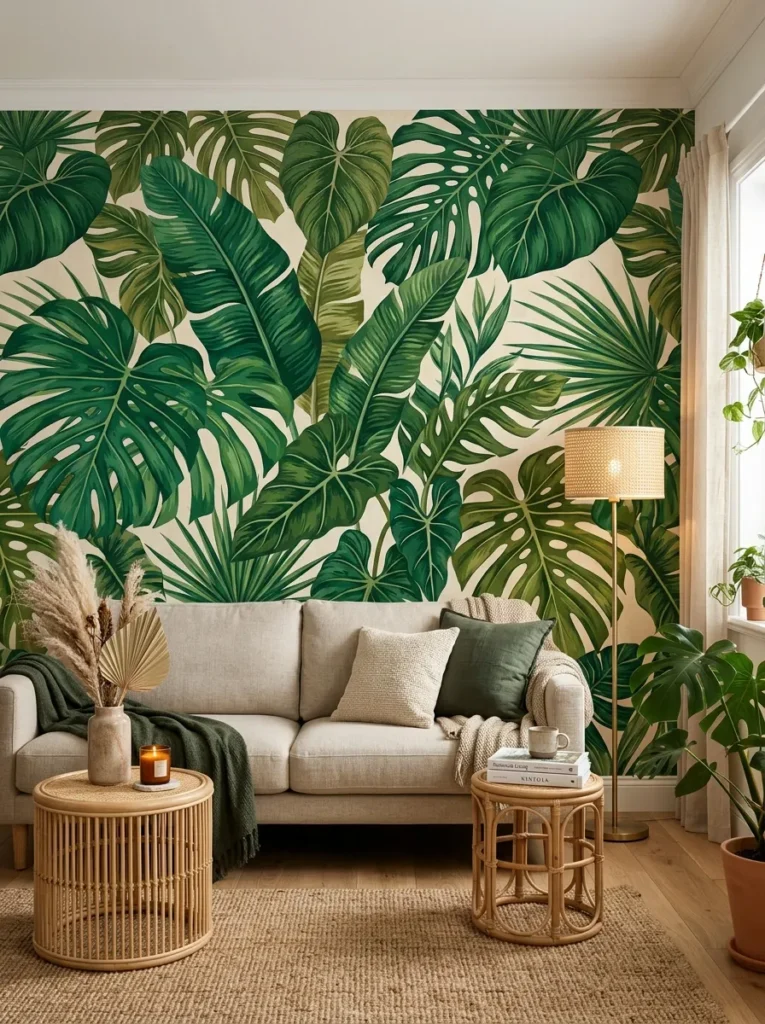
Vibe: The botanical mural wall feels like the forest moved inside — the large-scale leaf forms creating an immersive green environment that recedes in natural light and advances in the warmth of a floor lamp.
Why it works: A large-scale botanical mural on a living room accent wall applies the visual anchor principle — in a room where all other surfaces are neutral (the oat sofa, the warm white walls, the natural floor), one fully illustrated wall creates a gravitational center for the room that organizes all furniture arrangement around it and creates the visual depth that a plain painted wall cannot. The botanical mural format specifically (rather than a geometric pattern or a smaller repeat wallpaper) creates the most dramatic visual transformation available from a single wall, because the large-scale non-repeating imagery reads as a custom painted mural rather than as a pattern application.
Application notes: Mural peel and stick wallpapers are typically printed in numbered panels that must be applied in sequence. Lay all panels on the floor in order before beginning and draw a light pencil line at the panel widths to guide placement. The most common mural alignment error is not keeping the panels perfectly vertical — use a plumb line or a level at the start of each panel.
Pattern recommendation: Chasing Paper Canopy design, Spoonflower custom tropical mural, or Photowall tropical leaf options all produce high-resolution mural results in peel and stick format.
Quick Win: A botanical mural applied only to the section of wall visible above and behind the sofa (approximately 180cm wide, from sofa height to ceiling) creates the botanical wall moment without covering the full wall area — reducing material cost and installation time by approximately 60%.
Shop The Look
| Product |
|---|
| Tropical botanical mural peel and stick |
| Linen sofa oat contemporary |
| Natural rattan side table set |
| Warm floor lamp living room |
| Small ceramic object side table |
Also view: 14 Easy Sewing Projects You’ll Love to Make
2. Geometric Pattern Kitchen Backsplash
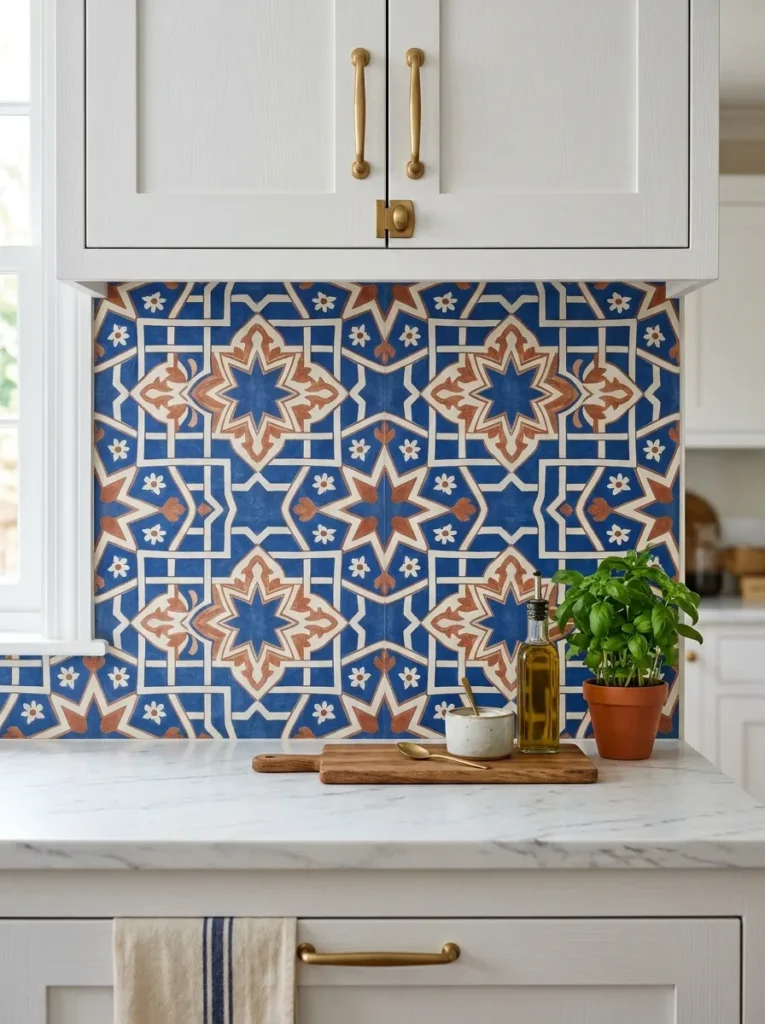
Vibe: The geometric backsplash feels like a Moroccan riad tile wall that a kitchen absorbed rather than installed — the cobalt blue and terracotta pattern creating a focal point that makes the whole kitchen feel considered.
Why it works: A geometric tile-effect peel and stick backsplash applies the material simulation principle — backsplash tile installation is among the most disruptive, permanent, and expensive kitchen updates available; a tile-effect peel and stick wallpaper achieves a visually comparable result in an afternoon, without grout, without tiling tools, and without permanent commitment. The backsplash zone (between countertop and upper cabinets) is the ideal peel and stick application zone in a kitchen because it is a naturally contained, flat, smooth, regularly bounded surface that limits the complexity of the application, and the vinyl-backed substrate specification provides adequate moisture and steam resistance for backsplash-adjacent use.
Application notes: Vinyl-backed peel and stick is the required specification for any kitchen or bathroom application — woven fabric paper substrates are not appropriate in humidity-adjacent environments. Clean the existing backsplash surface with isopropyl alcohol and allow to dry completely before application. Apply from the center of the backsplash working outward to ensure symmetrical pattern placement relative to the kitchen’s center.
Shop The Look
| Product |
|---|
| Moroccan geometric tile effect peel stick |
| Vinyl substrate kitchen rated |
| Brass cabinet knob set replacement |
| White marble effect countertop edge |
| Grout effect matching tile color |
Also view: 16 Elegant Dining Room Ideas Worth Saving and Stealing
3. Bedroom Feature Wall in a Dark, Moody Floral
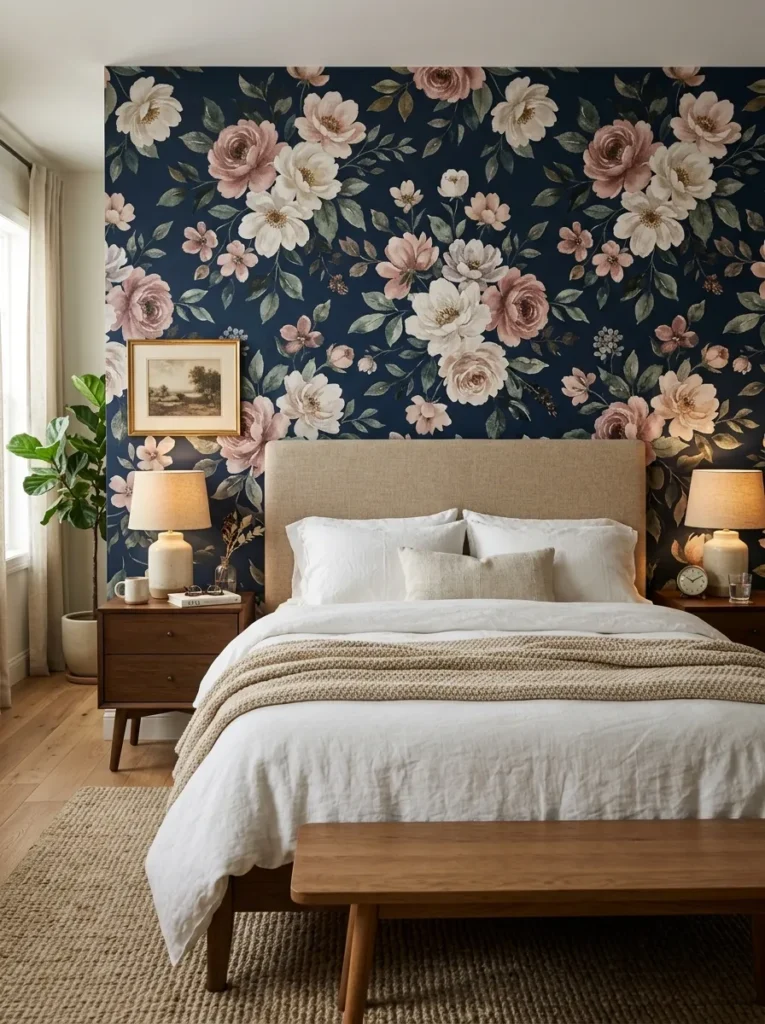
Vibe: The dark floral bedroom feels like the most luxurious version of a bedroom that was free to be bold — the deep navy ground and the large-scale flowers creating a visual warmth that a white or pale wall behind the same bed could never produce.
Why it works: A dark, moody floral wallpaper applied to the bedroom feature wall behind the bedhead applies the enclosure principle — the dark ground color of the wallpaper (navy, forest green, or deep charcoal) creates a visual backing to the bedroom that encloses the sleep space in a way that a pale or white wall does not. This enclosure quality specifically references the traditional bed canopy and alcove bed formats that human sleep environments have used for millennia to create the contained, den-like quality that sleep research consistently associates with better sleep quality. The large-scale floral pattern at this scale communicates abundance and confidence rather than the delicacy of a small repeat pattern.
Application notes: Dark ground wallpapers are the most unforgiving of seam misalignment — any gap between panels shows as a bright line against the dark background. Apply all panels in the same lighting condition (avoid applying in direct sunlight on one panel and shade on the next — the adhesive behaves differently), use a seam roller at every panel junction, and check every seam in raking light before the adhesive sets completely.
Shop The Look
| Product |
|---|
| Dark floral peel and stick feature wall |
| Oat linen upholstered bedhead |
| Ceramic bedside lamp pair warm shade |
| White linen duvet cover set |
| Textured knit throw bedroom |
4. Nursery Cloud and Rainbow Pattern — Children’s Room
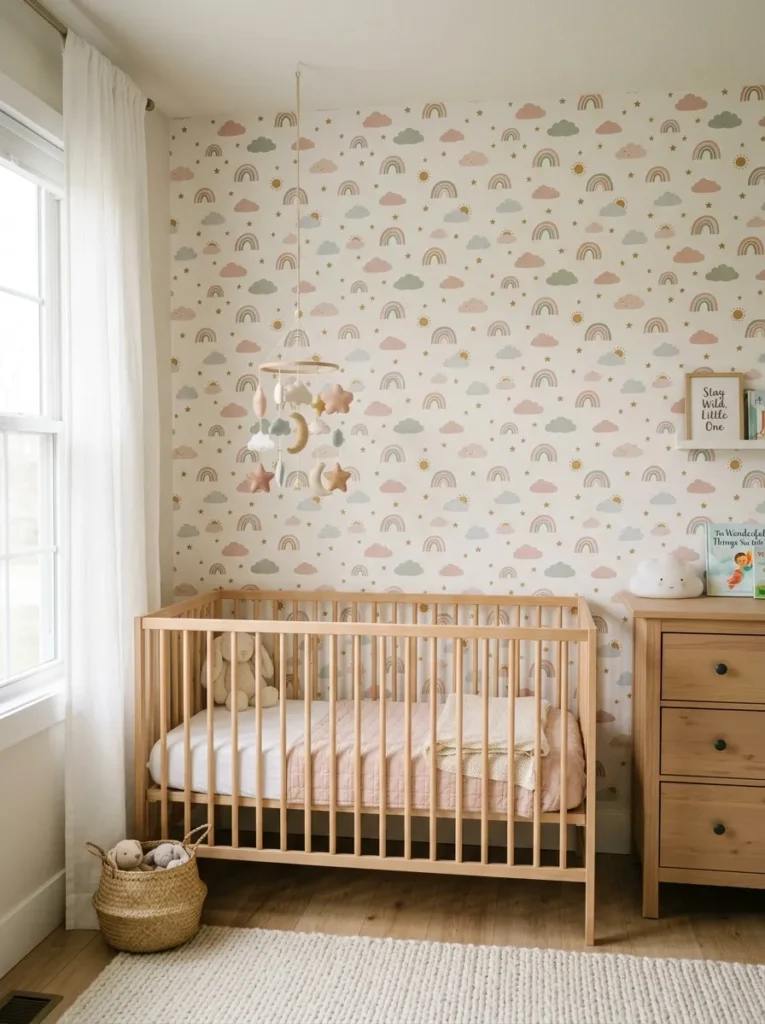
Vibe: The nursery cloud wall feels like the sky moved inside and stayed calm — the soft pastel repeat creating a visual environment that references the natural world without overstimulating the infant who lives within it.
Why it works: A soft pastel repeat pattern in a nursery applies the developmental environment principle — infants and young children benefit from visual environments with sufficient pattern to provide visual interest (a completely plain white room provides no visual stimulation for early visual development) but insufficient visual complexity to create the arousal that interferes with sleep. Small-scale repeat patterns in desaturated, muted pastel tones (not bright primaries, which produce the highest contrast stimulation) provide the appropriate level of visual interest for a sleep and rest environment while being soft enough to transition the room from stimulating during awake periods to non-distracting during sleep.
Application notes: Nursery walls are frequently painted in flat (matte) paint — the standard nursery paint choice for its washability and gentle appearance. Peel and stick wallpaper requires a minimum eggshell or satin paint finish for reliable adhesion and clean removal. If the nursery wall is in flat paint, apply two coats of eggshell in the same color and allow to cure for 30 days before applying the peel and stick paper.
Shop The Look
| Product |
|---|
| Pastel cloud rainbow nursery peel stick |
| Natural wooden crib nursery |
| Felt star mobile nursery hanging |
| White sheer nursery curtain pair |
| Small natural wood dresser nurser |
5. Bathroom Accent Wall in a Bold Tropical Print
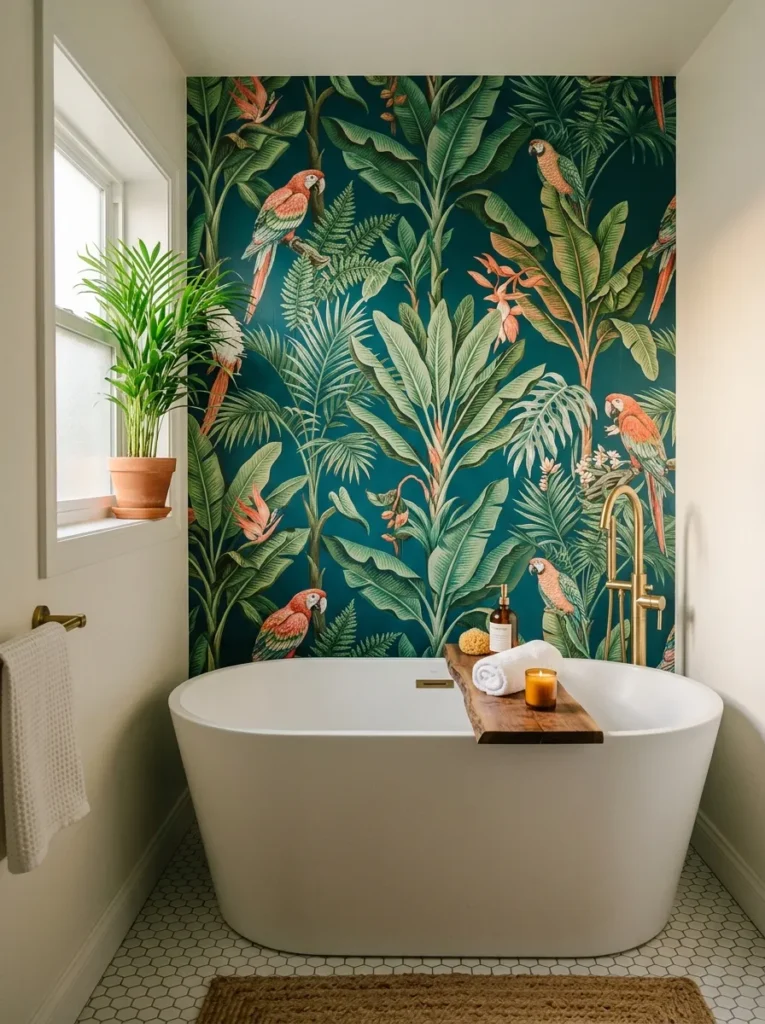
Vibe: The tropical bathroom wall feels like the most luxurious version of a small bathroom’s possibility — the bold pattern and the freestanding tub together creating a spa moment from a modest room’s square footage.
Why it works: A bold tropical print on a single bathroom accent wall applies the maximum impact from minimum area principle — a small bathroom (typically 4–8 square metres) has insufficient square footage for a bold pattern applied to all walls without creating visual overwhelm, but a single feature wall (typically the wall behind the bathtub or behind the vanity) provides a contained application zone where the bold pattern creates dramatic visual impact without visual saturation. The vinyl-backed peel and stick substrate is the mandatory specification for a bathroom application — moisture and condensation exposure from the bathtub requires genuine moisture resistance.
Application notes: Apply the wallpaper to the wall behind the bathtub only, stopping at the adjacent wall edges rather than turning the corner (corners in humidity-adjacent areas are the first place where peel and stick adhesion fails in bathroom environments). Seal all paper edges with a clear waterproof silicone sealant — this step is not standard for living room applications but is essential in moisture-adjacent zones to prevent edge lifting from steam and splash.
Shop The Look
| Product |
|---|
| Tropical print vinyl peel and stick |
| Matte white freestanding bathtub |
| Brass bath tap fittings |
| Wooden bath caddy bamboo |
| Clear silicone edge seal waterproof |
6. Staircase Riser Peel and Stick — The Detail Moment
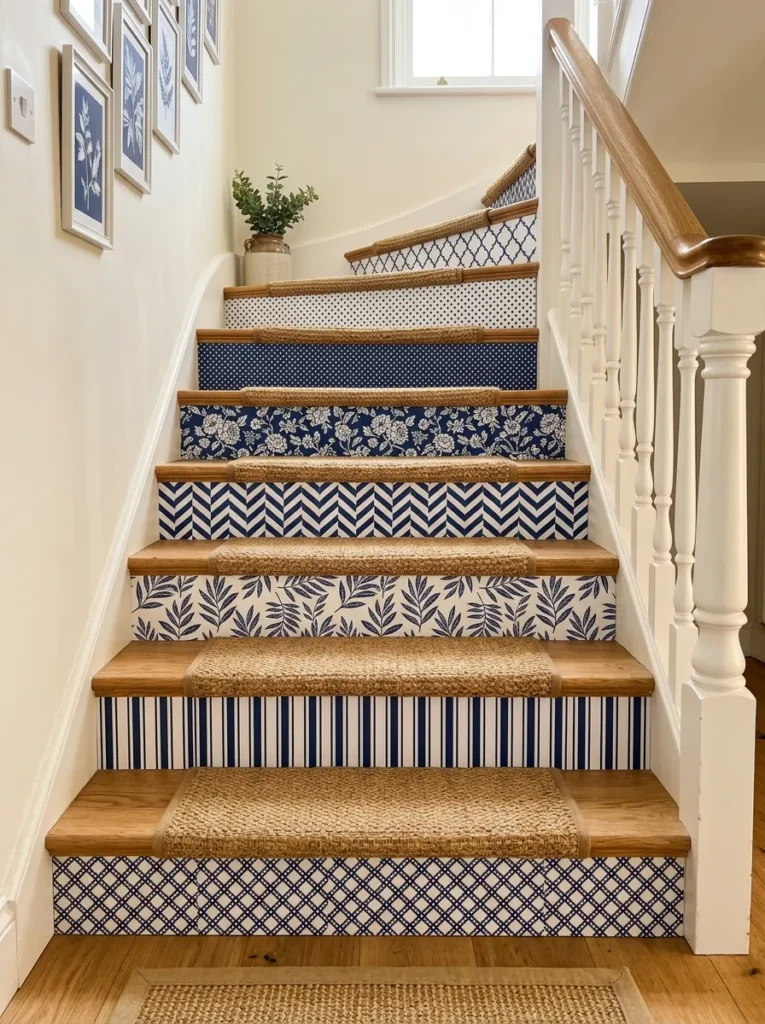
Vibe: The pattern-covered stair risers feel like ascending through a small gallery — the sequence of varied patterns within a consistent color family creating compositional interest in a space that normally functions as pure circulation.
Why it works: Peel and stick wallpaper on stair risers applies the detail architecture principle — the stair riser is the one architectural surface in the home that is almost entirely without functional purpose (its primary function is visual — to complete the step form between one tread and the next) but is directly in the sightline of anyone ascending or descending the staircase. Covering it with pattern converts a purely utilitarian surface into a designed element that makes the transition between floors an experience rather than a purely functional movement. The varied-pattern-within-consistent-color-family approach (different geometric, stripe, and botanical patterns all in the same navy and white) creates more visual interest than a single pattern repeated across all risers while maintaining the visual coherence that a completely mismatched collection would lack.
Application notes: Riser surfaces receive significant foot traffic adjacent to them — shoes brush against the riser face and hands may touch it when ascending or descending. Choose a durable, wipe-clean vinyl substrate for riser applications and apply a clear matte topcoat sealant over the applied paper for additional scuff resistance.
Shop The Look
| Product |
|---|
| Geometric peel and stick riser size |
| Stripe peel and stick riser size |
| Botanical peel and stick riser size |
| Jute stair runner natural |
| Clear matte sealant topcoat |
7. Home Office Concentration Wall — Dark Color Statement
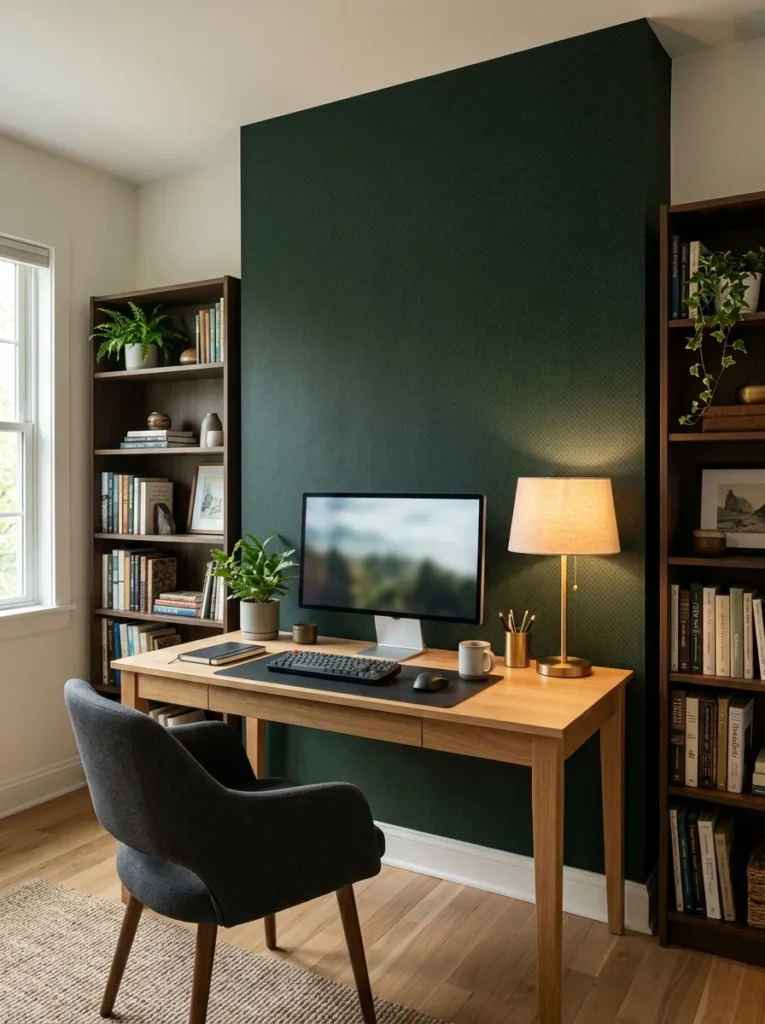
Vibe: The dark home office wall feels like it actively reduces visual noise — the deep color creating a background that absorbs rather than competes with the work that happens in front of it.
Why it works: A dark, near-solid texture wallpaper on the wall facing a home office desk applies the cognitive environment principle — research in workspace design documents that the wall a person faces during focused work significantly affects their concentration quality. A bright, highly patterned, or visually complex wall facing the worker creates continuous visual competition with the work task; a dark, low-pattern wall facing the worker creates a visually calm backdrop that allows the work surface and screen to be the dominant visual element in the sightline. The subtle texture within the near-solid deep color provides sufficient visual interest to prevent the wall from reading as empty while providing insufficient visual complexity to be distracting.
Application notes: Deep color wallpapers with subtle textures are the most forgiving peel and stick application because the dark ground color conceals minor seam irregularities and the subtle pattern provides no obvious alignment reference point (unlike a geometric or botanical pattern where misalignment is immediately visible).
Shop The Look
| Product |
|---|
| Deep navy texture peel and stick |
| Natural wood desk home office |
| Bookshelf flanking dark wall |
| Warm LED task lamp |
| Simple ergonomic task chair |
8. Ceiling Application — The Fifth Wall
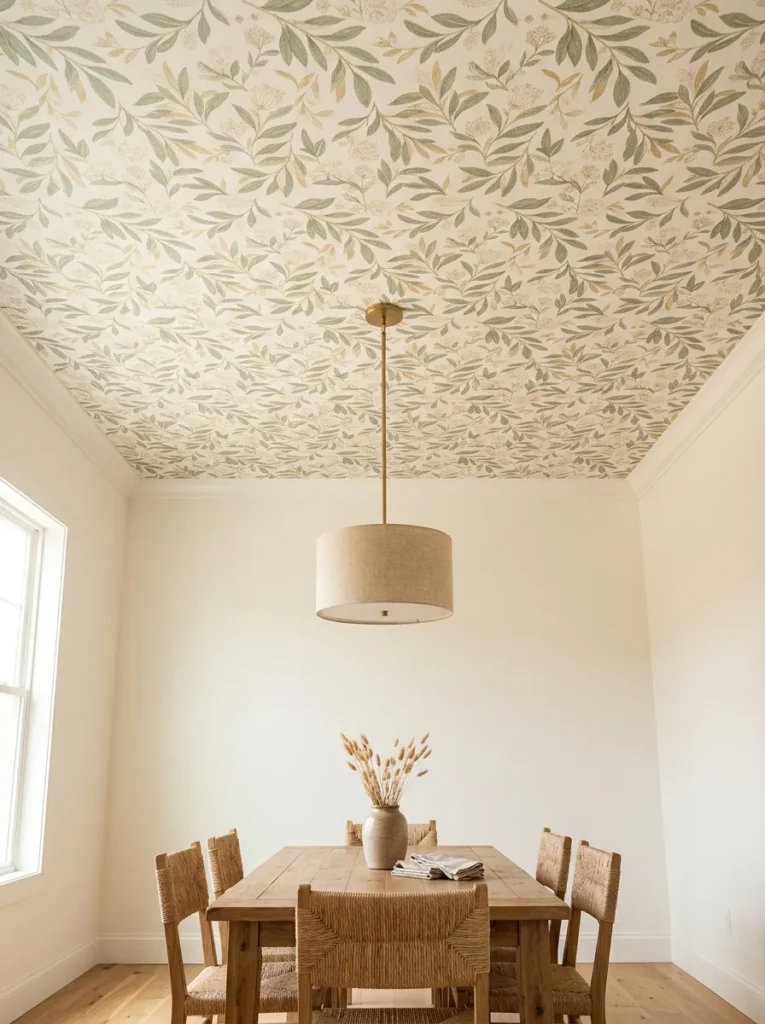
Vibe: The patterned ceiling feels like looking up and discovering the room’s best decision — the plain white walls below creating maximum contrast with the pattern overhead that makes entering the room a genuine surprise.
Why it works: Peel and stick wallpaper on a ceiling applies the unexpected focal surface principle — the ceiling is the room’s most consistently undecorated surface, appearing in most domestic interiors as an undifferentiated white plane that is experienced only negatively (the space above furniture and below the roof). A patterned ceiling with plain walls reverses the conventional visual hierarchy of the room, creating a surprise design moment that is experienced the moment anyone enters the room and looks upward. The ceiling application specifically suits peel and stick wallpaper better than traditional wallpaper because the repositionable adhesive allows a section to be lifted and repositioned if it droops during application — a critical practical advantage when working overhead.
Application notes: Ceiling application requires two people — one to hold the paper and manage the spool, one to smooth and adhere the paper from a step ladder. Work in strips parallel to the room’s longest dimension (shorter strip lengths mean less overhead paper management per strip). Use a wide plastic smoothing tool rather than a brush to press the paper against the ceiling without dragging or distorting. Allow the adhesive 24 hours to cure against the ceiling before the room is used normally.
Shop The Look
| Product |
|---|
| Pale gold geometric ceiling peel stick |
| Step ladder two-person application |
| Wide plastic smoothing tool set |
| Pendant lamp ceiling center |
| Seam roller ceiling application |
9. Entryway Statement — Full-Height Pattern
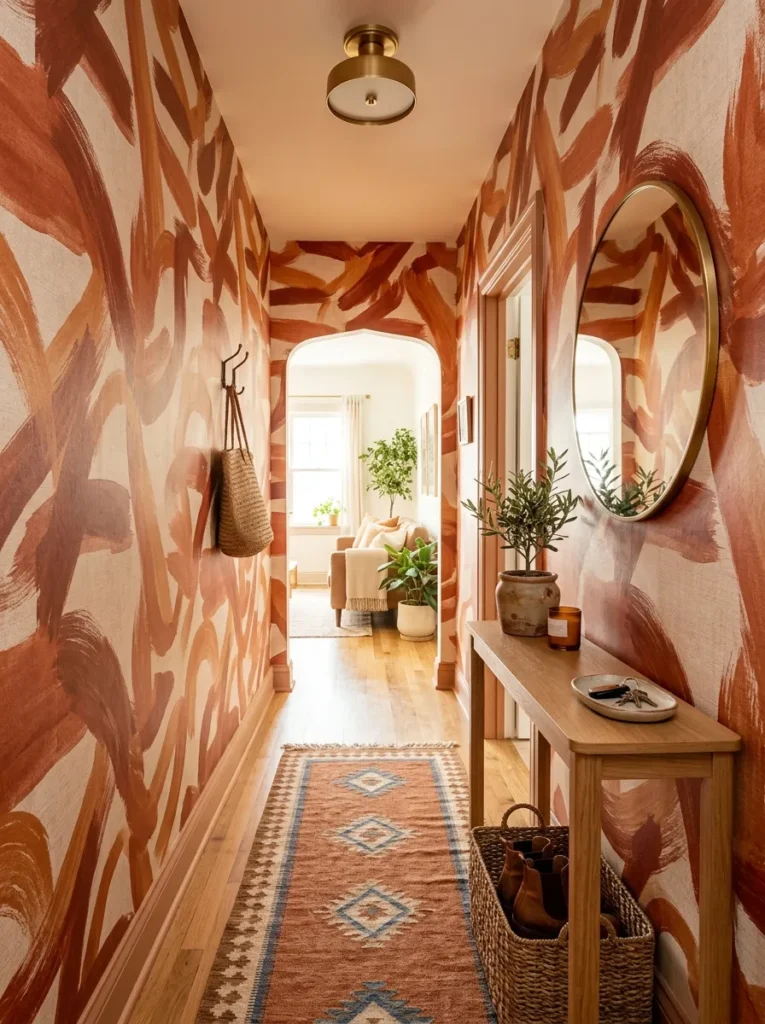
Vibe: The bold entryway pattern feels like the house has a personality before you have seen any other room — the entryway’s narrow dimensions requiring boldness rather than permitting it.
Why it works: A bold full-height peel and stick pattern in a narrow entryway applies the small space amplification principle — the conventional wisdom about small spaces (use light colors, minimize pattern, maximize apparent size) is specifically counterproductive in an entryway because an entryway is a transitional space rather than a living space. It does not need to feel spacious — it needs to feel interesting, welcoming, and indicative of what the rest of the home is like. A bold pattern in a narrow entryway makes the smallness irrelevant by making the space engaging — the visual interest created by the pattern in close proximity converts the narrow width from a constraint into an intimacy.
Application notes: A full-wrap entryway application (all visible walls including the two side walls and the end wall) requires careful corner work. Inside corners (where two walls meet inward) require the paper to be cut precisely to the corner and the adjacent panel begun from the corner — do not attempt to fold a single panel around an inside corner. Outside corners (where walls turn outward) can accommodate a fold if the paper is scored lightly at the corner fold position.
Shop The Look
| Product |
|---|
| Bold terracotta abstract entryway paper |
| Narrow console table natural |
| Round simple mirror above console |
| Small plant entryway ceramic pot |
| Corner application tool set |
10. Children’s Room Accent Wall — Under-Stair or Alcove
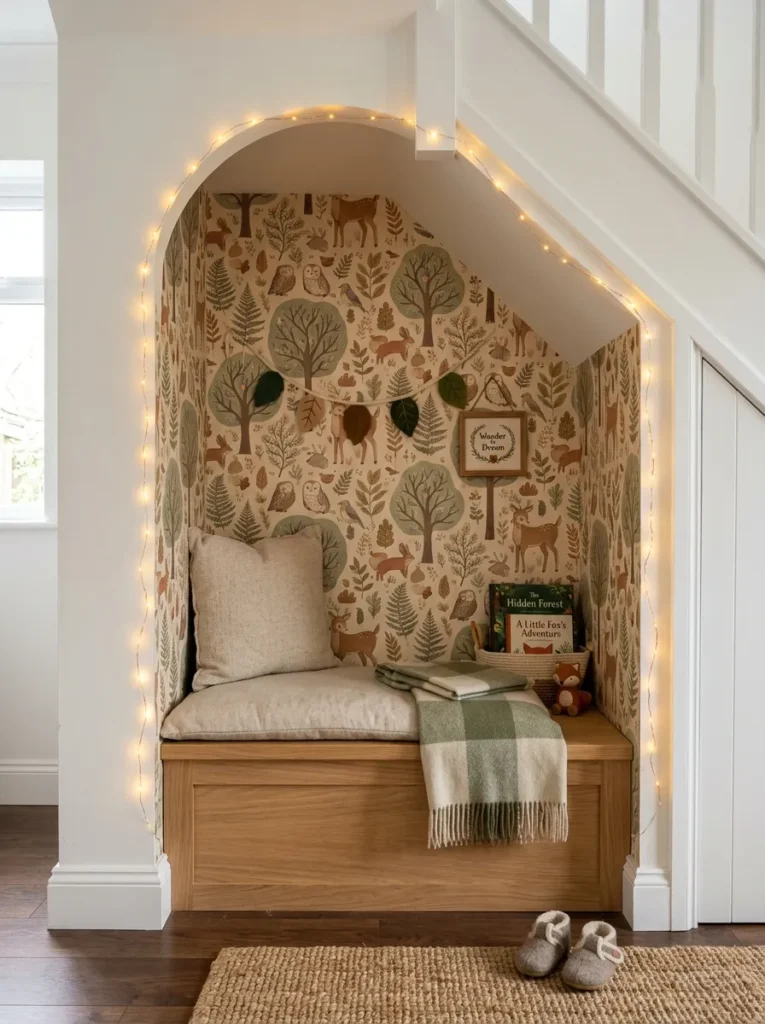
Vibe: The wallpapered alcove feels like a secret world that found the right wall to exist in — the illustrated scene converting a structural void into the most beloved corner of any child’s room.
Why it works: Peel and stick wallpaper in a small alcove or recessed space applies the immersive micro-environment principle — a wallpaper pattern applied to a room’s full walls creates pattern across a large field that the eye experiences from a distance; the same pattern applied within a small, enclosed alcove creates an immersive environment that is experienced from within, at close range, on three sides simultaneously. This three-sided immersion (back wall and two side walls within the alcove) creates a genuinely different spatial experience — the illustrated forest scene becomes an environment to be inside rather than a decoration to look at. The alcove’s small scale makes the three-wall application achievable in under an hour.
Application notes: Small alcove applications are the easiest peel and stick projects — the contained dimensions mean each strip is short (typically 80–150cm) and manageable by a single person. Apply the back wall first, then each side wall, matching the pattern across the two corners.
Shop The Look
| Product |
|---|
| Forest woodland illustration peel stick |
| Small wooden bench alcove base |
| Cushion oat soft bench |
| Fairy light string warm amber |
| Children’s room alcove cushion set |
11. Dining Room — Grasscloth Effect Texture
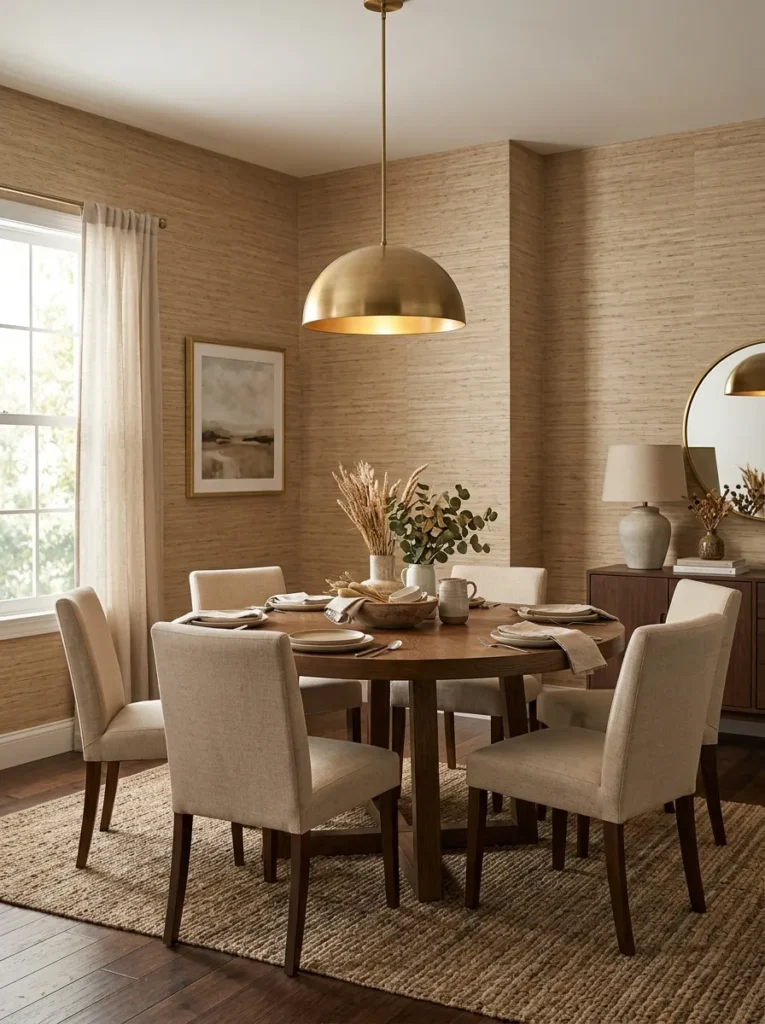
Vibe: The grasscloth dining room feels like the walls have absorbed a texture from the natural world — the fibrous pattern creating warmth at every angle of natural and artificial light.
Why it works: A grasscloth-effect peel and stick wallpaper applied to all four dining room walls applies the total material transformation principle — genuine grasscloth wallcovering is among the most beautiful and most expensive wallcovering options available, and its application to four dining room walls at premium grasscloth pricing represents a $2,000–8,000 installation depending on room size. A high-quality grasscloth-effect peel and stick wallpaper (the best examples are produced at resolutions that accurately replicate the fiber variation, the slight color inconsistency, and the texture shadow of genuine natural fiber wallcovering) achieves the same visual warmth and room transformation at 10–20% of the cost of genuine grasscloth. The four-wall application (rather than a single accent wall) creates the most fully resolved room transformation — the texture wrapping all four walls creates a genuinely warm, enveloping environment.
Application notes: Grasscloth-effect papers are the most forgiving of seam visibility because the fiber texture pattern at each seam visually interrupts the seam line in a way that mimics genuine grasscloth’s seam behavior. The texture direction (the fiber print runs vertically in all panels) must be consistent — flipping a panel will be immediately visible as the fibers appear horizontal against vertical adjacent panels.
Shop The Look
| Product |
|---|
| Grasscloth effect peel and stick set |
| Round dark oak dining table |
| Linen dining chair set 6 |
| Brass pendant dining room |
| Simple centrepiece table natural |
12. Maximalist Pattern Mix — Two Patterns, One Room
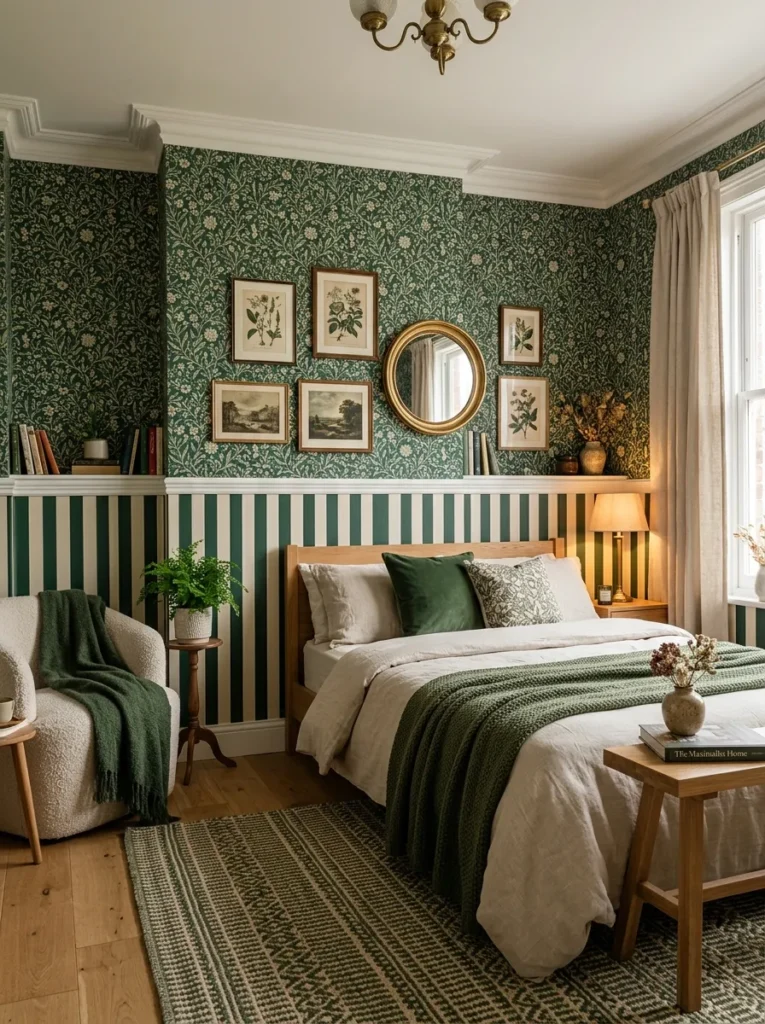
Vibe: The two-pattern room feels like someone understood that the rule about mixing patterns exists to be broken in exactly this specific way — same colors, different scales, the combination richer than either pattern alone.
Why it works: A two-pattern peel and stick room applies the pattern mixing principle of color unity with scale variation — the most reliable framework for mixing two patterns in the same room is identical or closely related color families at significantly different scales (a large-scale stripe and a small-scale botanical; a large-scale geometric and a small-scale texture). When two patterns share the same color family, the color relationship creates visual coherence that allows the pattern difference to read as richness rather than conflict. The dado rail (a horizontal division at approximately 90cm) is the design element that provides a physical boundary between the two patterns — without a division, two patterns on the same continuous wall surface require perfectly matched horizontal seams that peel and stick installation cannot reliably achieve.
Application notes: Apply the lower-half pattern first, stopping precisely at the intended dado rail height. Install the dado rail (a simple 4×2cm timber molding, painted white, adhered to the wall at 90cm with a bead of construction adhesive) over the upper edge of the lower paper. Apply the upper-half pattern beginning at the upper edge of the dado rail — the molding hides any imprecision at the boundary between the two papers.
Shop The Look
| Product |
|---|
| Bold stripe peel and stick lower half |
| Small botanical peel and stick upper half |
| Timber dado rail 4x2cm painted white |
| Construction adhesive dado rail fix |
| Pattern border complementary color |
13. Laundry Room or Utility Space — Practical Pattern
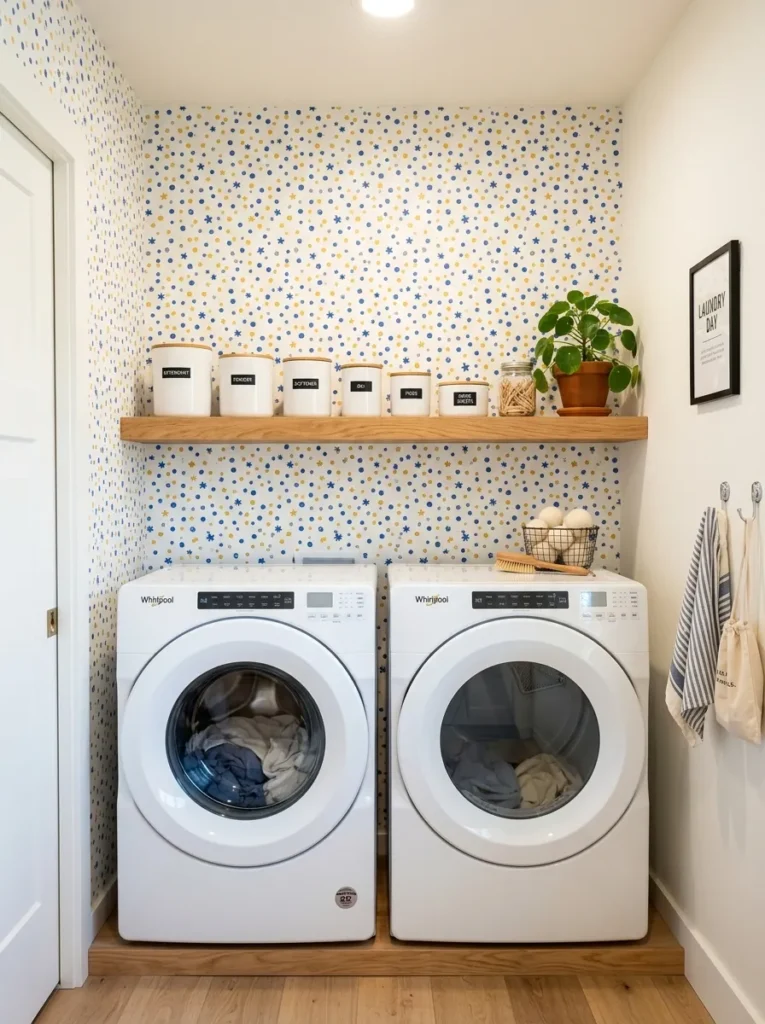
Vibe: The laundry room pattern feels like someone decided that a room used every day deserves to be pleasant every day — the simple cheerful pattern converting the most functional space in the house into one of the most visually deliberate.
Why it works: A cheerful peel and stick pattern in a laundry or utility room applies the everyday-use dignity principle — the spaces used most frequently in a home (the laundry room, the utility room, the hallway, the mudroom) are consistently the spaces given the least design attention, despite being the spaces where most inhabitants spend significant daily time. A bright, simple pattern in a laundry room costs the same as in any other application but delivers the disproportionately higher value of making a frequent-use functional space pleasant rather than merely tolerable. The vinyl-backed substrate is appropriate for laundry rooms where humidity from the washing machine and dryer creates an atmosphere comparable to a bathroom.
Application notes: Laundry rooms frequently have textured or semi-gloss painted walls (common in utility spaces for washability) — confirm the wall’s paint sheen before application. Semi-gloss paint provides better adhesion than flat paint but the surface should still be cleaned with isopropyl alcohol before application to remove detergent and moisture residue.
Shop The Look
| Product |
|---|
| Cheerful spot or star vinyl peel stick |
| Wooden shelf laundry room above |
| Uniform white laundry container set |
| Isopropyl alcohol surface prep |
| Squeegee application tool vinyl |
14. Furniture Surface Update — Wardrobe and Dresser Doors
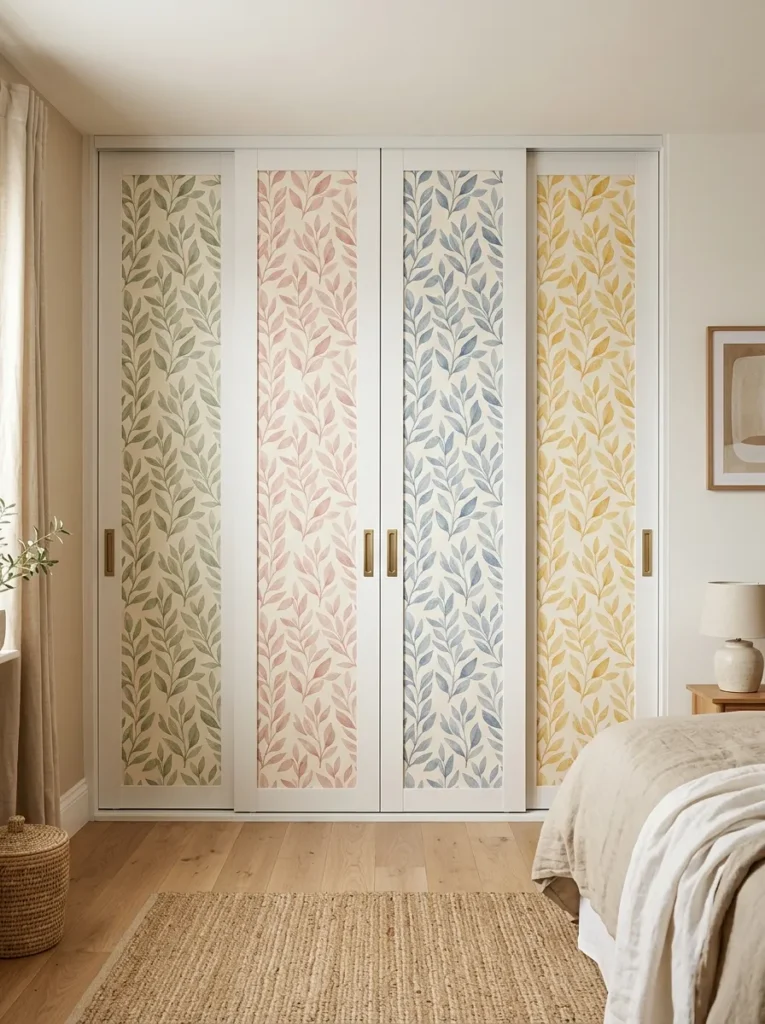
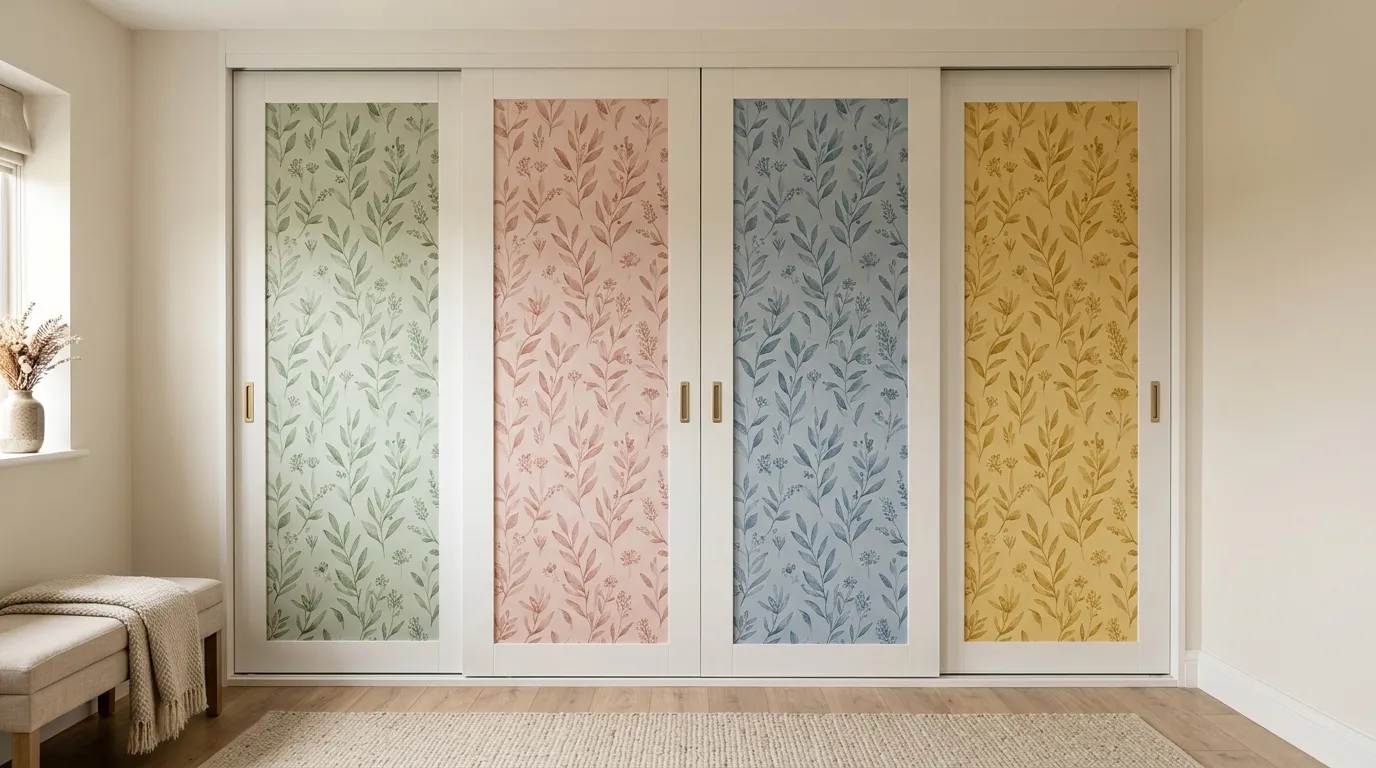
Vibe: The multi-panel wardrobe feels like the most specific and personal decorating decision in the room — the same pattern in four colors across four door panels communicating a design sensibility that could only be made by someone who thought about it specifically.
Why it works: Peel and stick wallpaper applied to furniture door panels applies the surface customization principle — the flat, smooth, factory-finished panels of standard IKEA PAX wardrobes, MALM dressers, and flat-pack furniture provide the ideal adhesion surface for peel and stick wallpaper (smooth, sealed, clean — the exact specification the adhesive requires). Applying pattern to the recessed center panel of each door (rather than the full door face) creates the appearance of a custom painted or fabric-inserted panel, referencing the tradition of fabric-backed cabinet doors and painted furniture decoration without requiring any permanent modification to the furniture. The same-pattern-different-color approach (one botanical pattern in four colorways across four panels) is the specific design decision that converts the treatment from a random pattern application into a composed furniture piece.
Application notes: Clean all door panel surfaces with isopropyl alcohol before application and allow to dry completely. Apply the paper to the recessed panel area only — measuring and cutting each panel piece precisely before application rather than applying and trimming. The furniture panel’s smooth factory surface provides better adhesion than most domestic walls, so removal should be accomplished carefully (use a credit card to lift a corner and peel slowly at an acute angle).
Shop The Look
| Product |
|---|
| Botanical peel and stick four colorways |
| Isopropyl alcohol furniture surface prep |
| Credit card lifting tool removal |
| IKEA PAX wardrobe door panel |
| Precision craft knife trim tool |
How to Start Your Peel and Stick Wallpaper Project
The single best first move before purchasing any peel and stick wallpaper is ordering sample panels — not paint chip-sized samples (which are available from most retailers for $1–5 each) but full 30×30cm or larger samples in the specific colorway and substrate being considered for the project. This sample size allows assessment of three things that smaller samples cannot reveal: the pattern repeat’s visual scale at room distance (a pattern that appears appropriately scaled on a 10cm sample can appear overwhelming at full wall scale or unexpectedly small and fussy), the substrate’s texture and thickness (which determines its application behavior and whether it will bridge minor wall texture imperfections), and the print quality at close range (the resolution of the print is visible as individual pixels or dot patterns in lower-quality products when examined at normal reading distance). Most quality peel and stick wallpaper retailers — Chasing Paper, Tempaper, Spoonflower, York Wallcoverings, and Walls Need Love — offer samples at accessible prices before full-roll purchase.
The most common mistake in peel and stick wallpaper application is not preparing the wall surface adequately before beginning. The checklist for adequate wall preparation: the wall must be smooth (no orange peel, skip trowel, or knockdown texture — sand or skim coat if textured), clean (wipe with isopropyl alcohol two hours before application), in the correct paint sheen (eggshell or satin minimum — not flat matte), fully cured (minimum 30 days from the most recent paint application), and at room temperature (below 16°C or above 29°C affects the adhesive’s performance during application). A wall that fails any of these five conditions will produce an installation that lifts, fails adhesion, or takes paint on removal. Checking all five conditions before ordering any wallpaper saves both the cost of a failed installation and the inconvenience of a damaged wall.
Three specific items under $30 that make peel and stick wallpaper application significantly more successful: a plastic smoothing squeegee ($5–8, which applies even pressure across the paper surface during application and eliminates air bubbles more effectively than a brush or cloth); a long level or laser level ($15–25, which provides the true-vertical reference line that the first panel must be aligned to — without this reference, pattern drift across multiple panels produces a visibly out-of-plumb result visible from across the room); and a roll of low-tack painter’s tape ($4–8, which allows paper strips to be temporarily held in position for pattern alignment assessment before the adhesive backing is committed to the wall). These three items combined for under $40 address the three most common application quality failures — bubbles, vertical drift, and pattern misalignment.
A simple single-wall peel and stick accent wall takes 2–4 hours for a beginner applying a pattern without a complex repeat, and costs $60–180 in material for a standard 3×2.5 metre wall. A four-wall room application takes 6–12 hours and costs $200–600 depending on room size and pattern scale. A furniture panel application takes 1–2 hours and costs $30–80 in material for a standard wardrobe door set. The sample panel order happens today; the wall preparation happens this week; and the installation happens this weekend when the preparation is complete and the confidence is established.
Frequently Asked Questions About Peel and Stick Wallpaper
Will peel and stick wallpaper damage my walls when removed?
When applied to a correctly prepared, properly cured (minimum 30 days) eggshell or satin painted wall, quality peel and stick wallpaper removes cleanly without damaging the paint surface. The conditions that cause wall damage on removal are: application to flat (matte) paint (the adhesive can bond to the paint layer rather than the wall surface, pulling the paint off with the paper), application to walls painted within 30 days (incompletely cured paint has not fully bonded to the primer and substrate, creating a weak point that the paper’s adhesive can exceed), application to textured walls (the adhesive bonds to the texture’s raised points at higher pressure, creating localized adhesion that resists clean release), and leaving the paper installed for extended periods above the manufacturer’s recommended maximum (typically 2–5 years — longer installations see adhesive migration into the paint surface). Following all four of these conditions consistently produces clean, damage-free removal in the vast majority of applications.
Can peel and stick wallpaper be used in bathrooms?
Yes, with the correct substrate specification and the correct edge treatment. Vinyl-backed peel and stick wallpaper (not woven fabric or paper-backed substrate) is appropriate for bathroom applications. Apply only to non-shower, non-bath-splash walls — the paper should not be exposed to direct water contact. Seal all paper edges with a clear silicone sealant immediately after application — this edge treatment is the critical step that prevents moisture from wicking under the paper’s edges from steam and condensation. Ventilate the bathroom adequately (extraction fan running during and after every shower or bath) to minimize the humidity that is the primary cause of edge lifting in bathroom peel and stick applications. With these three specifications (vinyl substrate, no direct water contact, sealed edges, adequate ventilation), peel and stick wallpaper can perform reliably in a bathroom for 1–3 years.
How do you match the pattern across multiple peel and stick wallpaper panels?
Pattern matching in peel and stick wallpaper uses the same process as traditional wallpaper: identify the pattern repeat length (listed in the product specifications — typically 25–80cm for most repeats), add the repeat length to the panel height measurement when calculating the quantity of paper required (this accounts for the pattern match offset at the start of each new panel), and align each new panel to the cut edge of the previous panel at the ceiling before sticking the panel to the wall. The specific technique is: apply the first panel, allowing it to extend 2cm above the ceiling line and 2cm below the skirting board (to be trimmed after adhesion). For each subsequent panel, hold it against the wall beside the first panel (without removing the adhesive backing) and slide it up or down until the pattern aligns perfectly at the seam. Only then remove the backing and apply. Most application failures occur because the backing is removed before the pattern alignment is confirmed.
How long does peel and stick wallpaper last?
Quality peel and stick wallpaper in a correctly prepared, appropriately ventilated room with moderate temperature and humidity stability lasts 3–5 years before the adhesive begins to soften or the substrate begins to show wear. In rooms with temperature extremes (south-facing rooms in summer, rooms with significant central heating adjacent to exterior walls in winter), the adhesive’s performance may reduce to 2–3 years before edge lifting occurs. Manufacturer warranties vary — Chasing Paper, Tempaper, and the highest-quality brands typically offer 2-year installation performance guarantees. Lower-priced peel and stick options (many available on Amazon and from mass-market retailers) frequently use adhesive systems that fail within 12–18 months in normal domestic conditions. The investment in a quality brand at $4–8 per square metre versus a budget alternative at $1–3 per square metre consistently produces a superior and significantly longer-lasting installation.
Can peel and stick wallpaper be applied over existing wallpaper?
Applying peel and stick wallpaper over existing traditional wallpaper is not recommended for two reasons: the existing wallpaper’s surface (which may be textured, slightly lifted at seams, or in poor adhesion condition) provides an unreliable base for the new paper’s adhesive, and the peel and stick paper’s adhesive may adhere to the existing wallpaper’s surface layer rather than to the wall itself — meaning that when the peel and stick is eventually removed, it may take sections of the existing wallpaper with it. The correct approach for walls with existing wallpaper is removal of the existing paper before peel and stick application. However, if the existing wallpaper is in excellent condition (no lifting seams, no bubbles, no texture irregularities) and is printed rather than embossed (smooth surface, not textured), some manufacturers permit application over existing paper with the addition of a primer coat applied over the existing paper and allowed to cure fully before the peel and stick is applied.
Ready to Transform Your Walls?
These 14 ideas move through every room, every aesthetic, and every application complexity level — from the immersive botanical mural living room that reads as a custom painted wall to the staircase riser pattern sequence that makes every ascent a designed experience, from the bold moody floral bedroom feature wall to the laundry room cheerful spot pattern that transforms the most utilitarian space in the house into a pleasant daily destination. Starting with the sample panel order — three or four candidates for the specific room in the specific colorway being considered — is not a cautious approach to decorating. It is the approach that produces the most confident final decision, because the sample panel on the actual wall in the actual room’s specific light conditions reveals the pattern at its true scale and color temperature in a way that a screen image or a paint chip never can. Order the samples this week, hold them against the prepared wall in the morning light and the evening lamp, and let the wall show you which pattern belongs there. The application follows the weekend after the decision is made, and the room that results will be genuinely transformed.