20 Blue Tile Bathroom Ideas for Bold Style Looks
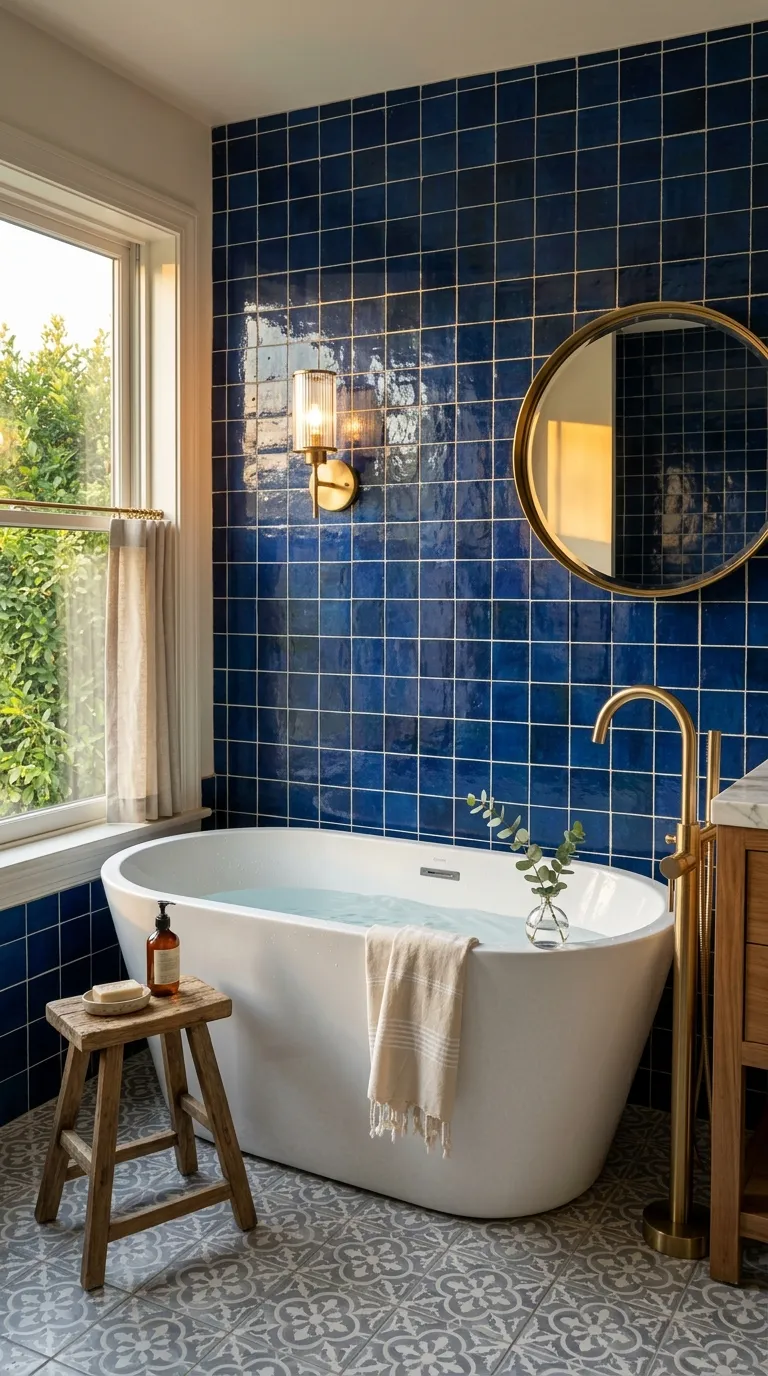
Blue tile bathrooms are spaces where saturated color and reflective glaze work together to feel bold without needing extra square footage the color itself does the heavy lifting.
This article gathers 20 blue tile bathroom ideas for bold style looks, moving through color, material, lighting, layout, furniture, accessories, and small-space adaptations so you can find the combination that fits your own room.
Walk into a bathroom wrapped in blue tile and the light behaves differently. It pools in glossy grout lines, deepens in the corners near evening, and turns an ordinary morning routine into something quieter and more grounded.
There’s a weight to a navy tub surround and a flicker to a cerulean mosaic catching afternoon sun that a painted wall simply can’t replicate.
Here are 20 ideas worth saving and stealing.
Why Blue Tile Bathrooms Work So Well
Blue tile in bathrooms draws from several design lineages at once: the hand-glazed zellige tradition of Morocco, the cobalt-and-white palettes of Portuguese azulejos, and the mid-century American fascination with colored bathroom suites.
What separates a true blue tile bathroom from a simply painted one is that the color lives inside a permanent, light-reactive material, so the room’s mood genuinely shifts with the hour.
Cobalt, navy, cerulean, teal, and deep indigo dominate this style, usually paired with brushed or unlacquered brass fixtures, white marble-look countertops, and warm oak or walnut vanities. Popular formats include handmade zellige squares, glossy ceramic subway tile, fluted panel tile, and small-format mosaic or penny tile for floors, finished in either white grout for contrast or charcoal grout for a more monochrome, ink-dipped effect.
Interest in colored bathroom tile has climbed steadily as homeowners move away from the all-white, resale-safe bathrooms that dominated the last decade, choosing instead to treat even powder rooms as spaces for personal expression a shift tied to more time spent at home and less patience for rooms that feel like a placeholder.
Small bathrooms can absolutely carry this look, and a saturated tile sometimes reads even better in a compact room because there’s less surface competing with it. The priority is choosing one dominant blue and running it floor-to-ceiling or wall-to-wall rather than blending several blue tones, which can make a tight room feel cluttered instead of immersive.
Style at a Glance
| Element | Color-Forward | Material-Forward |
|---|---|---|
| Philosophy | color as the room’s focal point | tactile glaze, texture, and handmade imperfection |
| Materials | ceramic subway tile, mosaic tile | zellige, fluted panels, terrazzo-chip tile |
| Color palette | cobalt, navy, cerulean, teal | deep indigo, marine blue, slate blue |
20 Blue Tile Bathroom Ideas
1. Cobalt Blue Statement Wall Tile
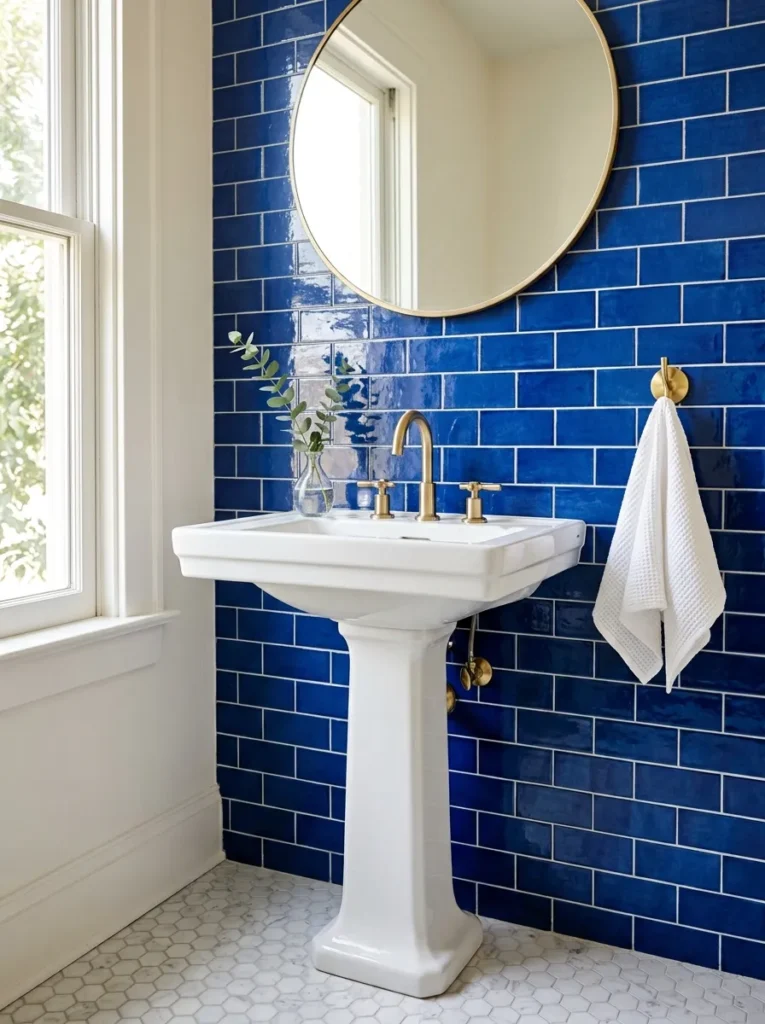
Vibe: Immersive and confident, like stepping into a small pool of color.
Why it works: A single saturated wall creates a clear focal point without overwhelming the whole room, using contrast between glossy tile and matte white fixtures to keep the eye anchored. The remaining three walls stay quiet so the cobalt reads as intentional rather than accidental.
How to get it: Tile only the wall behind the sink or tub, floor to ceiling, and keep the other walls painted a warm white like Benjamin Moore’s Simply White. Use white grout for crisp lines that let the glaze do the talking.
Quick Win: Peel-and-stick cobalt tile panels can mimic this look temporarily behind a pedestal sink for under $40.
Shop The Look
| Product |
|---|
| Cobalt blue glazed ceramic wall tile sample pack |
| White pedestal sink round modern |
| Brushed brass towel hook single |
| Small glass bud vase clear |
| White waffle weave hand towel set |
2. Handmade Zellige Blue Tile Backsplash
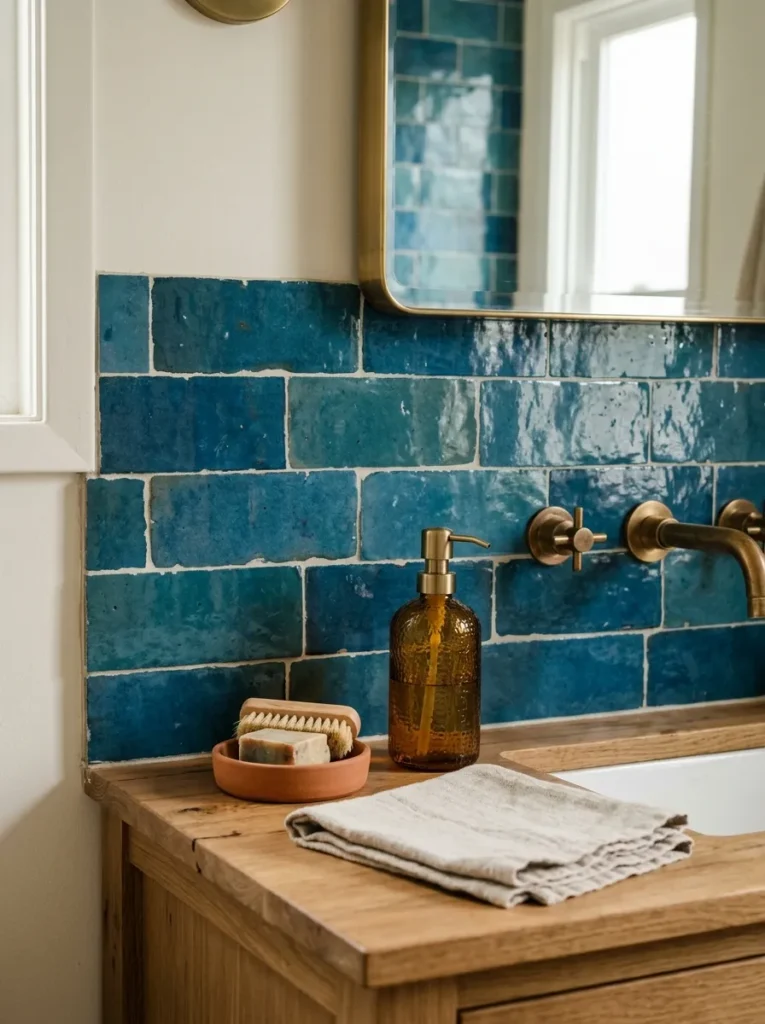
Vibe: Textured and alive, never quite the same tile twice.
Why it works: Zellige tile is hand-cut and kiln-fired individually, so no two pieces match exactly, giving the wall a rippled, handmade quality that machine-made tile can’t replicate. This variation reads as craftsmanship rather than imperfection.
How to get it: Order zellige in a marine blue tone and lay it in a simple running bond pattern so the natural color variation, not the layout, carries the visual interest. Pair with unlacquered brass fixtures that will patina alongside the tile over time.
Shop The Look
| Product |
|---|
| Handmade zellige-style ceramic tile marine blue |
| Unlacquered brass bathroom faucet |
| Amber glass soap dispenser pump |
| Small terracotta trinket dish |
| Linen hand towel set natural |
3. Warm Brass Sconces Against Navy Tile
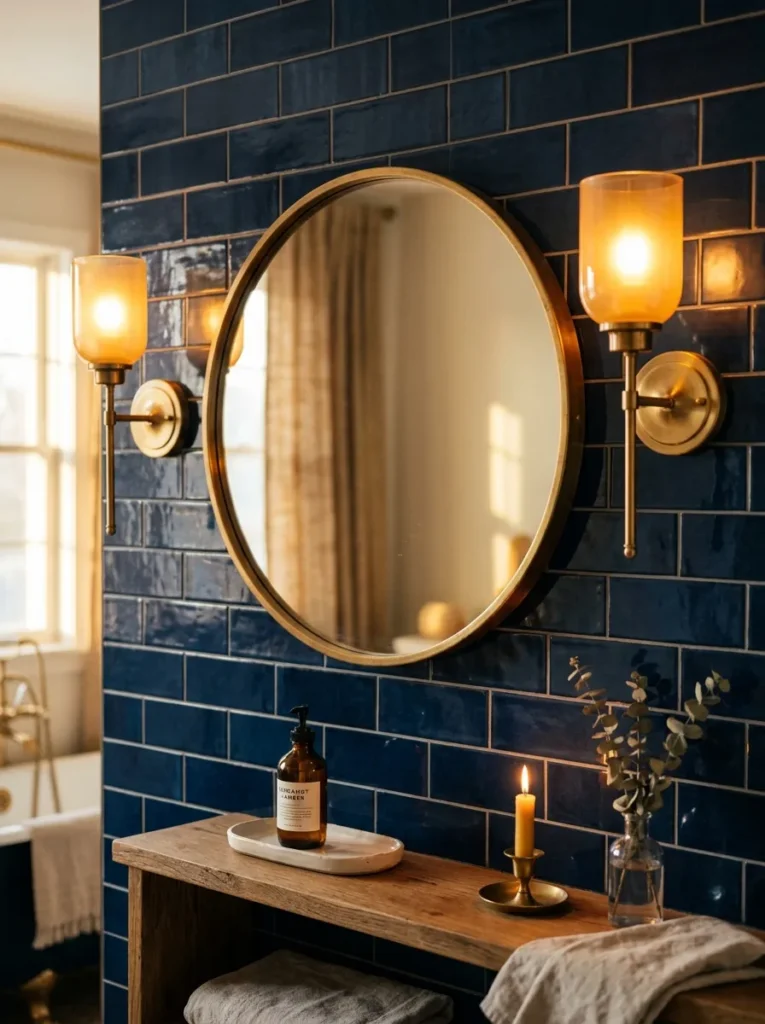
Vibe: Warm and hushed, like candlelight caught in dark water.
Why it works: Navy tile absorbs light rather than bouncing it, so warm-toned brass sconces placed at face height counteract the darkness and prevent the wall from feeling like a void. This is a matter of light temperature: cool LED bulbs would fight the navy, while 2700K warm bulbs complement it.
How to get it: Mount two brass sconces at eye level flanking a round mirror, using 40-watt equivalent warm bulbs rated around 2700K. Keep the tile matte or satin finish rather than high-gloss so the light softens instead of glares.
Quick Win: A plug-in brass sconce with a hardwired look can be added without an electrician for around $45.
Shop The Look
| Product |
|---|
| Brushed brass wall sconce warm light |
| Round brass framed mirror |
| Small ceramic vanity tray oval |
| Unscented pillar candle white |
| Warm white 2700K vanity bulb pack |
4. Freestanding Tub with Navy Herringbone Tile Surround
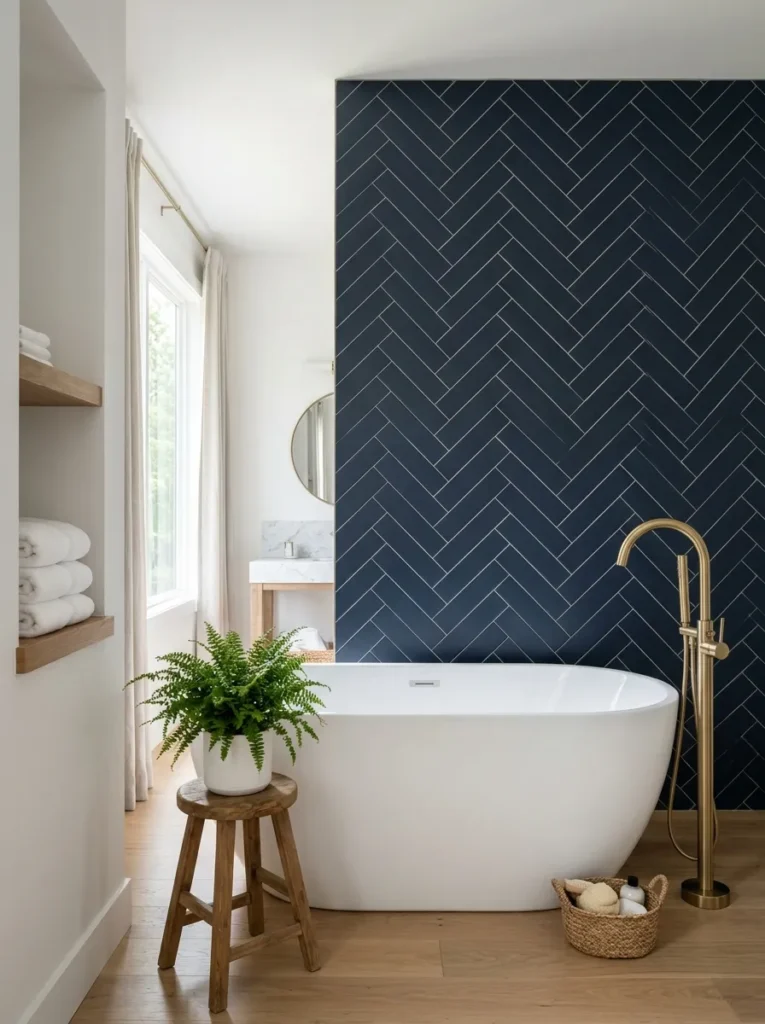
Vibe: Still and deliberate, a room built around one anchor piece.
Why it works: A herringbone layout adds visual movement to a single-color tile field, using diagonal lines to break up what could otherwise feel like a flat block of navy. The white tub reads as sculptural against the dense pattern behind it.
How to get it: Run navy herringbone tile only on the wall directly behind the tub, from floor to ceiling, and keep the tub itself in matte white acrylic or cast iron for maximum contrast.
Shop The Look
| Product |
|---|
| Freestanding acrylic soaking tub white |
| Brass floor mount tub filler faucet |
| Small teak bath stool |
| Rolled bath towel set navy trim |
| Potted fern artificial small |
5. Layered Textiles in Indigo and Cream
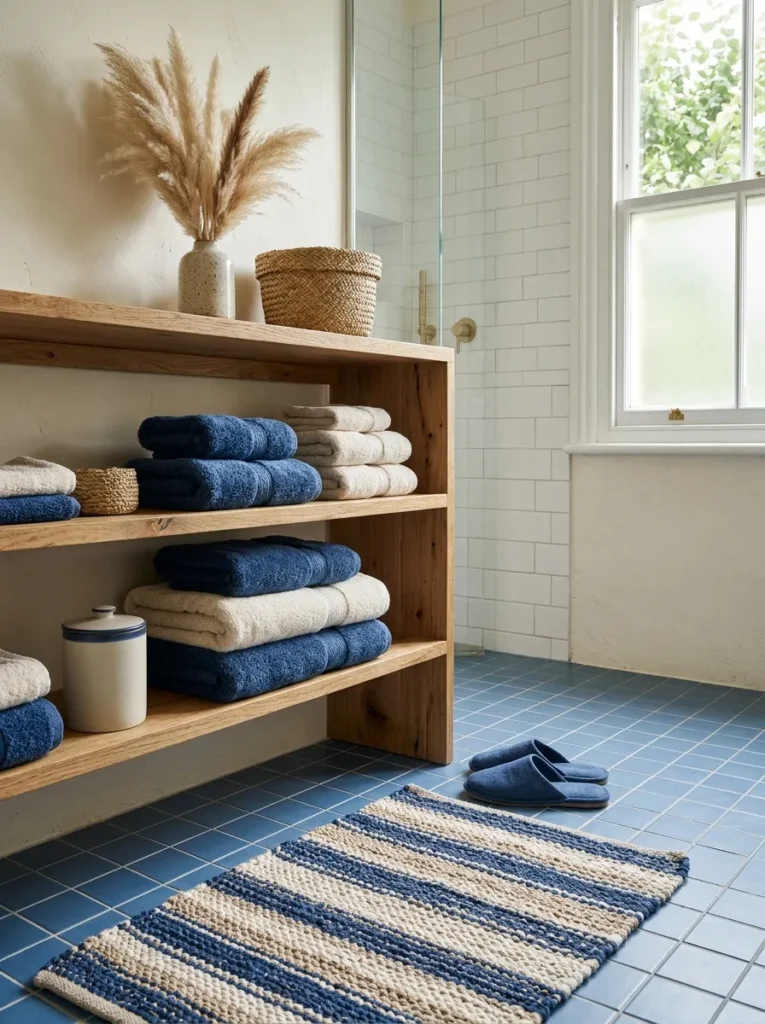
Vibe: Layered and soft, a counterpoint to all that hard glazed surface.
Why it works: Tile-heavy bathrooms can feel cold without textile layering, so pairing an indigo woven bath mat with cream towels introduces softness and warmth through fabric weight and texture rather than fighting the tile’s color. This layering also breaks up the visual weight of the blue.
How to get it: Choose a chunky cotton bath mat in indigo, stack two cream waffle-weave towels on open shelving, and add one woven basket for visual texture contrast against the smooth tile.
Quick Win: A single new bath mat in a complementary tone can refresh the whole room’s feel for under $30.
Shop The Look
| Product |
|---|
| Indigo cotton chunky bath mat |
| Cream waffle weave bath towel set |
| Open wood wall shelf bathroom |
| Woven seagrass storage basket small |
| Ceramic canister with lid cream |
6. Two-Tone Navy and White Half Wall Tile
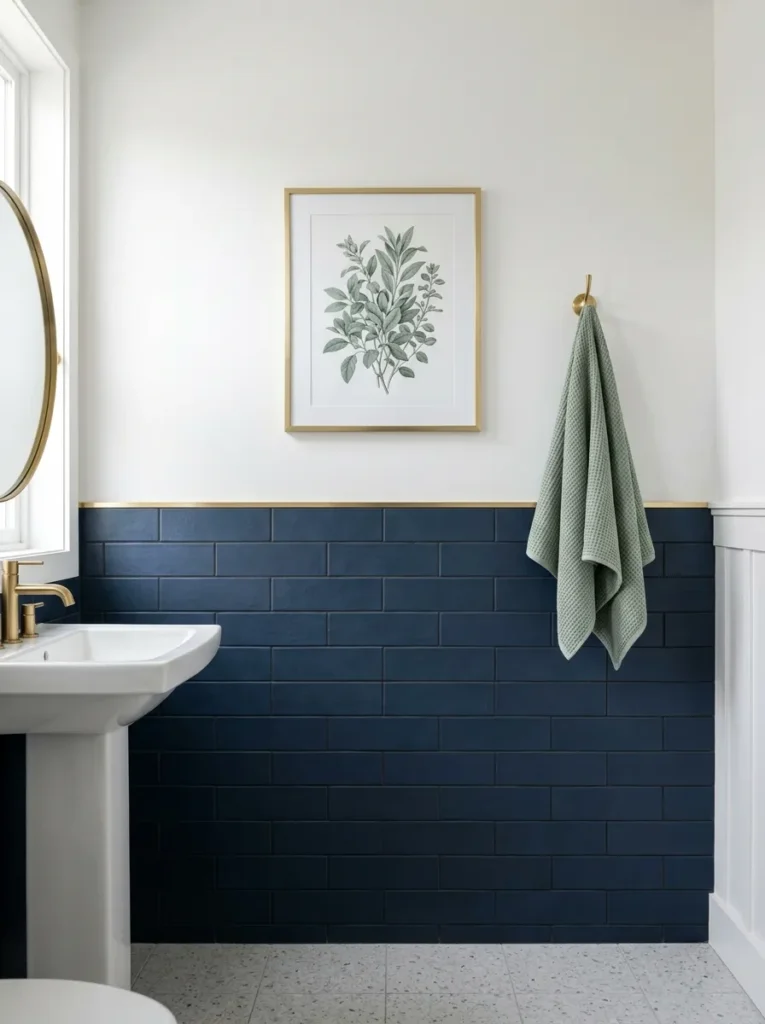
Vibe: Crisp and tailored, like a wainscoted room reimagined.
Why it works: Splitting the wall into two zones uses proportion the way traditional wainscoting does, keeping the navy at a height that reads as grounding rather than closing the room in. The brass divider strip gives the eye a clean stopping point between materials.
How to get it: Tile the lower 42 inches of the wall in navy and paint the upper portion in a soft white, separating the two with a quarter-inch brass Schluter strip rather than wood trim, which keeps the transition sleek.
Shop The Look
| Product |
|---|
| Navy blue ceramic wall tile matte |
| Brass tile edge trim strip |
| Framed botanical line art print |
| Small brass wall hook |
| White cotton hand towel |
7. Glossy Cerulean Subway Tile
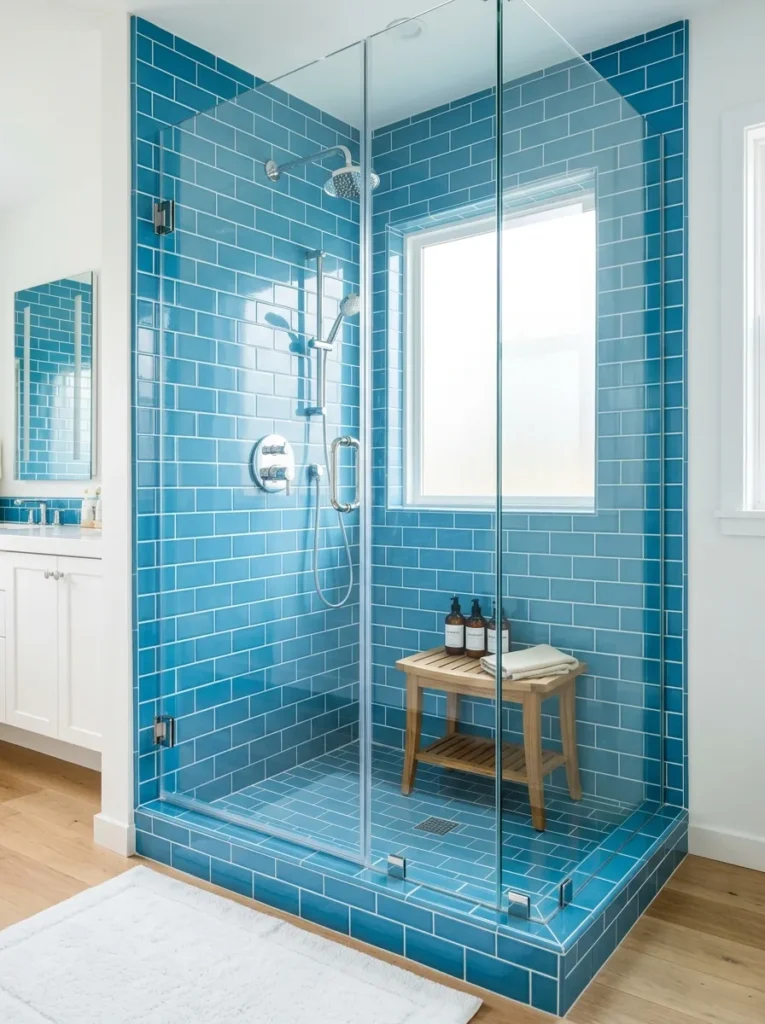
Vibe: Luminous and clean, a color that seems to hum under bright light.
Why it works: Glossy subway tile reflects light back into the room, which is why cerulean, a lighter and brighter blue, works especially well in a wet, enclosed space like a shower where natural light is limited. The classic offset pattern keeps the look timeless rather than trendy.
How to get it: Use a 3-by-6-inch glossy ceramic subway tile in cerulean, laid in a one-third offset rather than a straight stack, with white grout to maximize brightness in the enclosure.
Quick Win: Swapping only the shower niche tile to cerulean subway tile is a lower-cost way to test the color before committing to the whole stall.
Shop The Look
| Product |
|---|
| Cerulean blue glossy ceramic subway tile |
| Chrome rain shower head fixed |
| Teak wood shower stool |
| Glass amber bath bottle set |
| Waffle weave cotton washcloth set |
8. Powder Room Blue Tile Wrap
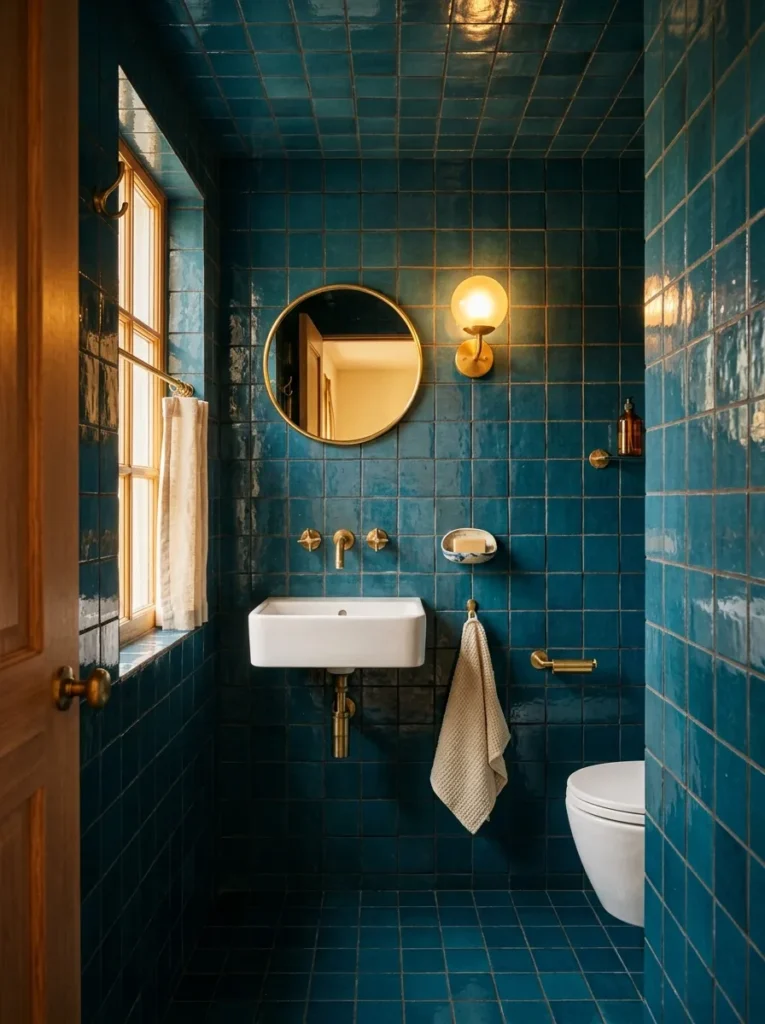
Vibe: Immersive and enveloping, a jewel box rather than a cramped afterthought.
Why it works: Wrapping every surface, floor, walls, and even the ceiling, in a single teal tile removes the visual seams that make a small room feel chopped up, so the eye reads the space as one continuous volume rather than a series of small walls.
How to get it: Choose one deep teal tile in a small format like 2-by-2-inch mosaic and use it on the floor, walls, and ceiling without switching materials, keeping fixtures minimal and wall-mounted to preserve floor space.
Shop The Look
| Product |
|---|
| Deep teal 2×2 mosaic ceramic tile |
| Wall mounted compact bathroom sink |
| Small round brass framed mirror |
| Brass wall sconce single light |
| Ceramic soap dish small oval |
9. Skylight Above Deep Teal Tile
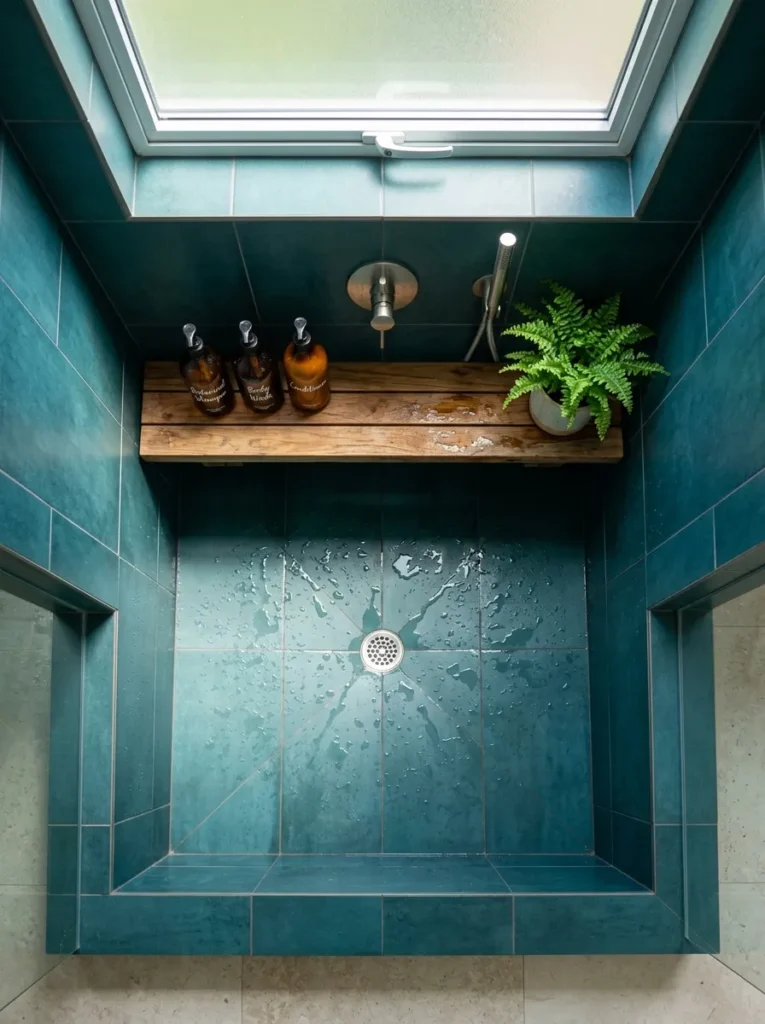
Vibe: Airy and sun-warmed, a dark tile made bright by a single light source.
Why it works: A skylight introduces top-down natural light that changes intensity throughout the day, which is especially effective with deep teal tile because the color shifts from moody in early morning to almost turquoise at midday. This is a matter of light direction rather than tile choice alone.
How to get it: If a full skylight isn’t feasible, a tubular daylight skylight can achieve a similar top-lit effect in an interior shower for a fraction of the cost and installation time.
Quick Win: A battery-powered puck light installed inside a shower niche can mimic overhead brightness where no skylight is possible.
Shop The Look
| Product |
|---|
| Teak wood shower corner shelf |
| Amber glass shower bottle set |
| Small potted plant faux green |
| Battery LED puck light warm white |
| Tubular skylight kit small |
10. Floating Vanity Against Blue Tile Wall
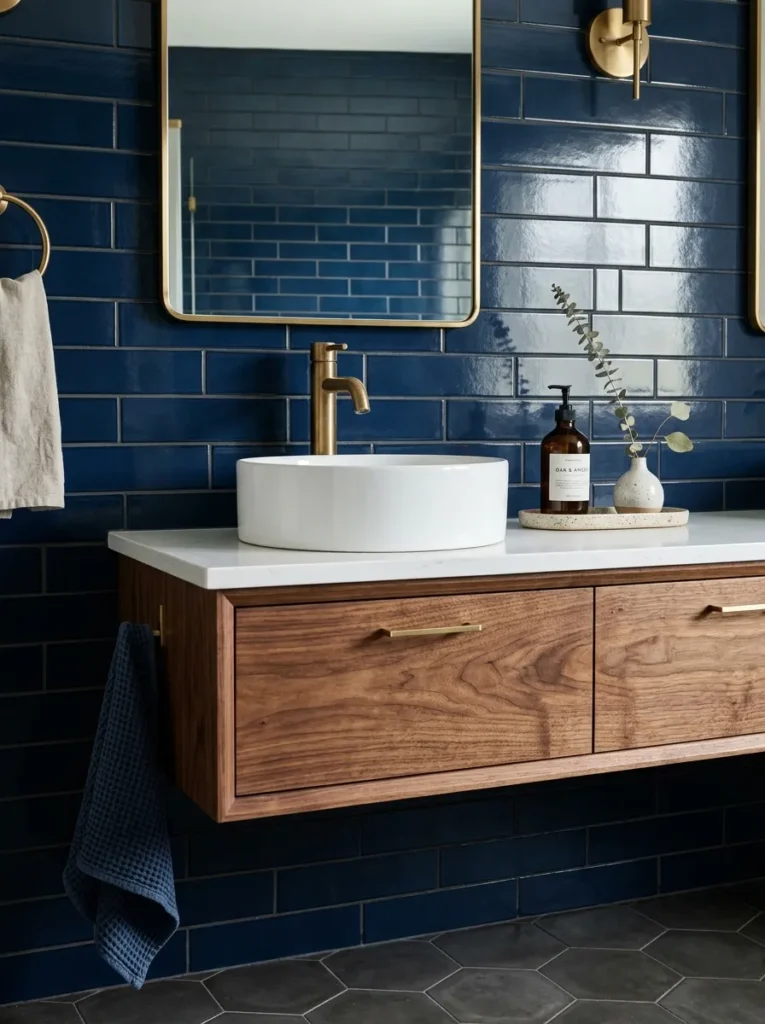
Vibe: Grounded yet light, weight and openness in the same frame.
Why it works: Mounting the vanity off the floor creates negative space that visually lightens the navy tile above it, using the principle that floor visibility, even a narrow strip, makes a saturated room feel less enclosed. The walnut wood tone also warms up the cool blue.
How to get it: Choose a floating walnut vanity roughly 30 inches wide, mounted 32 inches from the floor, so at least a foot of floor tile remains visible beneath it.
Shop The Look
| Product |
|---|
| Floating walnut bathroom vanity 30 inch |
| Brushed brass single hole faucet |
| Small ceramic vanity tray rectangular |
| Glass bud vase small clear |
| Round brass drawer pulls set |
11. Ombre Blue Tile Gradient
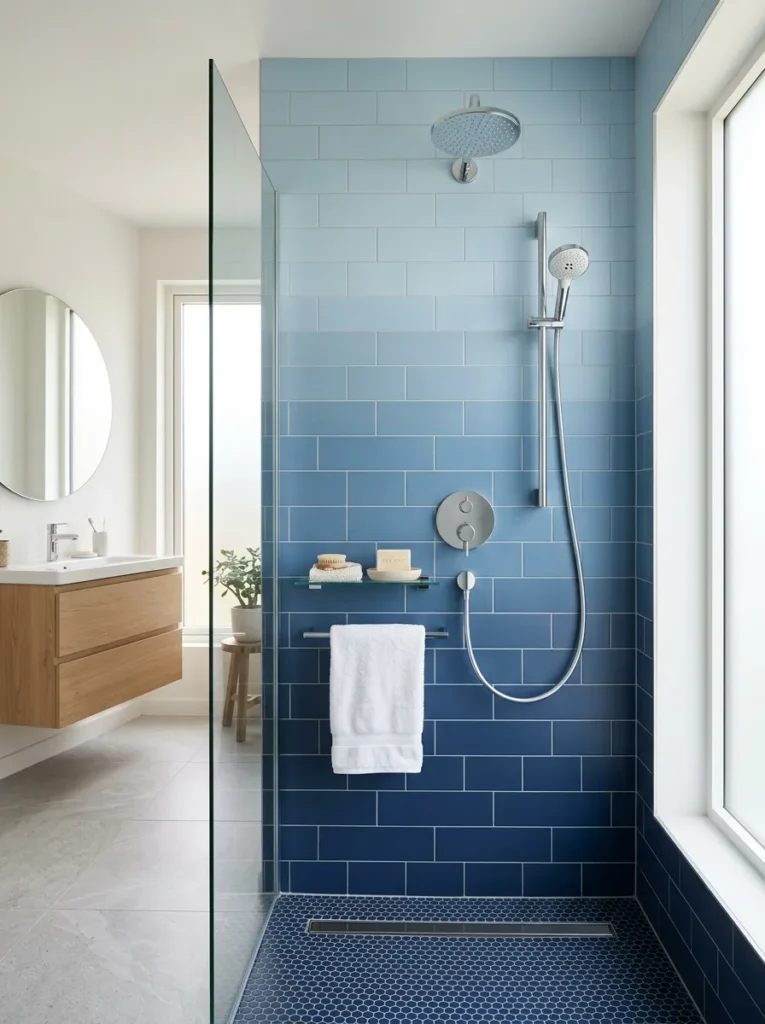
Vibe: Serene and dreamlike, a wall that shifts like water at dusk.
Why it works: A gradient tile layout uses value progression, light to dark, to create depth on a flat wall, mimicking the way natural light fades near a floor. This technique adds visual interest without introducing a second color family.
How to get it: Order the same tile in four to five shades of blue and lay them in horizontal bands from lightest at the ceiling to darkest at the floor, keeping grout color consistent throughout so the gradient reads smoothly.
Quick Win: A pre-made ombre tile sheet mosaic can achieve this gradient in a single order without custom sequencing.
Shop The Look
| Product |
|---|
| Ombre blue gradient mosaic tile sheet |
| Chrome shower shelf corner mount |
| White cotton bath towel set |
| Ceramic soap dish oval |
| Handmade soap bar unscented |
12. Brass and Blue Ceramic Vignette
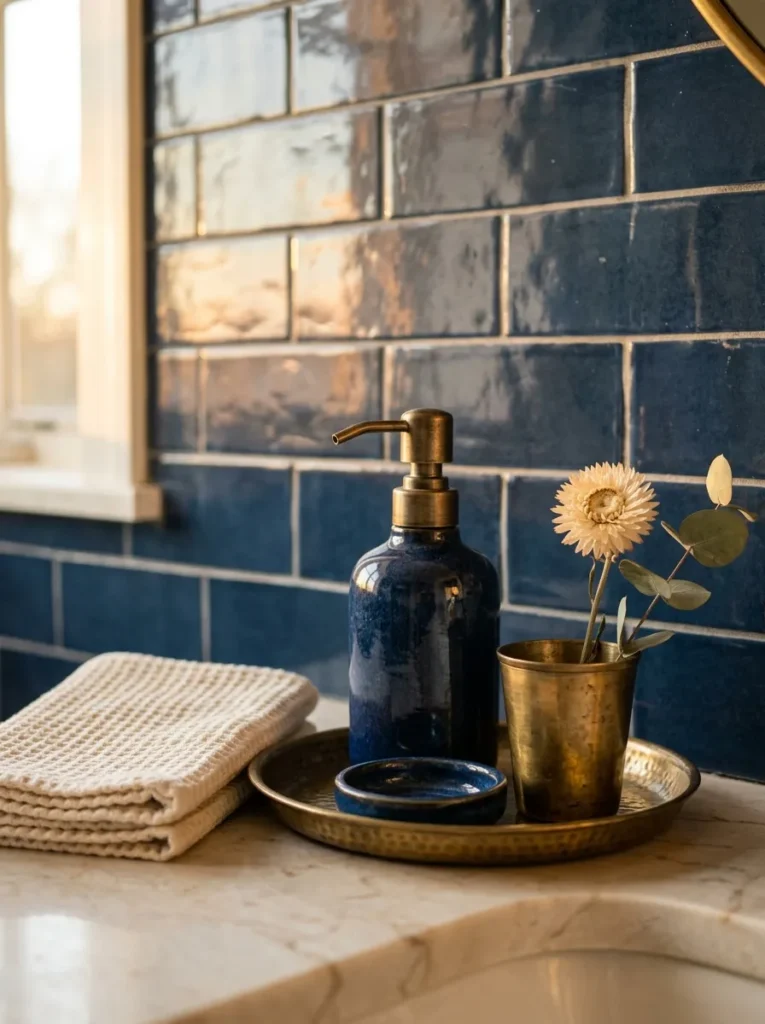
Vibe: Warm and curated, a small still life on an ordinary counter.
Why it works: Grouping a few brass and blue-glazed objects together on a tray uses the design principle of visual weight, giving the countertop a deliberate focal point instead of scattered clutter, while echoing the tile color in a smaller, tactile form.
How to get it: Arrange a brass tray with a matching blue ceramic soap dispenser, a brass tumbler, and a small dried floral stem, keeping the grouping to three or four objects of varying height.
Shop The Look
| Product |
|---|
| Brass rectangular vanity tray |
| Blue glazed ceramic soap dispenser |
| Brass tumbler cup small |
| Dried pampas stem single |
| Linen washcloth set cream |
13. Fluted Blue Tile Panels
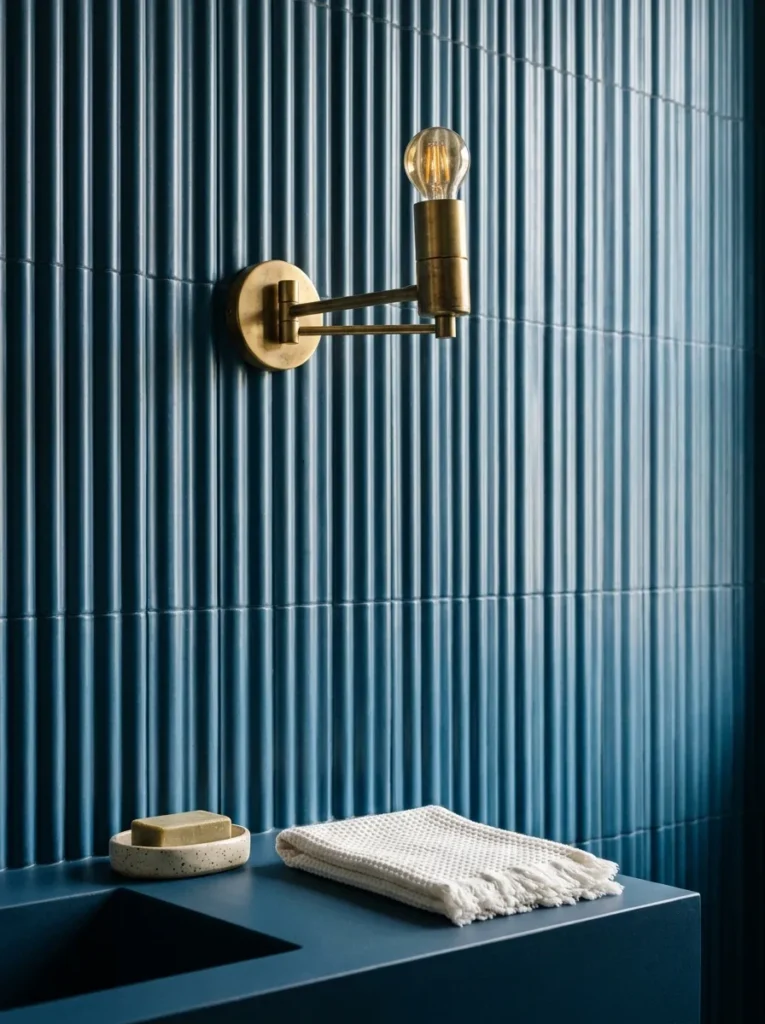
Vibe: Sculptural and tactile, a wall that changes as the light moves.
Why it works: Fluted, three-dimensional tile catches side light differently than flat tile, casting subtle shadow lines that add texture and movement to the wall throughout the day, a technique borrowed from architectural paneling rather than traditional tilework.
How to get it: Install fluted ceramic panel tile vertically on a single feature wall and light it from the side with a wall sconce rather than overhead lighting, so the ribbing casts visible shadow.
Quick Win: Fluted tile in a smaller sample size can be used just behind a mirror as a low-cost test of the texture.
Shop The Look
| Product |
|---|
| Fluted ribbed ceramic tile marine blue |
| Brass wall sconce directional light |
| Small ceramic trinket dish |
| White linen hand towel |
| Adjustable warm LED bulb |
14. Wet Room Zoning with Blue Tile
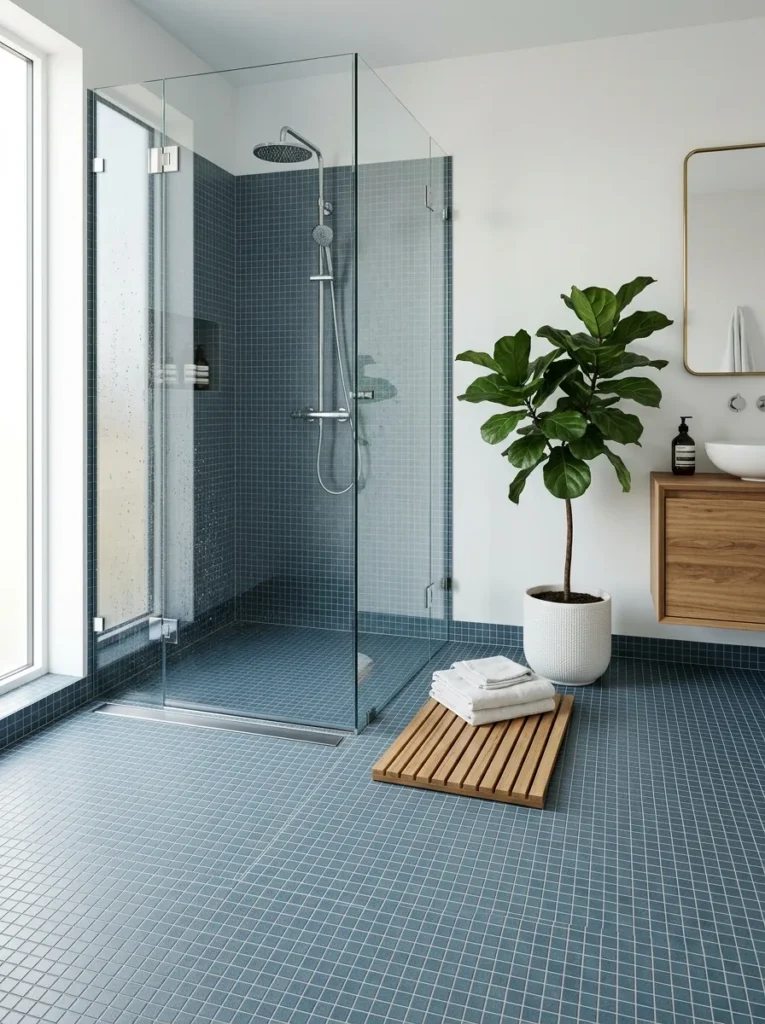
Vibe: Open and continuous, one room instead of separate compartments.
Why it works: Running the same slate blue tile across both the wet and dry zones, divided only by a glass panel rather than a curb, uses material continuity to make a small footprint feel larger, since the eye doesn’t register a break in the floor plane.
How to get it: Use a single slotted floor drain and a frameless glass divider instead of a shower curb, keeping the same tile and grout color on both sides of the glass.
Shop The Look
| Product |
|---|
| Slate blue non-slip floor tile |
| Frameless glass shower divider panel |
| Teak wood slatted bath mat |
| Small potted plant faux |
| Rolled bath towel stack set |
15. Moody Navy Ceiling Tile
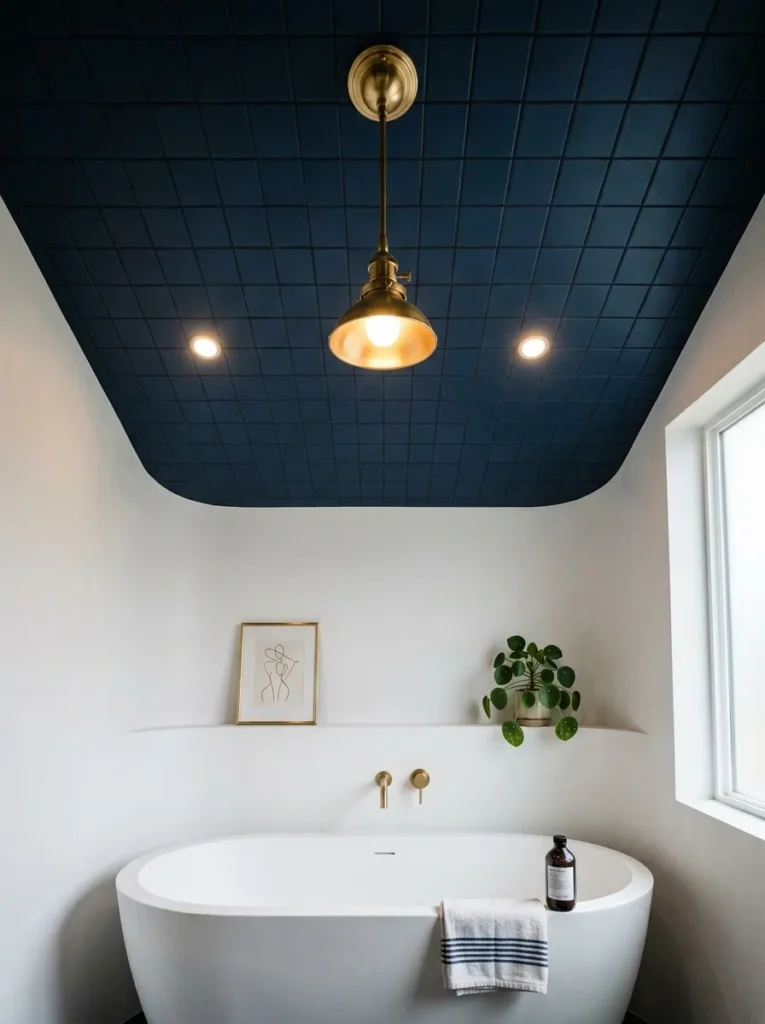
Vibe: Moody and enveloping, a fifth wall reimagined overhead.
Why it works: Tiling the ceiling instead of a wall is an unexpected use of the “fifth wall” concept, drawing the eye upward and making a plain white-walled room feel intentional and layered without adding any color at eye level.
How to get it: Keep the walls and floor in white or pale stone and tile only the ceiling in matte navy, adding a single brass pendant fixture as the room’s other point of contrast.
Quick Win: Painting the ceiling in a deep navy eggshell finish approximates this look for a fraction of the cost of tile.
Shop The Look
| Product |
|---|
| Navy matte ceramic ceiling tile |
| Brass pendant light fixture small |
| White cotton bath towel |
| Recessed LED ceiling light warm |
| White marble-look floor tile |
16. Candlelit Blue Tile Alcove
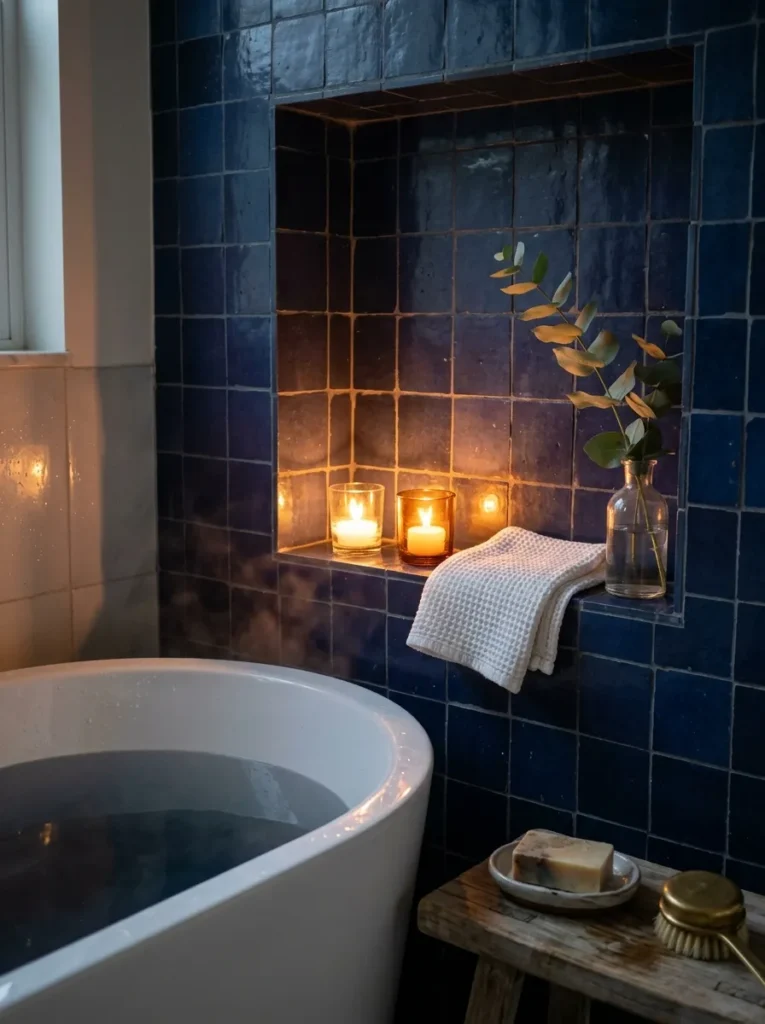
Vibe: Hushed and warm, a corner made for slowing down.
Why it works: A recessed alcove tiled in indigo and lit only by candlelight relies on low, warm light sources to make the deep color feel intimate rather than dark, a contrast to overhead lighting which would flatten the tile’s depth.
How to get it: Build a small recessed niche beside the tub, tile it in matte indigo, and light it with two or three glass candle holders rather than an electric fixture, keeping the rest of the room’s lighting dim during bath time.
Shop The Look
| Product |
|---|
| Matte indigo ceramic niche tile |
| Glass votive candle holder set |
| Unscented soy candle white |
| Linen washcloth set |
| Small brass candle snuffer |
17. Built-in Bench with Blue Mosaic
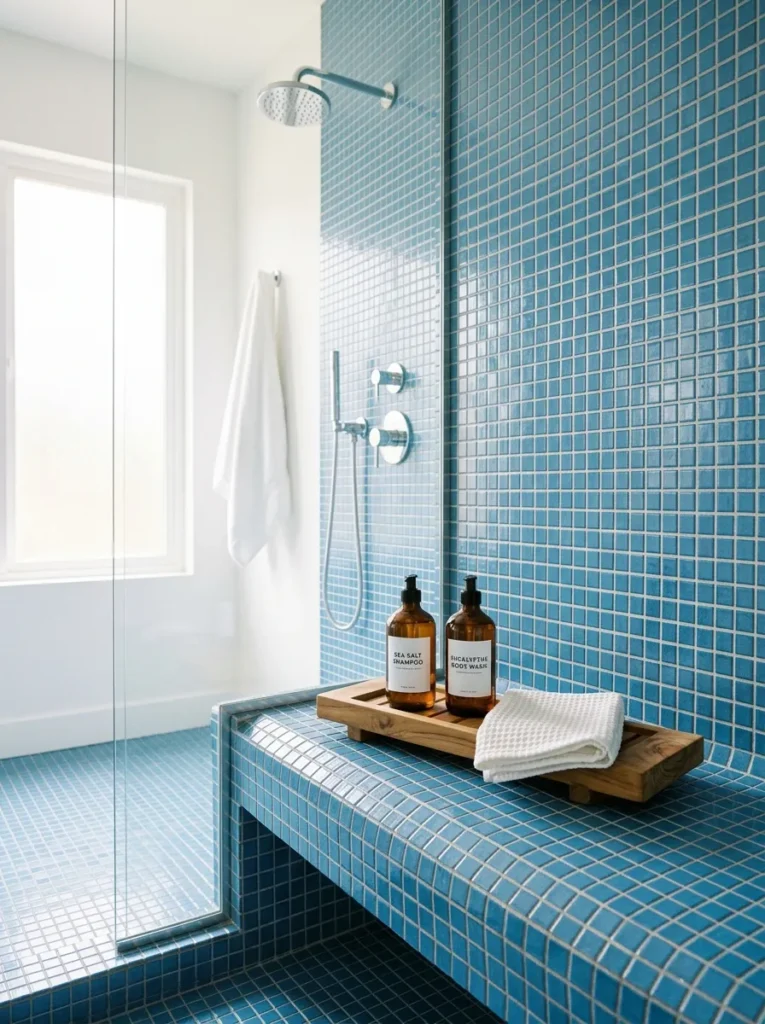
Vibe: Functional and calm, a seat that doesn’t interrupt the tile’s flow.
Why it works: A built-in bench tiled in the same mosaic as the surrounding walls disappears into the room rather than reading as an added fixture, following the principle that matching material eliminates visual competition between furniture and surface.
How to get it: Use the same small-format cerulean mosaic on the bench as the walls, sloping the seat slightly for drainage, and skip a separate bench material like teak or stone that would otherwise break the continuity.
Shop The Look
| Product |
|---|
| Cerulean blue mosaic tile sheet |
| Teak wood shower caddy hanging |
| Amber glass bottle set refillable |
| Linen washcloth natural |
| Non-slip shower mat clear |
18. Terrazzo-Style Blue Chip Tile Floor
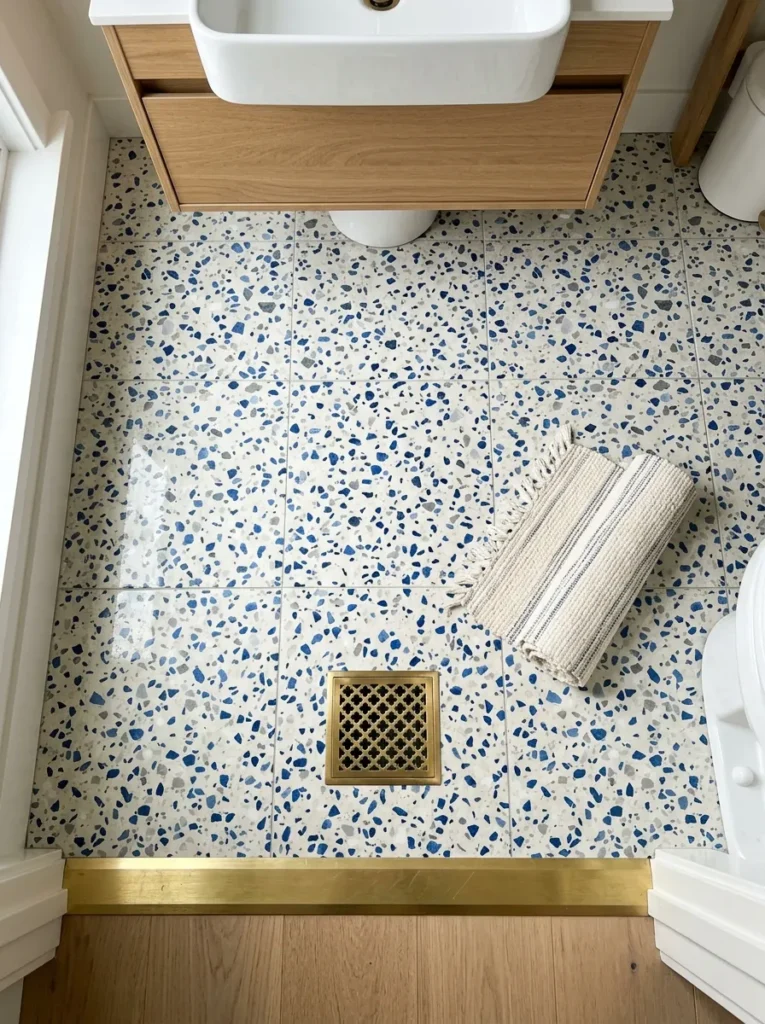
Vibe: Playful and light, a floor with movement instead of a flat block of color.
Why it works: Terrazzo-style tile introduces blue in flecked form rather than as a solid field, which lets a bathroom incorporate the color on the floor without competing with a bolder wall tile above it, using scale contrast between large chips and fine grout lines.
How to get it: Choose a terrazzo-look porcelain tile with visible blue and gray chips, laid with minimal grout lines, and pair it with plain white walls so the floor becomes the room’s main color statement.
Quick Win: A terrazzo-print vinyl floor tile can replicate this look temporarily for renters at a fraction of the tile cost.
Shop The Look
| Product |
|---|
| Terrazzo-look porcelain floor tile blue fleck |
| Brass floor transition strip |
| Brass floor vent cover round |
| White cotton bath mat |
| Small ceramic drain cover decorative |
19. Framed Art Against Blue Tile
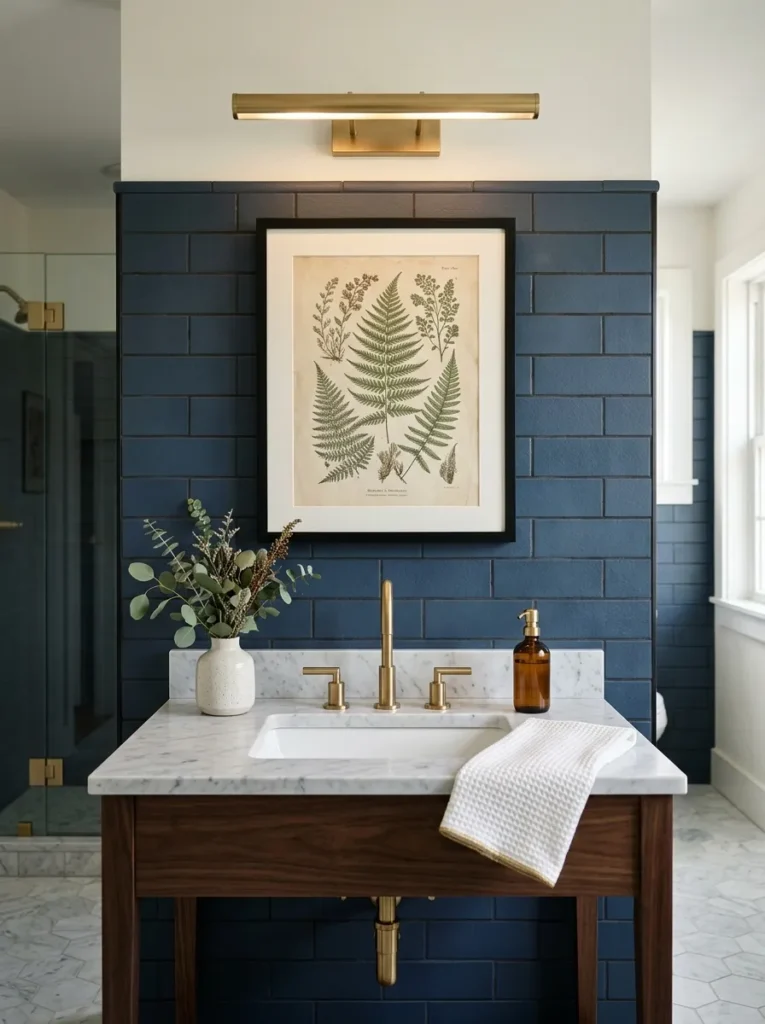
Vibe: Composed and grown-up, a bathroom that borrows from living-room styling.
Why it works: Hanging framed art directly on tile, rather than reserving art for painted walls, treats the bathroom as a fully designed room and uses the tile’s uniform pattern as a neutral backdrop that lets a single black frame stand out through contrast.
How to get it: Choose one botanical or abstract print in a slim black frame and mount it with tile-rated adhesive picture hooks directly on the navy subway tile, adding a small brass picture light above for emphasis.
Shop The Look
| Product |
|---|
| Black framed botanical wall art print |
| Brass picture light small |
| Tile-rated adhesive picture hooks |
| Small ceramic bud vase |
| Brass single hole vanity faucet |
20. Vertical Blue Tile Illusion for Narrow Bath
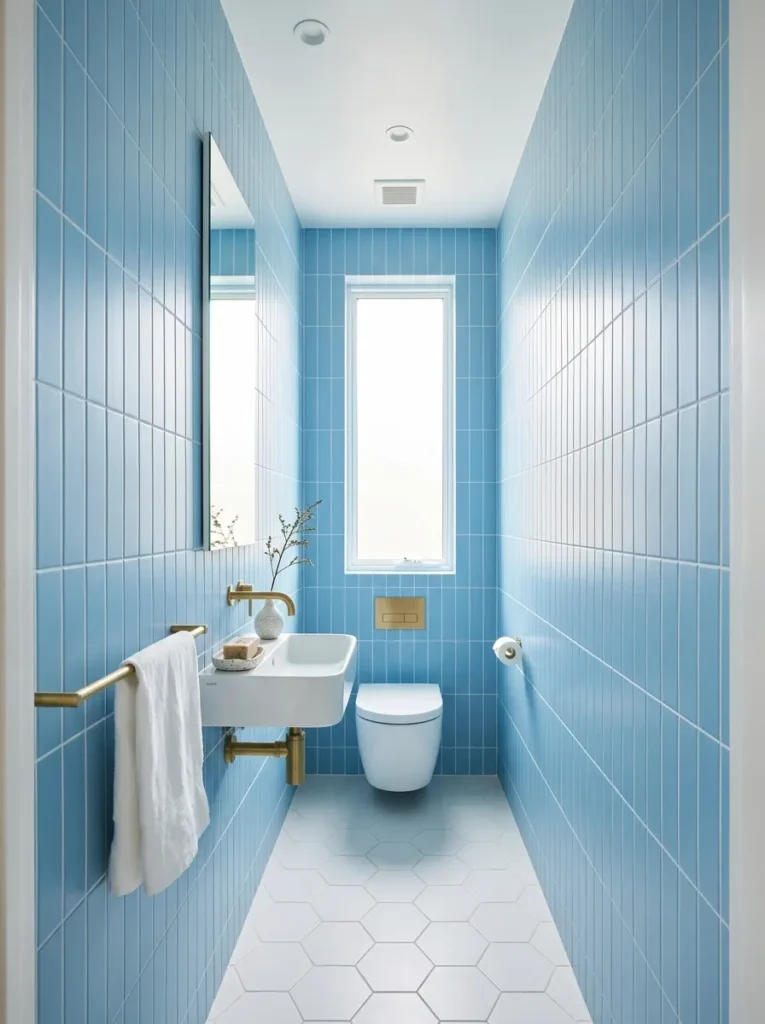
Vibe: Airy and elongated, a narrow room that stops feeling narrow.
Why it works: Laying tile in a vertical stack rather than horizontal offset draws the eye upward, using the same optical principle as vertical stripes in clothing to make a low or narrow room read as taller than it is.
How to get it: Choose a rectangular sky blue tile and install it in a straight vertical stack rather than a running bond, pairing it with a tall narrow mirror that continues the upward line.
Quick Win: A vertically hung tall mirror alone, even without retiling, can visually stretch a narrow bathroom.
Shop The Look
| Product |
|---|
| Sky blue rectangular ceramic tile |
| Tall narrow brass framed mirror |
| Slim brass towel bar |
| Small ceramic soap dish |
| Single stem glass bud vase |
How to Start Your Blue Tile Bathroom Transformation
The single best first move is choosing your exact blue before anything else pull a physical tile sample of a true navy or cerulean and view it in your bathroom’s actual light at both morning and evening, since undertone shifts dramatically under warm versus cool bulbs. This one decision anchors every fixture, grout, and metal finish choice that follows.
The most common mistake is mixing two different blue undertones, one warm and cobalt, one cool and slate, within the same room, which reads as a mismatch rather than intentional layering. The fix is simple: pick one blue family and let secondary elements like towels or art introduce contrast instead of a second tile tone.
Three budget entry points under $50 each: a brass towel hook set to introduce warm metal, a single stem of eucalyptus in a small glass bud vase for softness, and a two-pack of warm-white LED vanity bulbs to correct any harsh overhead lighting that flattens the tile’s color.
A full retile typically takes one to two weeks of labor and runs from $2,500 for a powder room to well over $12,000 for a primary bathroom with a walk-in shower, while a starter version using accessories, lighting, and a single accent wall can be completed in a single weekend for under $300.
Frequently Asked Questions About Blue Tile Bathrooms
What’s the difference between a blue tile bathroom and a navy accent wall bathroom?
A full blue tile bathroom uses tile as the dominant, permanent finish across multiple surfaces like the shower, floor, or backsplash, while a navy accent wall bathroom relies on paint for a single feature wall and keeps the rest of the room neutral. Tile costs more upfront but holds its color and gloss far longer in a wet environment than painted drywall.
What color grout works best with blue tile?
White grout maximizes contrast and brightness, which suits lighter blues like cerulean or sky blue in smaller or darker rooms. Charcoal or navy-toned grout, by contrast, creates a more monochrome, ink-dipped look that works well with deeper navy or indigo tile in larger, well-lit bathrooms.
How much does a blue tile bathroom renovation typically cost?
A powder room retile using ceramic subway or mosaic tile generally runs $2,500 to $5,000 including labor, while a full primary bathroom with a walk-in shower, tub surround, and floor can range from $8,000 to $15,000 depending on whether the tile is machine-made ceramic or handmade zellige, which commands a higher price per square foot.
Does blue tile work with warm wood tones like oak and walnut?
Yes, and the combination is one of the more popular pairings in this style, since warm wood tones like white oak or walnut counteract the coolness of blue tile the same way brass hardware does. A walnut floating vanity or oak stool against a navy tile wall creates a balanced, layered look rather than an overly cool one.
What’s the most popular blue tile format for bathrooms right now?
Handmade zellige tile in marine or cobalt blue is currently the most searched format, prized for its irregular glaze and handmade texture, closely followed by small-format mosaic tile used for full-room wraps in powder rooms and glossy subway tile for shower enclosures.
Ready to Create Your Dream Blue Tile Bathroom?
These 20 ideas span color choices, tile materials, lighting techniques, and even ceiling and floor treatments, so there’s more than one entry point depending on your space and budget. Starting small, with a single accent wall or a set of brass fixtures, is not a compromise; it’s the smartest way to test a bold color before committing to a full retile. Today, pull one physical tile sample in your preferred blue and hold it against your bathroom wall in both morning and evening light. Once the room comes together, it should feel less like a functional stop on your way out the door and more like a space that slows you down for a minute. Save the ideas that matched your exact undertone of blue, whether that’s cerulean, navy, or indigo, so you have a clear reference when it’s time to order tile.